




Commercial displays often arrive after the walls, ceilings and electrical work are finished. By then, a misplaced outlet, unsupported wall or blocked ventilation path can mean reopening finished surfaces and delaying the store launch.
This checklist is for buyers, store managers and project managers—not installers. It covers three decisions: which display format to choose, what to tell the general contractor, and how to accept the finished installation.
1. Choose the Most Practical Display Format
| Display format | Best suited to | Confirm before installation |
| Wall-mounted | Shops, restaurants, hotels and corridors | Wall support and outlet position |
| Floor-standing | Entrances, malls, showrooms and reception areas | Base footprint, stability and power access |
| Ceiling-mounted | Menu boards, windows and overhead signage | Structural attachment points and cable routing |
| Mobile | Meeting rooms, classrooms and temporary events | Clear travel routes, caster locks and power access |
For a permanent location with limited floor space, explore our wall-mounted digital signage guide. Where wall mounting is impractical, our floor-standing digital signage guide explains the available base and placement options.
Outdoor signage commonly uses wall-mounted or floor-standing formats. It also needs a weather-resistant enclosure, suitable temperature control and daylight visibility; see our outdoor LCD selection guide.
2. Send These Four Site Requirements to Your Contractor
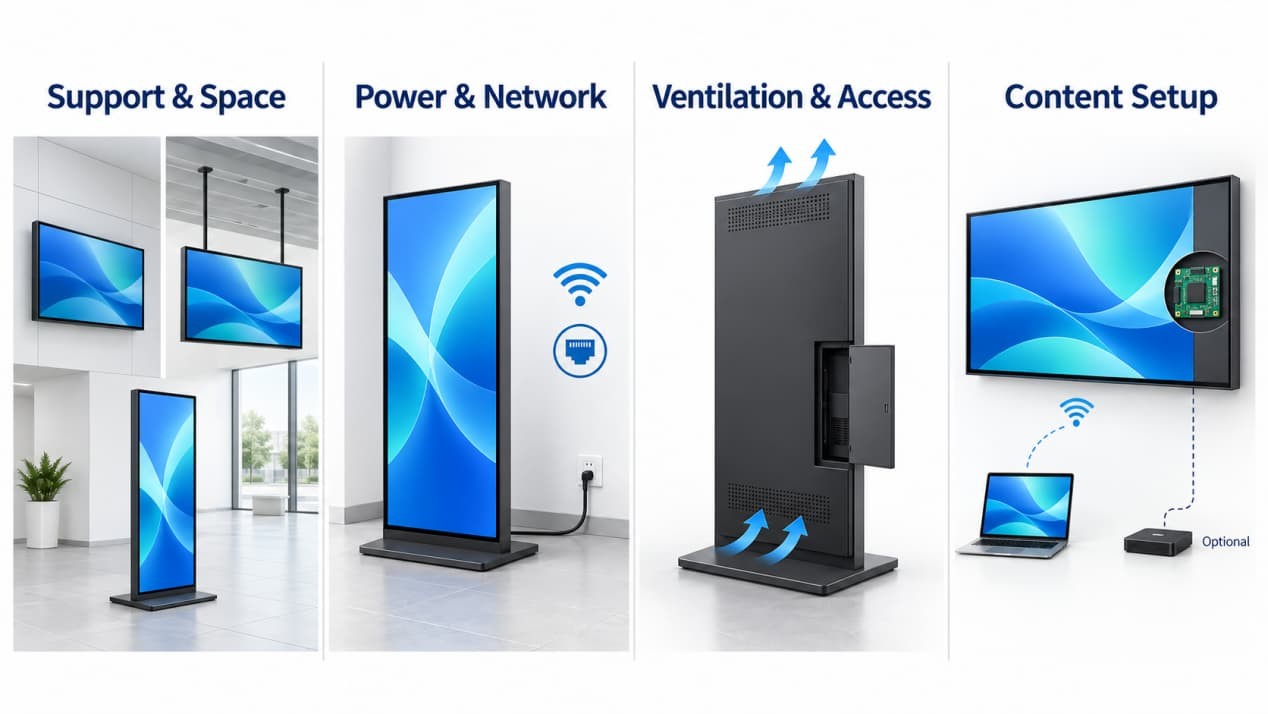
Many commercial displays have a built-in Android or Windows computer, so they do not need a separate media player or equipment rack. Confirm the selected configuration first: an all-in-one display typically needs power and, for remote content updates, a network connection.
Copy these four requirements to your general contractor, electrician or AV team before the fit-out is completed:
- Prepare the support and space: For wall-mounted or suspended displays, confirm the supporting structure before closing walls or ceilings. For floor-standing units, confirm the base footprint and any required floor anchors. For mobile screens, keep travel routes clear and provide a suitable parking position.
- Position power and data connections: Follow the product drawing so outlets do not obstruct brackets, bases or service panels. Keep floor-standing and mobile display cables out of customer walkways. Confirm Ethernet or Wi-Fi coverage if remote content management is required.
- Keep ventilation and service access clear: Leave the specified vents and access panels unobstructed, including when the screen sits inside decorative millwork. Sun-facing window displays need particular attention because trapped heat can contribute to LCD blackening. Confirm whether maintenance requires front access, rear access or removal of the display.
- Confirm how content reaches the screen: For all-in-one displays, agree on local playback or network-based content updates. Only plan an external video cable route when the project uses a separate player, computer or central AV system. For long concealed runs, have the AV contractor select and test the transmission solution before the walls are closed.
3. Complete Three Acceptance Tests
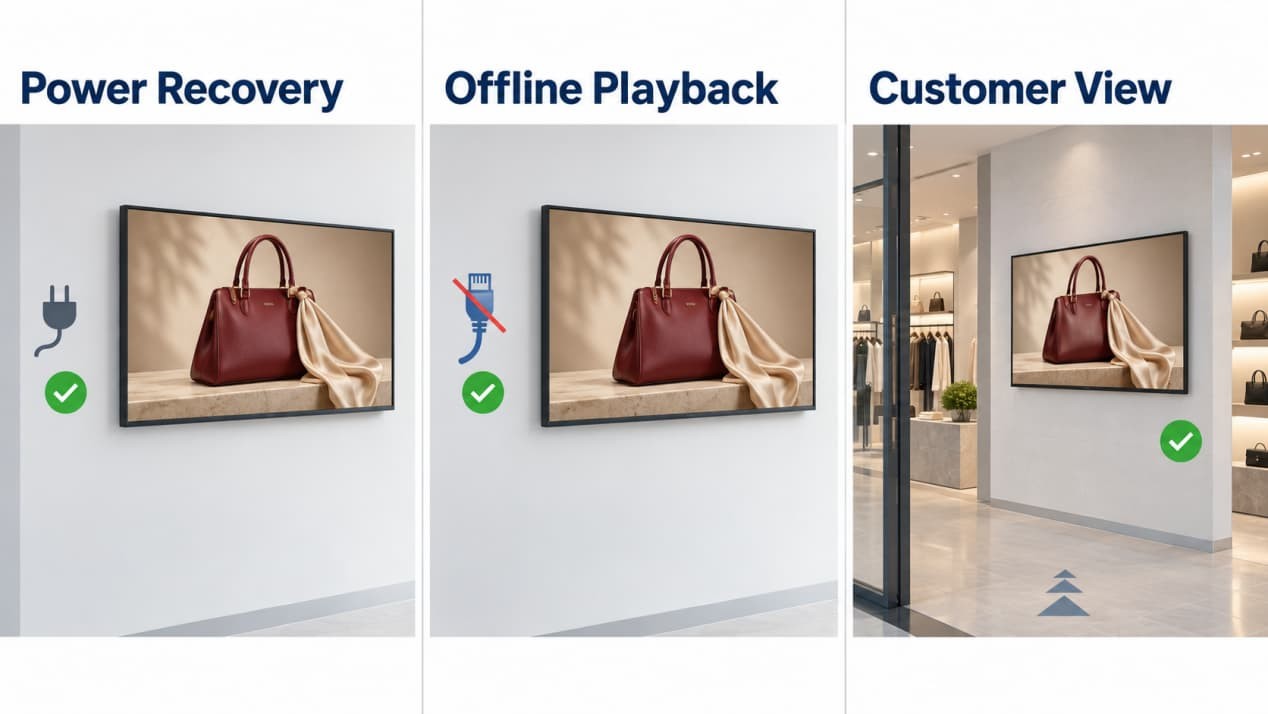
Agree on the expected startup and offline behavior before installation, then test the finished system with the contractor.
Test 1: Automatic Restart
Ask the installer to safely interrupt and restore power to the display and any external playback equipment.
- Pass: Scheduled content resumes automatically within the agreed startup time.
- Fail: The screen remains in standby, stops at a desktop or requires manual intervention.
If it fails, ask the technical team to check power-recovery and application-startup settings.
Test 2: Playback Without Internet
For network-connected displays, temporarily disconnect the network. For standalone displays, check the local playlist instead.
- Pass: The agreed local or backup content keeps playing. Network-connected systems reconnect and accept an update when the connection returns.
- Fail: The promised fallback content does not play, or the system requires manual recovery.
Live feeds need an agreed backup screen or playlist if they must remain useful during an outage.
Test 3: Customer-Route Check
View the final content from the entrance, main walkway, queue and checkout position.
- Pass: The message is readable, reflections do not obscure it, and the display and cables leave customer routes clear.
- Fail: Text is too small, fixtures block the screen, or the installation creates an obstruction.
4. Documents and Support
Before the fit-out begins, RusinDisplay can provide:
- Product dimensional drawings
- Mounting-hole drawings
- CAD or structural drawings
- Installation instructions
- Matching display-side brackets and standard hardware
- Remote installation and setup guidance
A qualified local GC, electrician or AV contractor can normally complete the installation using these documents. Onsite support can also be discussed for qualifying large-volume projects.
Before finalizing the wall, ceiling or electrical plan, contact the RusinDisplay team to request the drawings for the selected model and confirm the installation requirements.
Frequently Asked Questions
When should digital signage installation be planned?
Plan it before the contractor closes the walls or ceilings. The mounting position, reinforcement, power outlet, network port, ventilation and cable route should all be confirmed during the rough-in stage.
Are the mounting bracket and hardware included?
RusinDisplay supplies the matching display-side bracket and standard mounting hardware for the selected product. The local contractor must choose building-specific anchors according to the wall or ceiling structure.
Can an indoor commercial display be installed outdoors?
No. An indoor display does not have the enclosure sealing, environmental protection or thermal management required for exposed outdoor use. Select a purpose-built outdoor model for locations exposed to rain, dust or direct sunlight.
What should be tested before accepting the installation?
Test automatic restart after a power interruption, offline playback when that function was specified, and visibility from the actual customer route. Also confirm that the power, network and service areas remain accessible.