




A television can display advertising. That does not automatically make it a dependable digital signage system.
For one indoor screen showing simple content for limited hours, a consumer TV may be enough. Once the screen must run all day, mount vertically, update remotely or recover from a power outage without staff assistance, a commercial digital signage display becomes the safer choice.
At RusinDisplay, we recommend making the decision around three practical questions:
- How long must the screen operate?
- Where and how will it be installed?
- Who will manage it after installation?
Digital Signage Display vs TV: Quick Comparison
| Decision Factor | Consumer TV | Commercial Digital Signage Display |
| Intended use | Home entertainment | Business communication |
| Operating schedule | Varies by model | Available for continuous commercial operation |
| Mounting orientation | Usually designed for landscape use | Portrait and landscape options |
| Screen surface | Often selected for home viewing | Matte or anti-glare options available by model |
| Media playback | Smart TV apps, USB or external source | May include an integrated playback system |
| Content management | Usually local or app-dependent | Cloud CMS and remote scheduling available |
| Power control | Limited or model-dependent | Scheduled power on and off |
| Power recovery | Must be checked by model | Automatic restart can be integrated |
| Warranty and maintenance | Consumer warranty; commercial-use restrictions and coverage vary | Product-specific commercial warranty; the referenced RusinDisplay model includes three-year coverage |
| Initial cost | Usually lower | Higher, with additional operating functions |
A buyer does not need to compare every specification. Use this faster rule:
Choose a TV only when the installation is simple, supervised and non-critical. Choose commercial digital signage when the screen must operate as part of the business.
When Is a Consumer TV Good Enough?
A TV remains a practical option for a meeting room, staff area or small shop with one lightly used screen. It can play content from a USB drive, smart TV application or external media player.
The arrangement works best when:
- The screen operates indoors for limited periods
- Landscape installation suits the content
- Staff can restart it if playback stops
- Content changes are infrequent
- Screen downtime will not interrupt sales or customer service
This is the lower-cost route, but it still needs checking. Read the model manual before installation. Confirm the permitted orientation, ventilation requirements, operating schedule, automatic power behavior and warranty terms.
Samsung’s U.S. consumer warranty, for example, describes coverage for normal noncommercial use and excludes problems caused by commercial or non-normal consumer use. Its product safety information also identifies the covered products as intended for personal rather than industrial or commercial use. These conditions illustrate why buyers should check the exact Samsung warranty terms instead of assuming that a household warranty follows the TV into a shop.
When Should You Use a Commercial Digital Signage Display?
A commercial display earns its higher initial price when it solves operating problems that a television leaves to store staff. Three areas matter most.
1. The Screen Runs for Long Hours
Retail promotions, menu boards, hotel information screens and building directories often operate throughout the business day. Some installations require 24/7 service.
That schedule affects the backlight, power supply and thermal design. It also makes basic automation more important. Staff should not need to find a remote control every morning or walk around switching off dozens of screens at night.
Commercial digital signage can support scheduled startup and shutdown. After a temporary power cut, an automatic recovery function can restart the display and return it to scheduled content.
No employee intervention. No screen sitting in standby until somebody notices.
Static content also needs sensible management. LCD image retention is not the same phenomenon as OLED burn-in, but leaving the same high-contrast menu, logo or interface on screen for extended periods can still produce temporary image retention in some LCD configurations. Rotating content and using appropriate display settings reduces that risk. For more preventive measures, read our guide to LCD burn and image retention in commercial displays.
2. The Installation Is Customer-Facing
A television is normally engineered around landscape home viewing. Its ventilation path, stand position and internal layout are designed for that orientation.
Do not rotate a TV into portrait mode unless the manufacturer explicitly approves it. Changing the orientation can alter natural airflow through the enclosure and create local heat concentration around the power supply or mainboard.
Commercial digital signage is available for both portrait and landscape mounting. Portrait screens suit shop entrances, promotional posters and narrow wall areas. Landscape screens work well for menu boards, presentations and wide-format campaigns.
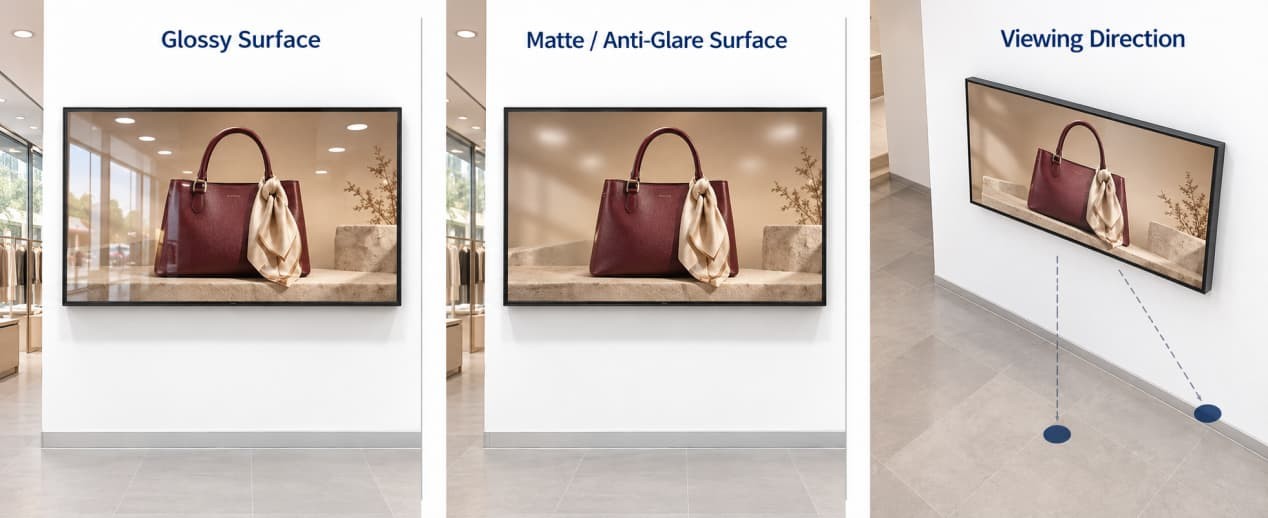
Visibility also depends on the installation environment. Nits—or cd/m²—describe screen brightness, but brightness alone does not determine readability. Surface reflections can make black areas appear gray and wash out the image.
Many consumer TVs use glossy or semi-gloss surfaces because they can produce an attractive picture in controlled home lighting. A commercial project may instead need a matte finish, suitable haze level or another anti-glare treatment.
The correct choice depends on the actual lighting and viewing direction, so ask the manufacturer about available surface treatments—such as matte finishes, anti-glare treatments and suitable haze levels—rather than comparing brightness alone.
3. Content Must Be Managed Without Visiting the Screen
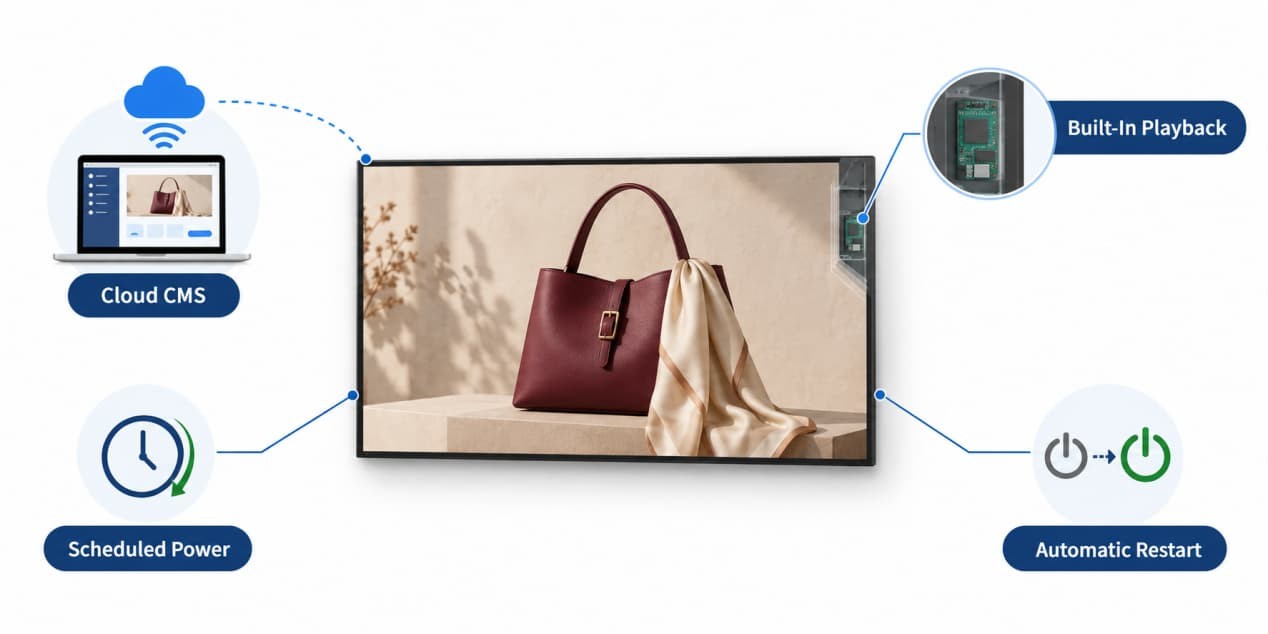
A television can become a basic signage screen when connected to a USB drive, application or external player. That may be sufficient for one location.
The process becomes inefficient across several stores. Staff must update each screen, confirm the correct input and deal with playback errors locally.
An all-in-one commercial digital signage display can integrate its operating system and playback hardware inside the enclosure. It does not necessarily need a separate media-player box.
Built-in Android suits routine image and video campaigns. Windows is useful when the project depends on Windows software, an existing business application or specific peripherals. A cloud CMS allows authorized staff to update campaigns, schedule content and manage multiple screens remotely.
The key advantage is not the Android or Windows name. It is having one planned system for playback, scheduling, power control and recovery.
What This Looks Like in a Real 55-Inch Configuration
The RusinDisplay 55-inch wall-mounted digital signage display provides a useful specification walkthrough.
It combines a 55-inch 4K screen with support for 24/7 operation and portrait or landscape installation. Android and media playback are built in, while Windows is available when the project requires it. The display also supports cloud CMS management, scheduled power control and automatic restart after power recovery.
These functions address a common retail problem: the screen must keep working when nobody is standing beside it.
Warranty and Long-Term Ownership Costs
Warranty terms can change the real cost of a display after installation. Some consumer televisions include only a one-year limited warranty, while commercial use may be restricted or excluded under the applicable terms. If the screen fails, the buyer may therefore need to pay for diagnosis, parts, labor or replacement.
Coverage varies by brand, model and market, so it must be checked before purchase. For comparison, all RusinDisplay products include a three-year warranty from the date of receipt.
During the warranty period, parts that fail for reasons unrelated to misuse can be replaced free of charge. Customers can submit their order number, a description of the problem, and supporting photos or videos; RusinDisplay typically verifies the issue within three to five business days, then arranges replacement parts and remote installation guidance. Damage caused by improper operation, accidental impact, external conditions, unstable voltage, or unauthorized repair is not covered. Paid repair support remains available for excluded damage and products outside the warranty period.
Which Should Your Business Choose?
A consumer TV may be sufficient for one indoor screen with limited operating hours, simple content and staff nearby to handle interruptions. Choose a commercial digital signage display when the screen runs throughout the business day, requires portrait installation, serves a customer-facing location, or must support remote content management and automatic power recovery.
Do not decide from 4K resolution alone. A TV and a commercial display may contain the same number of pixels while differing substantially in thermal design, mounting support, content control, recovery functions and warranty coverage.
Choose the Right Commercial Display
Browse the RusinDisplay indoor wall-mounted display series to compare available commercial configurations.
If you already know the installation location, operating schedule and preferred orientation, contact the RusinDisplay team for a recommended configuration and quotation.
Frequently Asked Questions
Can I use a regular TV for digital signage?
Yes, for a simple indoor installation with limited runtime and staff available to manage it. Check the exact model’s operating limits, mounting orientation and warranty before using it commercially.
Does every digital signage display need an external media player?
No. An all-in-one display can include Android, media playback and CMS connectivity inside the enclosure. External players remain useful when a project requires a separate software platform or hardware source.
Is a 4K TV the same as a 4K digital signage display?
No. The 4K label only describes resolution. It says nothing about operating hours, portrait mounting, remote content management, power recovery or commercial warranty coverage.
Can a commercial display show static content all day?
It can, but rotating high-contrast content is still good practice. Sensible scheduling reduces the risk of temporary LCD image retention and keeps promotions from becoming visually stale.
Is a commercial display always worth the additional cost?
No. A supervised, lightly used single screen may not need one. Commercial hardware becomes more valuable when uptime, portrait mounting, remote management or unattended recovery affects daily business.