




In a busy drive-thru, customers need to scan the menu and make a decision quickly. Small prices, distracting promotions, and reflections make that harder. Outdoor digital menu boards let restaurants present clear menus, update prices remotely, and schedule breakfast, lunch, and dinner content without replacing printed panels.
Start with what the driver needs to see. Then match the screen layout to the ordering position, choose hardware for the outdoor conditions, and make sure your staff can manage the content easily.
Choose the Screen Layout Around Your Menu
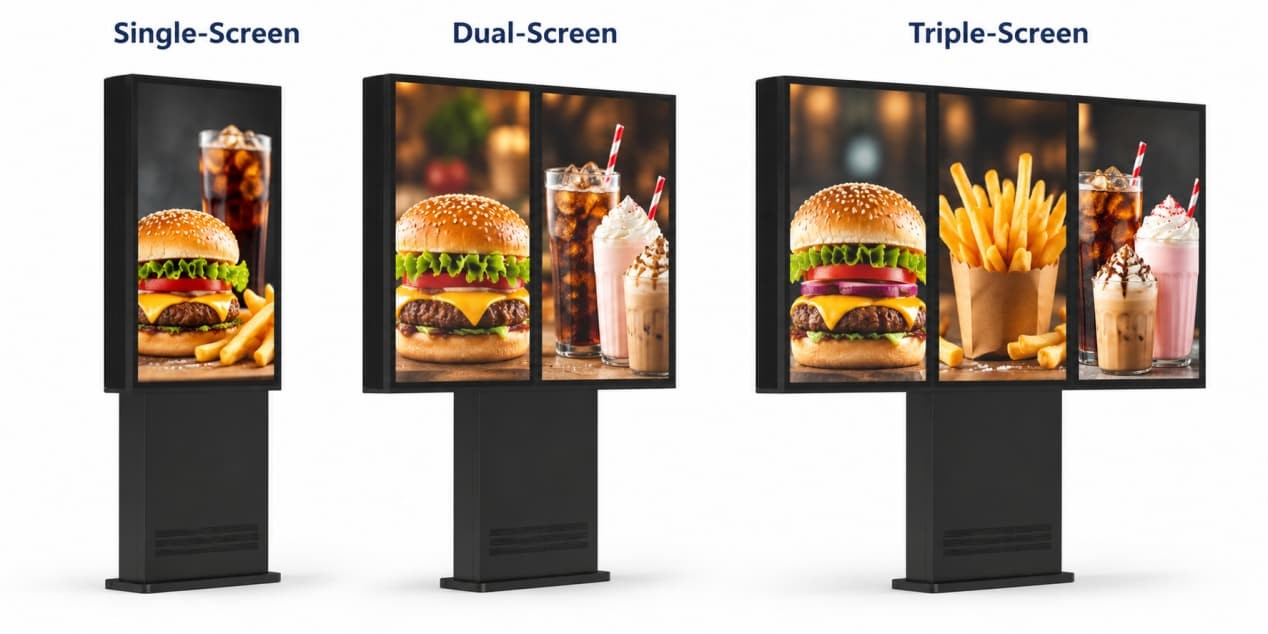
Divide your menu into clear groups before choosing the hardware: main meals, combinations, drinks, sides, and promotions. This gives you a practical basis for deciding how many screens you need.
More screens help when they make the menu easier to read—not simply when they create more advertising space.
| Screen Layout | Practical Starting Point | Main Decision |
| Single-Screen | A concise menu or a separate promotional board before the ordering point | Can customers see essential items and prices without waiting for another slide? |
| Dual-Screen | Main meals on one screen, with combinations, drinks, or sides on the other | Does separating the categories make ordering easier? |
| Triple-Screen | A broader menu divided into clear sections, with room for selected promotions | Can the driver comfortably see the full layout from the stopping position? |
RusinDisplay offers 49-, 55-, and 65-inch configurations. Compare sizes using your actual menu artwork rather than a full-screen food photograph. Item names and prices are a better test of readability.
Keep core menu items visible throughout the ordering process. Use changing content for promotions and add-ons; customers should not have to wait for a slide to return just to check a price.
Dual-Screen vs. Double-Sided
Dual-screen and double-sided displays solve different layout problems.
Dual-screen places two screens side by side, facing the same direction. It expands the space available for a menu that one audience needs to read.
Double-sided presents content in opposite directions. It suits locations with a useful viewing position on each side, such as separate pedestrian approaches.
For a drive-thru, map the driver’s sightline before choosing either arrangement. A second display face adds little value if customers cannot see it from their intended position.
Check Readability from the Driver’s Seat
Do not approve the layout only by standing directly in front of the display. Review it from the actual ordering position, including the viewing heights of vehicles that regularly use the lane.
Check the smallest essential text first. Customers need to read item names, prices, and choices without leaning forward or searching across the screen. Posts, landscaping, payment equipment, and the angle of the vehicle can all affect the view.
Position the menu where drivers naturally look when they stop. Avoid placing important information at the far edge of a wide layout, where the viewing angle makes it harder to read.
Built for Sunlight and Outdoor Exposure
RusinDisplay outdoor digital menu boards combine 3000-nit brightness with IP65-rated enclosure protection. High brightness supports daylight visibility, while the enclosure protects the installed electronics against dust and water jets.
Optical bonding and anti-glare treatment improve readability in different ways. Optical bonding removes the air gap between the cover glass and LCD, reducing reflections at those internal surfaces. The anti-glare surface softens reflected light, making it less distracting when customers read menu details.
Impact-resistant protective glass adds a barrier against accidental knocks. Sensible placement still matters: keep the display outside the vehicle path and plan suitable protection where contact is a risk.
A built-in ambient-light sensor automatically adjusts brightness as conditions change. The menu remains bright during the day and dims as the surroundings darken, reducing unnecessary glare and power use.
Heat management remains part of the installation. Keep the designed ventilation paths clear, and match the operating-temperature specification to the site’s climate and direct-sun exposure. Our guide to outdoor LCD brightness, IP ratings, and sunlight readability explains these factors in more detail.
Keep Menu Updates Simple
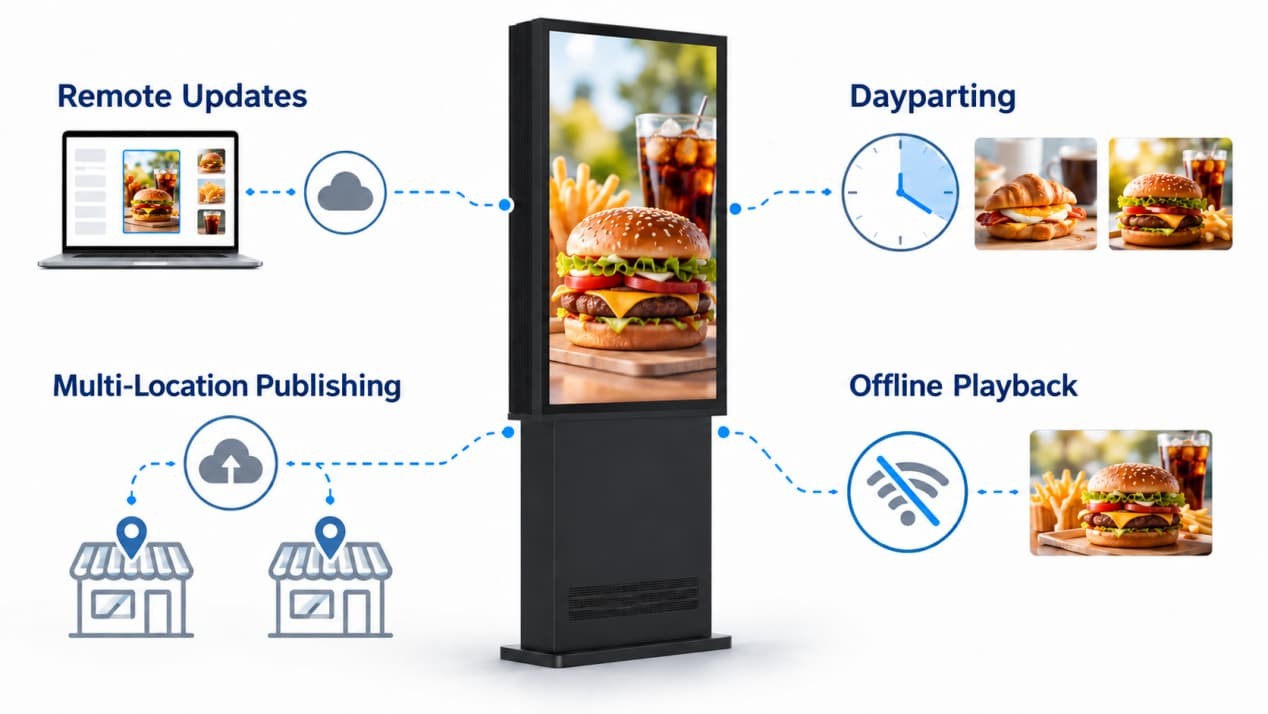
A menu change should not become an onsite maintenance job.
RusinDisplay outdoor digital menu boards support remote menu and price updates, scheduled content changes, and coordinated publishing across multiple locations. Dayparting lets your team schedule breakfast, lunch, and dinner menus to appear at the appropriate times.
If the network connection drops, the displays continue playing locally stored content. Remote changes require connectivity, so keep saved menus current rather than relying on a last-minute upload before service.
Before handover, have a staff member complete three routine tasks: change a price, schedule a menu transition, and check local playback with the network disconnected. This confirms that the everyday workflow is ready for use.
All-in-One Playback, with Clear Integration Boundaries
RusinDisplay typically uses an all-in-one design, with computing and media playback integrated into the display. Routine menu playback does not require a separate external computer, keeping the installation simpler and reducing equipment around the ordering area.
POS synchronization, live order confirmation, intercom audio, and payment processing are separate integration requirements.
If prices must update directly from your POS, identify the software when requesting a quote. If customers need to review their order on a screen, specify order confirmation separately from menu presentation.
When comparing quotations, check what each includes: displays and supporting structure, software fees, delivery, site preparation, installation, and after-sales support. A lower screen price does not necessarily mean a lower completed-project cost.
Configure Your Outdoor Menu Boards with RusinDisplay
RusinDisplay offers outdoor digital menu boards in 49-, 55-, and 65-inch configurations, with single-, dual-, and triple-screen layouts and single-sided or double-sided options. Choose the arrangement around your menu, customer viewing position, and available installation space.
All RusinDisplay products include a three-year warranty. To discuss a suitable configuration and obtain a quotation, contact the RusinDisplay team with your menu and a photo or plan of the intended installation area.
Frequently Asked Questions
How much do outdoor digital menu boards cost?
Pricing depends on screen size and quantity, hardware configuration, software, and site work. Compare complete quotations, including installation and ongoing software charges where applicable.
Can I use a consumer TV as an outdoor menu board?
A consumer TV designed for indoor use is not a substitute for equipment suited to outdoor exposure. A rain cover alone does not address sunlight readability, heat buildup, or moisture protection.
Do digital menu boards include ordering and payment functions?
Not automatically. POS integration, order confirmation, intercom audio, and payment processing require separate confirmation alongside the display and content-management functions.
Can outdoor digital menu boards serve walk-up customers?
Yes. For takeaway windows and pedestrian ordering areas, adjust the installation height, text size, and screen position for standing customers rather than drivers.