




Customers should be able to read your menu before they reach the serving window. For a food truck, that means choosing a screen that works in daylight, fits your power supply, and is manageable when service ends.
Choose a truck-mounted screen if you have a consistent ordering position and suitable power. Choose a battery-powered board if you need to reposition the menu at different stops. Here is how to compare digital menu boards for food trucks around your daily routine.
Truck-Mounted Screen or Portable Menu Board?
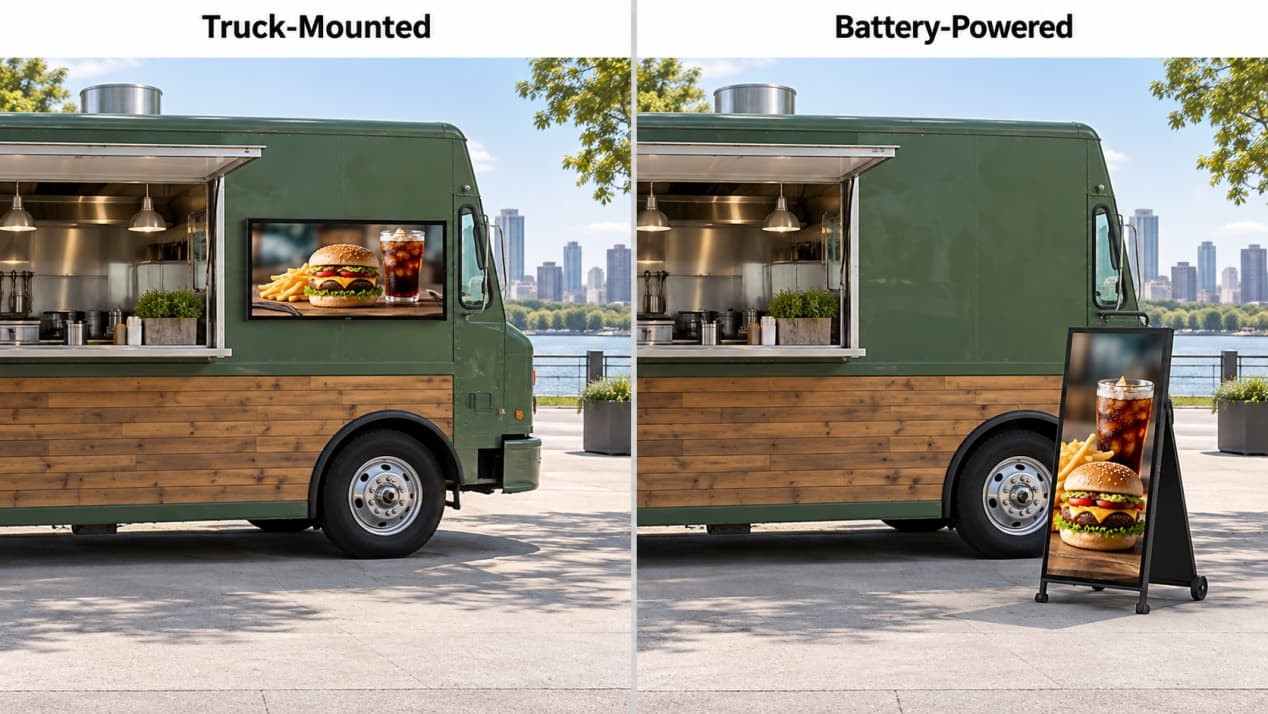
| Consideration | Truck-Mounted Landscape Screen | Portable Battery Menu Board |
| Placement | Beside or above the serving window | Beside the truck or near the queue entrance |
| Power | Suitable AC supply from the truck or site | Built-in battery or external mains power |
| Before service | Leave installed or attach a removable screen | Roll into position, unfold, and lock the wheels |
| After service | Secure for travel or remove for storage | Fold, load, and secure inside the vehicle |
A mounted screen leaves the ground clear. A portable board gives you more freedom when an event changes your parking position or customers approach from a different direction.
Before choosing a size, check where people will stand. A larger screen will not solve a crowded menu with tiny prices.
Will Customers Be Able to Read It?
RusinDisplay offers truck-mounted landscape configurations with 3000-nit brightness and automatic dimming. Our 43-inch single-sided portable model provides up to 2000 nits, automatic dimming, and tempered anti-glare glass.
These are different configurations, not a rule that every food truck needs the same brightness. Look at the actual serving position: direct sun, reflections, and the angle from the queue all affect readability.
Check the menu from where customers wait—not just directly in front of the screen. Make item names and prices easy to find, use strong contrast, and keep the main menu visible while promotions change.
At night, automatic dimming reduces unnecessary brightness so the menu remains comfortable to read.
Weather Protection Matters Too
RusinDisplay’s truck-mounted landscape menu boards and portable battery-powered boards both offer IP65 protection against dust and water ingress, helping protect the display during outdoor food service.
Plan Power for the Full Shift
Truck-Mounted Screens
The 43-inch and 55-inch high-brightness configurations accept AC 100–240 V. Their specified display-unit power limits are 153 W and 230 W respectively; the finished installation may include additional electrical loads.
Ask your installer to include the screen in the truck’s power budget alongside refrigeration, cooking equipment, and lighting. These AC configurations do not connect directly to a vehicle’s 12 V battery.
Battery-Powered Boards
The single-sided portable model takes approximately seven hours to charge and also supports external mains operation. Plan where it will charge between shifts before deciding where it will stand during service.
Ask how long it runs at the brightness you expect to use. A runtime figure from a low-brightness test does not establish how long it will last at maximum output outdoors.
Before relying on it for a full trading day, test your menu and daytime settings over your normal service schedule. Automatic dimming can reduce power demand as the surroundings become darker, but it does not replace a charging plan.
Setup, Loading, and Travel
Mounting a Landscape Screen on the Truck
RusinDisplay supports permanent installations and removable arrangements that let staff mount the screen for service and store it afterward.
Choose the position with the serving hatch open. The display should remain visible without blocking doors, ventilation, or maintenance access. Confirm the finished assembly’s weight and mounting arrangement before modifying the vehicle.
A configured vehicle installation can allow the screen to remain attached during travel. Specify this requirement when ordering so the attachment, retention hardware, and enclosure are selected together; an ordinary building wall mount is not a substitute.
Moving a Battery Board Beside the Truck
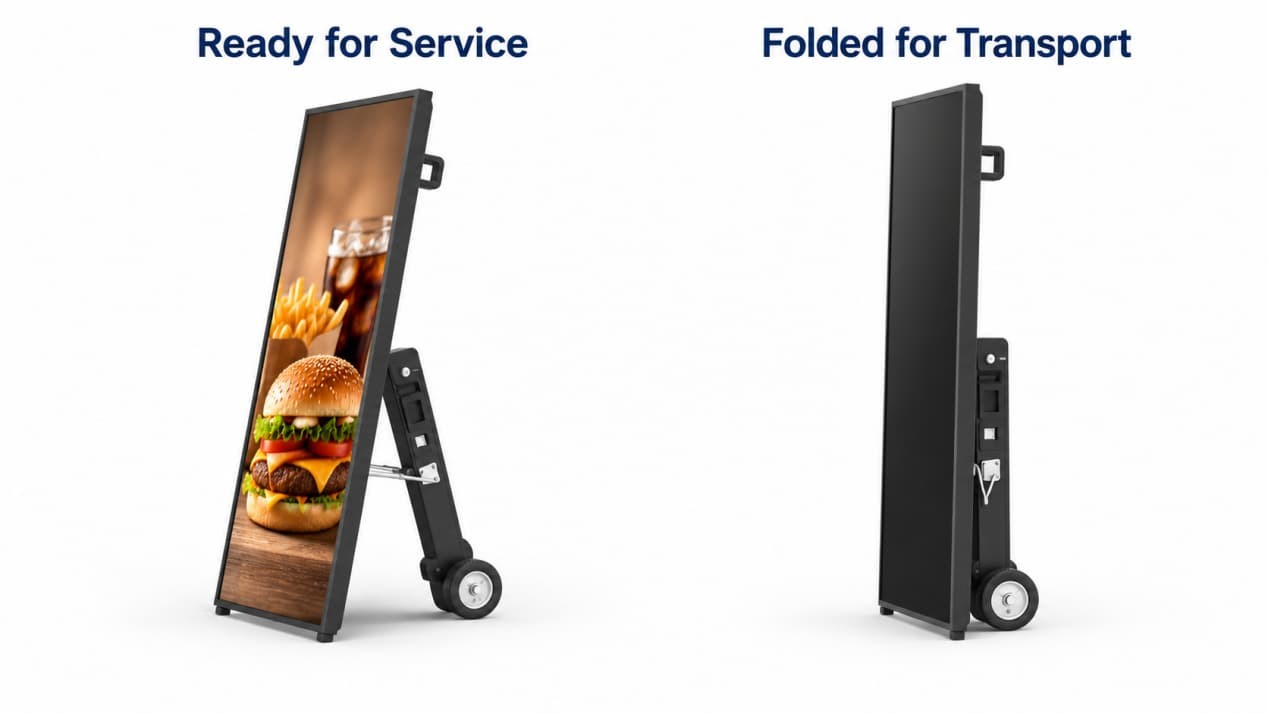
The portable model includes locking casters, a rear handle, and a folding support. Position it on firm, level ground and keep the customer walkway clear.
Wheels make repositioning easier. Loading the approximately 48 kg unit back into the truck is a separate task—check your loading arrangement and storage space before ordering.
Lock the wheels during use, but remember that wheel locks are not wind anchors. Fold and secure the board before moving the truck.
Change Menus Without a Separate Player
Both RusinDisplay solutions support built-in playback, remote menu updates, scheduled breakfast and lunch menus, and publishing across multiple displays. A separate playback computer does not need to stay connected.
Downloaded menus keep playing if the network drops. New prices and sold-out updates will not reach the screen remotely until it reconnects.
Before leaving for an event, download the required content and schedules, then briefly disconnect the network to confirm local playback. Keep the everyday menu readable rather than replacing it with a full-screen promotional loop.
Configure Your Food Truck Menu Display
RusinDisplay offers truck-mounted landscape solutions and portable battery-powered menu boards. Double-sided portable options are also available for locations with customers approaching from opposite directions.
Send a photo of your truck, your available power source, and your usual service hours to the RusinDisplay team. We can help select the display and mounting arrangement and provide the relevant product and installation information.
FAQ
Can I use a regular TV as a food truck menu board?
Do not assume a household TV is suitable for an exposed exterior installation. Check its permitted operating environment, daylight visibility, mounting requirements, and warranty before considering it.
Do I need a separate media player?
No separate player is required for the RusinDisplay all-in-one configurations described here. Playback runs within the display, while a connected device can be used to manage content remotely.
Can I use the same menu design on both formats?
You can reuse the same food photos, prices, and branding, but landscape and portrait screens need different layouts. Reformat the menu rather than stretching the original image or shrinking the text to fit.
When is a double-sided portable board useful?
Choose it when both faces have clear sightlines and serve customers approaching from different directions. For a single queue beside the serving window, a single-sided board is usually sufficient.