




When specifying display panels for commercial and industrial deployments—from digital signage to 24/7 control rooms—engineering teams face a core hardware choice: OLED (Organic Light Emitting Diode) vs. LCD (Liquid Crystal Display).
While consumer evaluations focus primarily on dark-room contrast, commercial B2B procurement is dictated by duty cycles, sustained luminance, thermal dissipation, L70 lifespan, and burn-in risks. This guide provides a direct comparison of oled vs lcd display technologies and evaluates lcd vs led vs oled architectures to assist in hardware selection.
Core Architectural Differences
The primary distinction between OLED and TFT-LCD lies in how light is generated and modulated across their physical layers: transmissive liquid crystal light valves versus self-emissive organic sub-pixels.
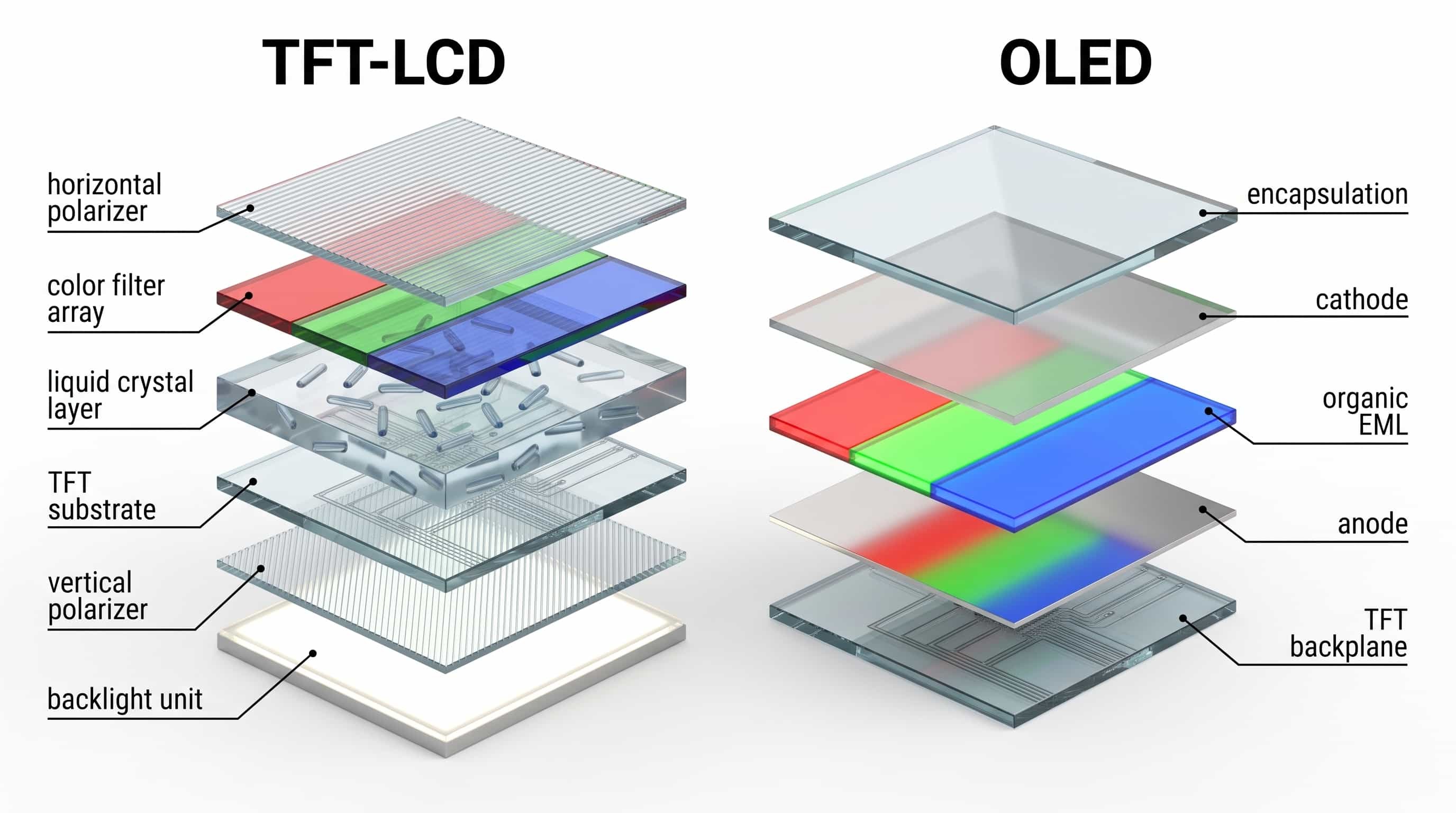
- TFT-LCD (Transmissive Light Valve): TFT-LCD panels do not generate their own light. As shown in the diagram, light originates from the bottom backlight unit and passes through a vertical polarizer. The TFT substrate applies voltage to align molecules in the liquid crystal layer, acting as an optical shutter to control light passing through the color filter array and exiting the top horizontal polarizer. Commercial "LED displays" simply use energy-efficient LED backlights within this multi-layer transmissive stack.
- OLED & Transparent OLED (Direct Self-Emissive Stack): OLED panels eliminate the backlight entirely. Built on a TFT backplane, each sub-pixel features an organic EML (emissive layer) positioned between an anode and a cathode, all sealed beneath a protective encapsulation top layer. Applying current causes the organic diodes to emit direct light or shut off completely for true zero-nit blacks. In commercial implementations such as Transparent OLED, this self-emissive architecture achieves 43% to 45% visual transparency, allowing dynamic graphics to float directly over physical displays.
Optical Performance & Picture Quality
| Optical Metric | Commercial TFT-LCD (IPS / VA) | Commercial Mini-LED LCD | Commercial Grade OLED / AMOLED |
| Native Static Contrast | 1,000:1 (IPS) to 5,000:1 (VA) | 1,000:1 - 5,000:1 | ∞ : 1 (True Zero Black) |
| Sustained Full-Screen Brightness | 250 – 600 nits, up to 1,000 nits | 1,000 – 2,500+ nits | 150 – 250 nits |
| Peak Small-Window Brightness | 300 – 700 nits | 1,500 – 4,000+ nits | 1,000 – 2,000+ nits |
| Motion Response (GtG) | 1.0 – 8.0 ms | 1.0 – 5.0 ms | < 0.1 ms (Instantaneous) |
| Viewing Angles & Shift | 178° on IPS; Minor Color shift on VA | Depends on panel type (IPS vs VA shift profile) | 178° (Near-perfect Lambertian profile) |
| Color Gamut Coverage | 90%–95% DCI-P3 | 95%–99% DCI-P3 | 99%–100% DCI-P3 |
Key Optical Engineering Considerations
- True Blacks vs. Backlight Bleed: OLED achieves virtually infinite contrast because individual sub-pixels shut off completely to produce true black. TFT-LCD panels cannot fully block the continuous backlight, leaving a faint gray black floor between 0.05 and 0.30 nits. While Mini-LED panels with local dimming significantly improve dynamic range, high-contrast borders—such as bright white text against dark backgrounds—can still produce visible haloing around active LED zones.
- Sustained Brightness vs. Automatic Dimming: Commercial high-brightness and Mini-LED LCDs maintain 700 to over 2,500 nits continuously across the entire screen, regardless of what is displayed. OLED panels, however, use built-in brightness limiters to manage heat and power draw. When displaying bright, full-screen content like white backgrounds or telemetry dashboards, overall panel brightness automatically drops to around 150 to 250 nits.
- Viewing Angle Consistency: IPS LCD panels provide consistent 178-degree viewing angles with stable color for multi-screen installations, whereas VA panels tend to shift color off-center. OLED panels emit light evenly in all directions, delivering near-perfect contrast and zero color distortion from any viewing angle.
Reliability, Lifespan & Power Profiles
Differential Aging & Burn-in Vulnerabilities
Burn-in, or permanent image retention, is an irreversible hardware condition caused by uneven decay in organic layers. Because blue organic sub-pixels require higher energy to operate, they degrade faster than neighboring red and green sub-pixels. When commercial screens display static elements for extended periods—such as menu bars, live video tickers, or telemetry dashboards—fixed pixels wear out unevenly, leaving permanent ghost outlines. TFT-LCD technology is structurally immune to this organic emitter decay. While LCD panels can occasionally exhibit temporary image retention caused by lingering electrical charge on the liquid crystal layer, this is fully reversible and does not permanently damage the hardware.
L70 Operational Lifespan Benchmarks
- Commercial TFT-LCD Lifespan: Industrial LCD displays deliver between 50,000 and 100,000 operating hours. This represents 7 to 11 years of continuous 24/7 service before reaching the L70 threshold, the point where brightness drops to 70% of its initial level. Because the lifespan depends primarily on the solid-state LED backlight rather than the liquid crystals, the backlight unit in modular commercial chassis can often be serviced or replaced independently of the glass panel.
- Commercial OLED Lifespan: OLED panel lifespan is tied directly to the organic emissive stack. Under typical commercial brightness levels, standard single-stack OLED panels deliver 30,000 to 50,000 operating hours, reaching the L70 mark in about 3 to 5 years of continuous use and requiring full panel replacement once output degrades. Newer commercial displays with tandem multi-stack architectures distribute electrical load across multiple layers, extending operational lifespan toward 60,000 to 80,000 hours.
Power Consumption Dynamics
- LCD Power Profiles: Standard edge-lit and direct-lit LCDs draw a relatively constant amount of power because the backlight stays illuminated uniformly regardless of on-screen colors. In contrast, Mini-LED LCDs with local dimming adjust power dynamically based on the brightness of active screen zones.
- OLED Dynamic Power & Heat: OLED power consumption scales directly with overall screen brightness and white-area coverage. While an OLED display is energy-efficient when playing dark content, full-field white interfaces drive power draw up to 132 watts on a 55-inch LG module and 215 watts on a 55-inch BOE module. This increased load generates localized heat in the driver chassis, which triggers automatic brightness limiters to protect the panel from thermal stress.
Commercial Application & Procurement Guide
Deployment Scenarios for Commercial LCD and Mini-LED
- High-Ambient Sunlight and Outdoor Signage: Installations exposed to direct sunlight or strong ambient light require continuous brightness between 2,000 and 3,500 nits. Commercial-grade high-brightness LCD panels equipped with active thermal cooling loops sustain these high output levels without visual washout or heat-induced panel damage.
- Continuous 24/7 Static Monitoring: In network operations centers, CCTV command rooms, and security dispatch facilities, screens display fixed telemetry, camera grids, and system dashboards around the clock. Industrial LCD panels provide reliable, continuous uptime with zero risk of permanent image retention.
- Cost-Effective Large Video Walls: Tiled video wall arrays utilizing ultra-narrow bezels from 0.88mm to 3.5mm offer lower hardware costs, predictable thermal performance, and consistent color uniformity across dozens of connected displays.
Deployment Scenarios for Commercial OLED and Transparent OLED

- Luxury Retail Showcases and Museum Displays: Transparent OLED displays, such as 55-inch Full HD kiosks with 45% transparency, allow physical merchandise and artifacts to sit directly behind the glass while dynamic 10-bit interactive graphics float seamlessly in front of them.
- Color Mastering and Medical Diagnostic Displays: Broadcast mastering suites, color-grading workstations, and clinical imaging systems benefit from OLED's pixel-level dimming, infinite contrast ratio, and wide viewing angles for critical shadow and grayscale accuracy.
- Automotive and Curved Cockpit Displays: In-cabin automotive consoles and curved instrument clusters leverage OLED's ultra-thin profile, deep black integration, and sub-millisecond response times across wide temperature ranges.
Procurement Summary & Engineering
Choosing between commercial TFT-LCD and OLED depends on matching panel physics to operational constraints:
- TFT-LCD and Mini-LED remain the practical standard for 24/7 continuous operation, static user interfaces, and high-ambient environments exceeding 1,000 nits, offering predictable thermal management and a lower total cost of ownership over a 7- to 11-year lifespan.
- Commercial OLED and Transparent OLED are optimal for light-controlled environments prioritizing true zero-nit black levels, sub-millisecond response times, or floating interactive visuals with 43% to 45% transparency.
If your project requires commercial display hardware—whether high-brightness outdoor LCD totems, 24/7 control room video walls, or interactive transparent showcases for museums and retail—you can reach out to our engineering team. We supply commercial LCD panels ranging from 32 inches to 98 inches, as well as 30-inch, 48-inch, 55-inch, and 77-inch Transparent, Flat, and Curved OLED displays, and support comprehensive customization across optical bonding, enclosure fabrication, touch integration, signal cabling, and modular compute systems.
Frequently Asked Questions
Can OLED displays operate reliably in 24/7 commercial environments?
OLED panels are not recommended for continuous 24/7 deployment displaying static telemetry or persistent user interfaces due to differential sub-pixel burn-in risks. However, in environments running continuously rotating, dynamic video content (such as hospitality branding or experiential retail), OLED can be used effectively if automatic pixel-refresh and screen-shift cycles are scheduled during off-peak hours.
How does Mini-LED compare to OLED in commercial projects?
Mini-LED enhances traditional LCD technology by replacing standard backlights with thousands of miniaturized LED elements divided into dense local dimming zones. This design approaches OLED-level black depth and high contrast while preserving LCD advantages: sustained 1,500+ nits brightness, zero burn-in vulnerability, and a 50,000+ hour L70 operating lifespan.
Why does OLED brightness decrease when displaying full white screens?
OLED displays utilize built-in Automatic Brightness Limiting (ABL) firmware to control total power consumption and prevent thermal degradation of the organic layers. When a large portion of the screen displays white or high-brightness graphics (high Average Picture Level), the display automatically attenuates overall panel luminance down to 150–250 nits.