




LCD terminology can be confusing because the same display may be described as an LCD, a TFT display, and an IPS panel. These names do not necessarily identify competing technologies. They often describe different parts of the same display architecture.
LCD is the broad display technology. TFT describes a common active-matrix method for controlling individual pixels, while IPS describes how the liquid crystals are arranged and respond to an electric field. An IPS screen can therefore be an LCD, a TFT LCD, and an LED-backlit display at the same time.
Understanding these layers makes it easier to interpret product specifications and avoid misleading comparisons such as LCD vs IPS or TFT vs IPS. This guide explains the main types of LCD displays, how they are classified, and what each term actually tells you about a display.
How Are LCD Displays Classified?
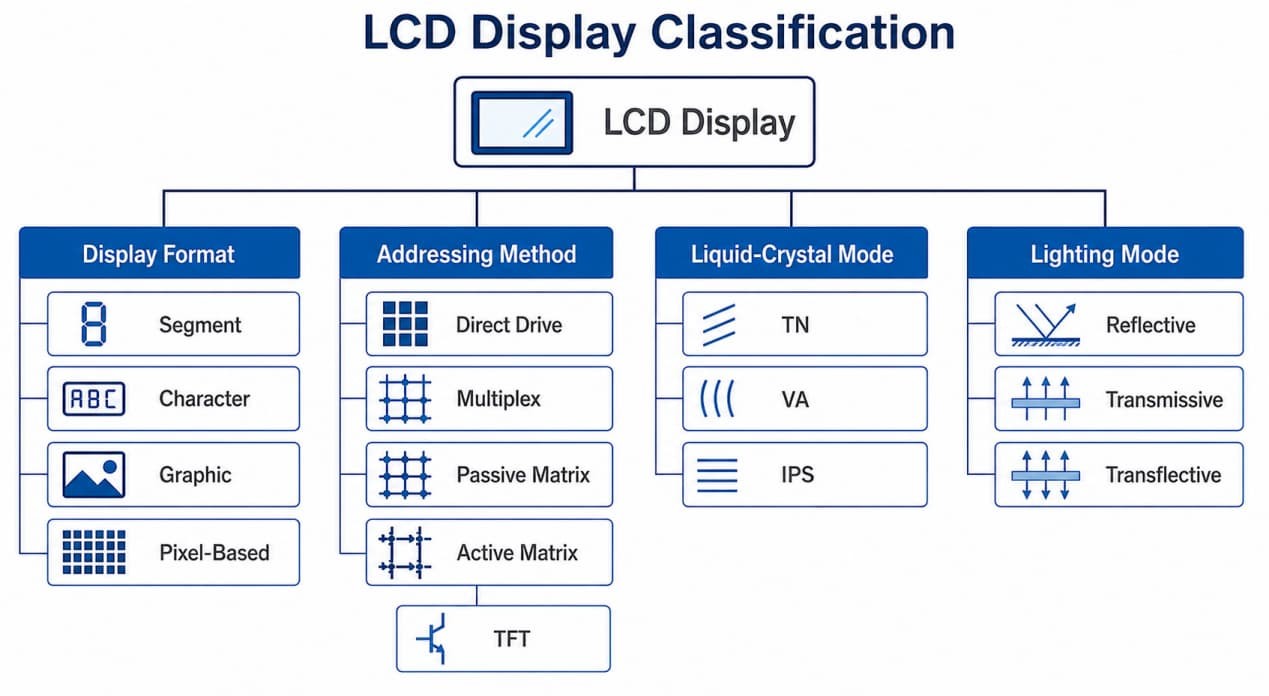
There is no single list that captures every type of LCD. Displays can be classified by what they show, how their segments or pixels are addressed, how their liquid crystals move, and how the panel uses light.
These categories describe different design dimensions:
| Classification dimension | Main categories | What it describes |
| Display format | Segment, character, graphic, pixel-based | The type and complexity of information the display can show |
| Addressing method | Direct drive, multiplex, passive matrix, active matrix | How electrical signals select display segments or pixels |
| Matrix technology | TFT active matrix | How individual pixels are switched and controlled |
| Liquid-crystal mode | TN, VA, IPS | How the liquid crystals are arranged and respond to voltage |
| Lighting mode | Reflective, transmissive, transflective | How the display uses ambient light or a backlight |
| Product form | Panel, module, monitor, commercial display | How the LCD is integrated into a usable product |
Because these dimensions overlap, one display can belong to several categories. For example, a commercial screen may be a pixel-based, active-matrix, IPS TFT LCD with a transmissive panel and an LED backlight.
That description is more informative than simply calling it an “IPS display” or a “TFT screen.”
Segment, Character, Graphic, and Pixel-Based LCDs
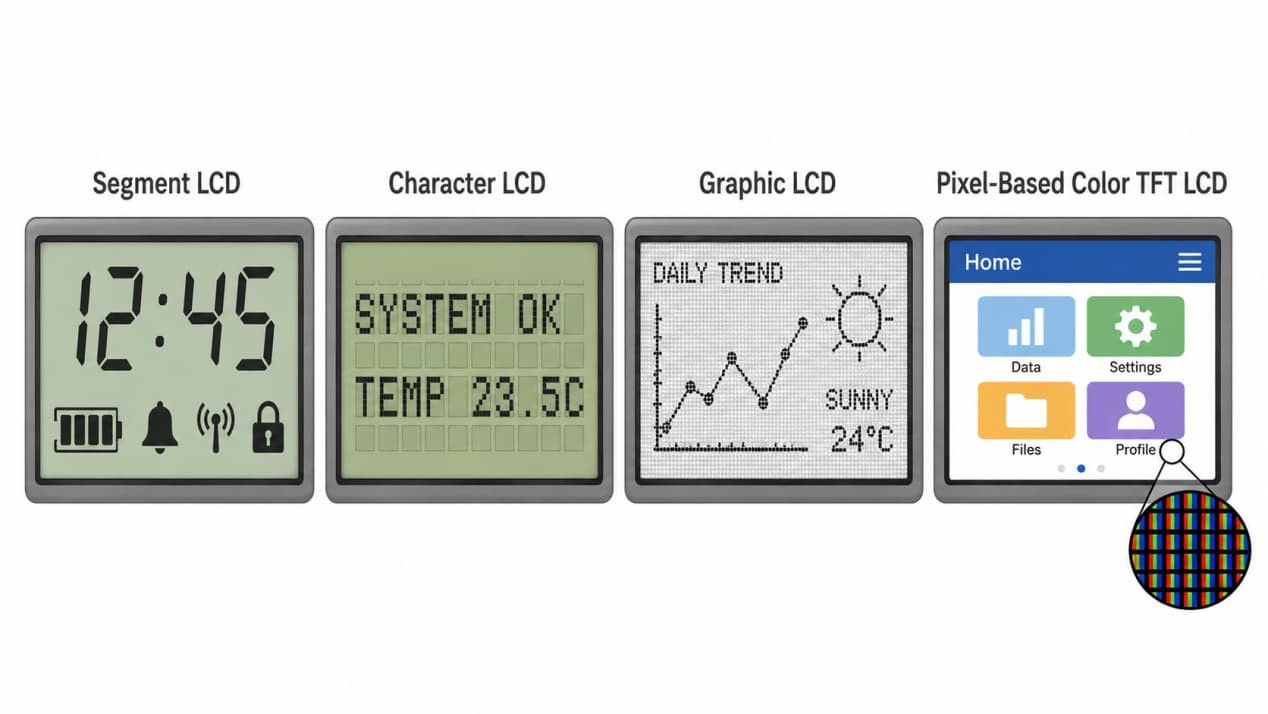
One practical way to classify LCD displays is by the kind of information they are designed to present.
Segment LCDs
A segment LCD uses predefined shapes that turn on or off to form numbers, symbols, icons, or status indicators. A calculator display is a familiar example: each digit consists of fixed segments rather than independently programmable pixels.
This structure is well suited to applications where the displayed information remains predictable, such as clocks, utility meters, simple dashboards, control panels, and measurement instruments. Because the screen does not need to render arbitrary images, the display and its controller can remain relatively simple.
Segment LCDs may use direct drive or multiplexed addressing, depending on the number of elements that must be controlled.
Character LCDs
Character LCDs use a predefined grid to display letters, numbers, and symbols. Instead of assigning a separate connection to every part of every character, the module normally uses a character matrix and controller to generate standard text.
These displays work well for menus, machine status messages, measurement results, and simple text interfaces. They provide more flexibility than fixed segment displays but are not intended for detailed images or rich graphical interfaces.
Graphic LCDs
A graphic LCD uses a matrix of addressable dots, allowing developers to place text, symbols, and simple graphics more freely. Many graphic LCDs are monochrome, although the term “graphic LCD” describes the display format rather than its color capability.
Graphic LCDs occupy the space between fixed-format displays and full-color TFT screens. They are useful when an interface needs custom icons or diagrams but does not require video, photographic content, or complex animation.
A graphic LCD is not automatically a TFT LCD. Some graphic modules use passive-matrix addressing, while others may use more advanced control structures.
Pixel-Based Color TFT LCDs
A color TFT LCD also uses addressable pixels, but each pixel is normally divided into red, green, and blue subpixels. Thin-film transistors control these subpixels so the display can reproduce complex interfaces, photographs, animation, and video.
This makes TFT LCDs common in monitors, embedded interfaces, control systems, kiosks, digital signage, medical devices, and other applications that require detailed color content.
Direct-Drive, Multiplexed, Passive-Matrix, and Active-Matrix LCDs
LCD displays can also be classified according to how their segments or pixels receive electrical signals.
Direct-Drive LCDs
In a direct-drive LCD, each display segment has a dedicated electrical connection. The drive scheme is straightforward because the controller can address each element directly.
This approach is practical when a display has a limited number of segments. As the number of independently controlled elements increases, however, the required connections and controller complexity also increase.
Direct drive is therefore most closely associated with simple, fixed-format displays rather than high-resolution pixel arrays.
Multiplexed LCDs
Multiplexed LCDs use shared common and segment electrodes. The controller scans groups of display elements in sequence instead of maintaining a dedicated connection for every visible segment.
This reduces the number of connections required for a more complex display, but the drive waveform must be carefully controlled. As multiplexing complexity increases, contrast, crosstalk, and viewing characteristics can become more difficult to manage.
The practical limit depends on the display construction, controller, waveform, liquid-crystal material, and required optical performance. It should not be reduced to one universal segment-count threshold.
Passive-Matrix LCDs
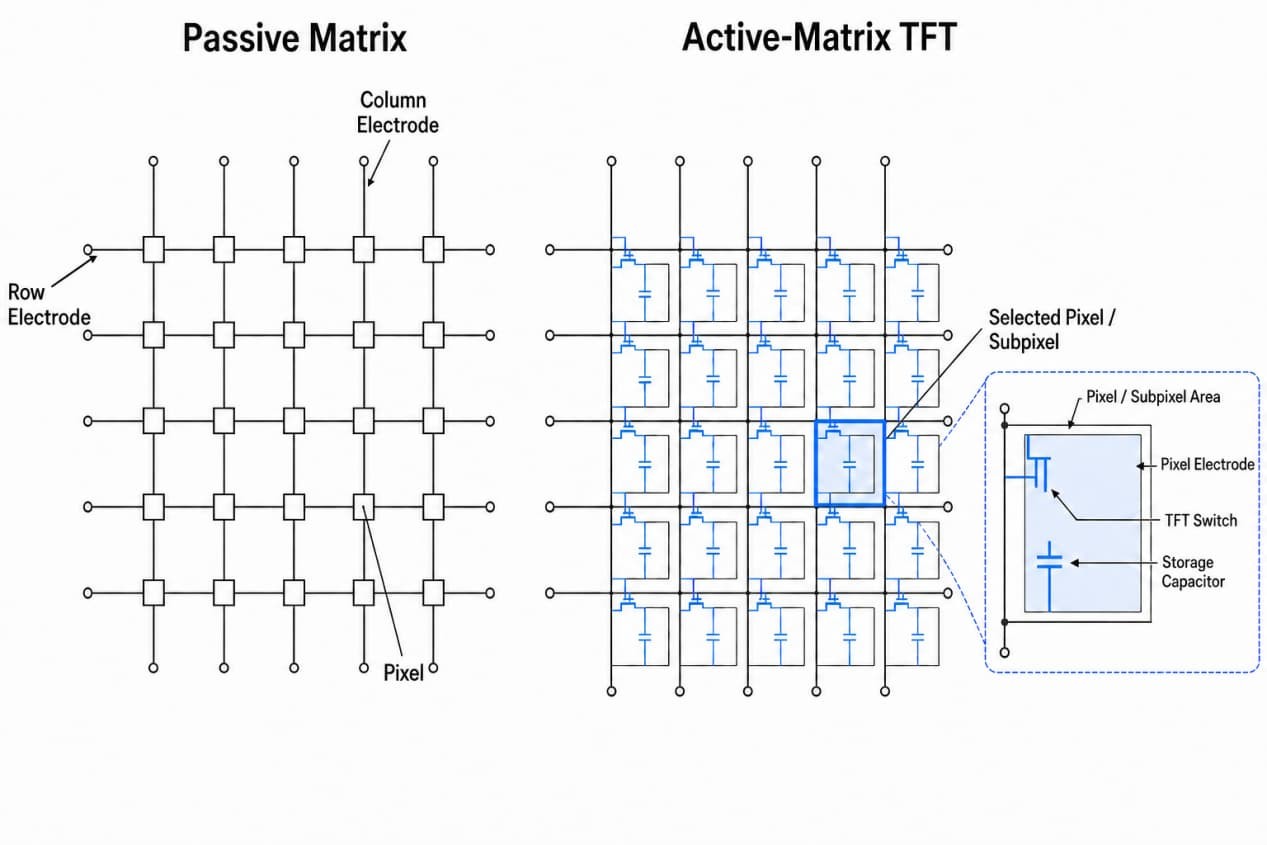
A passive-matrix LCD uses intersecting row and column electrodes to select pixels. When a row and column are energized, the pixel at their intersection receives the required signal.
Because a passive-matrix pixel does not have its own active switching transistor, its voltage is tied more closely to the scanning cycle. This design is relatively simple and remains useful for certain text, graphic, and low-information-density displays.
Passive matrix describes the addressing method. It does not mean that every passive-matrix LCD is monochrome, nor does it define the panel’s lighting mode or product format.
Active-Matrix LCDs
An active-matrix LCD assigns an active switching element to each pixel or subpixel. This allows the display to control individual pixels more precisely and maintain their electrical state between refresh cycles.
TFT is the most common active-matrix implementation. Small switching transistors control individual pixels, while storage capacitors help retain their charge until the next refresh cycle. This structure supports stable, detailed images and the accurate control required for fast-changing color content. For a broader explanation of the panel structure and light-control process, see how an LCD works.
What Is a TFT LCD Display?
TFT stands for Thin-Film Transistor. In a TFT LCD, thin-film transistors are arranged in a matrix on a glass substrate. Each transistor acts as an active switch for a pixel or subpixel.
When the display addresses a particular row and column, the corresponding transistor controls the voltage applied to that pixel. A storage capacitor helps maintain the pixel state until the next refresh cycle. Red, green, and blue subpixels are then controlled at different levels to form the final color image.
TFT therefore describes how pixels are electrically addressed. It does not describe how the liquid crystals are aligned, and it is not a self-emissive display technology. A TFT LCD still uses liquid crystals to regulate light and normally relies on a backlight to make the image visible.
A typical TFT LCD contains polarizers, glass substrates, a TFT array, a liquid-crystal layer, color filters, and a backlight unit. The TFT array controls the voltage applied to the subpixels, the liquid-crystal layer regulates light transmission, and the color filters produce the red, green, and blue components of the image.
A TFT LCD may use several liquid-crystal modes, including:
- TN, or Twisted Nematic
- VA, or Vertical Alignment
- IPS, or In-Plane Switching
For this reason, “TFT” should not automatically be treated as another name for TN. A product described only as a TFT display may use TN, VA, or IPS technology, even when the shortened product name does not identify the specific liquid-crystal mode.
LCD vs IPS: Is IPS a Type of LCD?
Yes. IPS is a type of LCD.
LCD is the larger technology family, while IPS is one method of arranging and switching the liquid crystals within an LCD panel. Every IPS LCD belongs to the LCD family, but not every LCD uses IPS.
The phrase “LCD vs IPS” remains common because product listings often use “LCD” as an imprecise label for a basic, unspecified, or non-IPS screen. In different contexts, “standard LCD” might refer to:
- A TN TFT LCD
- A VA LCD
- A passive-matrix LCD
- An LCD whose panel mode has not been disclosed
- Any LCD being contrasted with OLED
These meanings are not interchangeable. The word LCD alone does not reveal a screen’s viewing-angle behavior, response performance, color consistency, resolution, brightness, or backlight design.
A more technically useful comparison would identify both sides clearly:
- IPS TFT LCD vs TN TFT LCD
- IPS TFT LCD vs VA TFT LCD
- TFT active-matrix LCD vs passive-matrix LCD
The key relationship is straightforward: IPS defines how the liquid crystals operate within an LCD, while TFT describes the active-matrix system that controls the pixels. IPS does not replace LCD technology; an IPS panel is normally an IPS TFT LCD.
TFT vs IPS: Why They Are Not Opposing Technologies
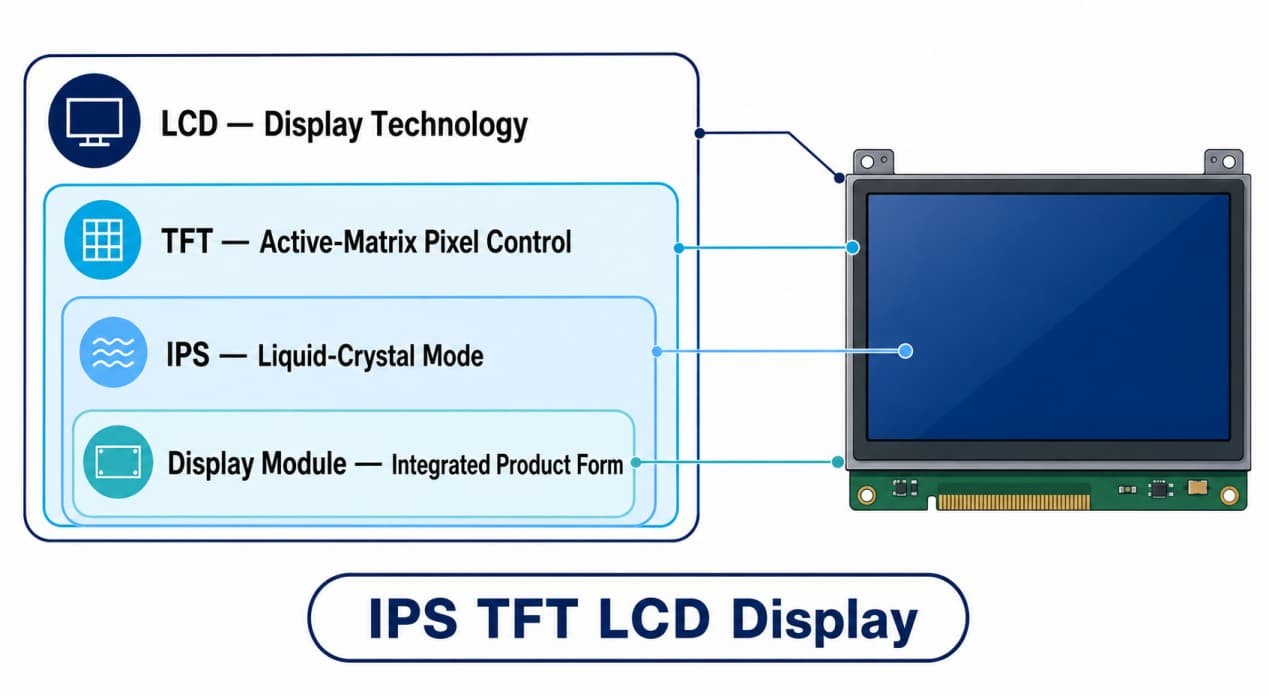
TFT and IPS describe different layers of a display, so they are not normally mutually exclusive choices.
TFT answers this question:
How is each pixel electrically addressed and controlled?
IPS answers a different question:
How do the liquid crystals move when the electric field changes?
In an IPS panel, the liquid-crystal molecules are arranged mainly parallel to the glass substrate and rotate within the panel plane as the electric field changes. This helps the display maintain more consistent optical behavior when viewed from different directions.
The TFT array beneath the liquid-crystal layer still provides active-matrix control of the pixels. An IPS panel used in a modern color screen is therefore normally an IPS TFT LCD.
What Does “IPS TFT LCD Display” Mean?
The phrase can be separated into four parts:
- LCD: The display uses liquid crystals to regulate light.
- TFT: Thin-film transistors actively control the pixels.
- IPS: The liquid crystals use an in-plane switching arrangement.
- Display or module: The panel has been integrated into a usable display component or product.
The terms complement one another rather than compete.
Why Do Product Listings Compare TFT and IPS?
In commercial product language, “TFT” is sometimes used as shorthand for a conventional TN TFT LCD, while “IPS” is used for an IPS TFT LCD. Under that informal convention, a “TFT vs IPS” comparison may actually mean TN TFT LCD vs IPS TFT LCD.
That shorthand can be convenient, but it hides the real technical distinction. When evaluating a specification, check whether “TFT” identifies the active-matrix architecture or is being used informally to imply a TN panel.
The detailed performance differences between TN, VA, and IPS—including viewing-angle behavior, contrast, response characteristics, and suitable applications—belong in a panel-mode comparison rather than in the basic TFT definition. See TFT LCD Panel Types: IPS vs TN vs VA for that comparison.
Reflective, Transmissive, and Transflective LCDs
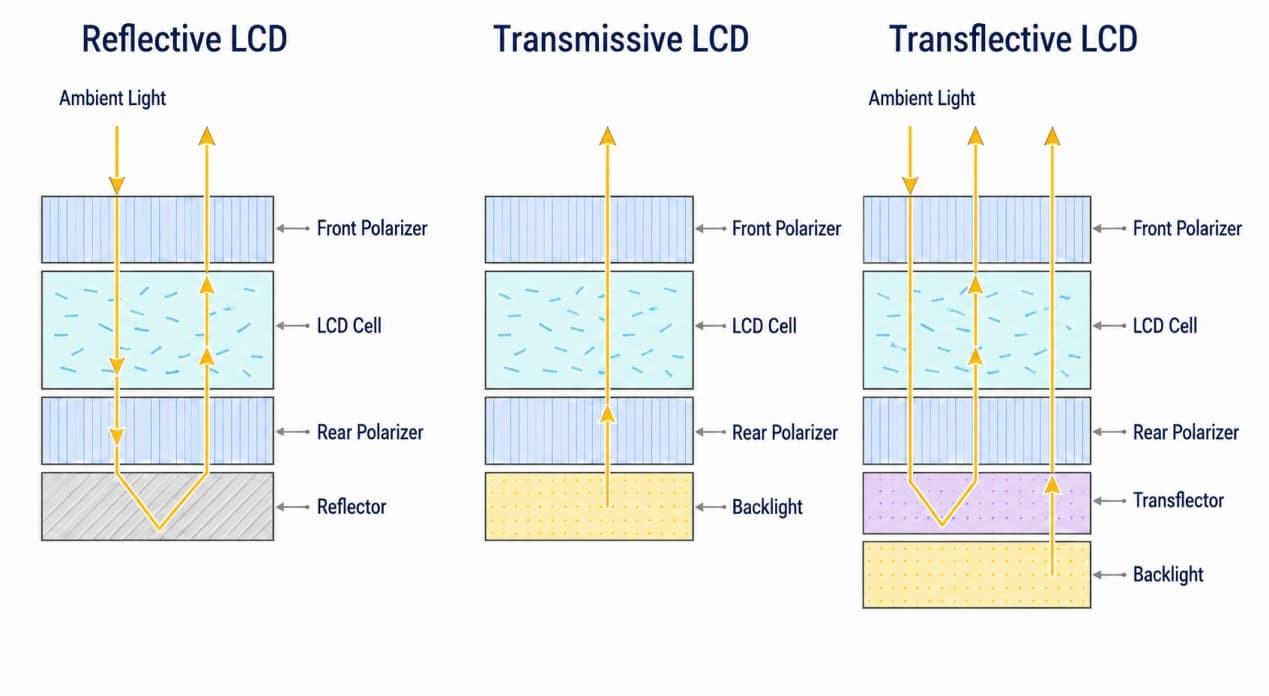
The same LCD can also be classified according to how it uses light. This dimension is separate from active-matrix control and liquid-crystal mode.
Reflective LCDs
A reflective LCD uses ambient light that enters from the front and is redirected back toward the viewer by a reflective layer. Because the display can remain visible without a continuously operating backlight, reflective construction is useful in applications where power consumption and daylight visibility matter.
Its limitation appears in dark environments: when little ambient light reaches the display, the image may require a separate front light or other illumination.
Reflective does not mean passive matrix. Although reflective construction is common in simple LCDs, addressing method and lighting method are separate design decisions.
Transmissive LCDs
A transmissive LCD depends primarily on light passing through the panel from a backlight. This arrangement is common in color TFT LCDs because it supports bright, full-color images in indoor or controlled-light environments.
The final brightness is not determined by the TN, VA, or IPS label alone. It also depends on the backlight output, optical films, panel transmittance, power limits, brightness settings, and thermal design.
A transmissive IPS LCD, for example, combines an IPS liquid-crystal mode with TFT active-matrix addressing and a separate backlight. Each term describes a different part of the system.
Transflective LCDs
A transflective LCD combines transmissive and reflective optical paths. It can use a backlight in darker conditions while also redirecting some ambient light toward the viewer in brighter environments.
This approach can be valuable when lighting conditions vary, but the balance between reflection and transmission involves design trade-offs. Actual readability depends on the complete panel construction, surface reflections, backlight, viewing direction, and surrounding environment.
Transflective should not be treated as a guarantee of sunlight readability without examining the specifications and the finished display design.
How the LCD Classifications Fit Together
The following examples show how the different classification dimensions can combine:
| Display example | Display format | Addressing method | Matrix/control | LC mode | Lighting mode |
| Simple numeric display | Segment | Direct or multiplexed | Usually passive | Depends on design | Reflective or transmissive |
| Monochrome graphic LCD | Graphic | Matrix | Often passive | Depends on design | Reflective, transmissive, or transflective |
| TN TFT LCD | Pixel-based | Active matrix | TFT | TN | Usually transmissive |
| VA TFT LCD | Pixel-based | Active matrix | TFT | VA | Usually transmissive |
| IPS TFT LCD | Pixel-based | Active matrix | TFT | IPS | Usually transmissive |
This framework explains why a single-name comparison can be misleading. LCD, TFT, IPS, LED backlight, resolution, and product format do not describe the same design decision.
A complete description might look like this:
A 1920 × 1080 transmissive IPS TFT LCD module with an LED backlight.
Here:
- 1920 × 1080 describes resolution.
- Transmissive describes how light travels through the panel.
- IPS describes the liquid-crystal mode.
- TFT describes active-matrix pixel control.
- LCD identifies the display technology.
- LED backlight identifies the illumination source.
- Module identifies the product form.
How to Identify the LCD Type in a Specification
When reviewing an LCD specification, start by separating the terms into their proper categories.
1. Identify the Display Format
Determine whether the product is a segment, character, graphic, or pixel-based display. This indicates the kind of content it can present, but not necessarily how it is addressed.
2. Check the Addressing and Matrix Technology
Look for terms such as direct drive, multiplex, passive matrix, active matrix, or TFT. These describe how the display controls its visible elements.
If a product is described as a TFT LCD, it is an active-matrix display. You should still check which liquid-crystal mode it uses.
3. Find the Liquid-Crystal Mode
Look for TN, VA, IPS, or a related variant. This part of the specification helps explain optical tendencies such as off-axis image stability and native contrast behavior.
The panel-mode name is useful, but it is not a substitute for the actual specifications of the selected model.
4. Check the Lighting Mode and Backlight
Determine whether the panel is reflective, transmissive, or transflective. For a transmissive display, check the backlight type and the luminance specified for the panel or finished product.
“LED display” may mean an LED-backlit LCD in consumer terminology, but it may also refer to a direct-view LED display. The product structure must be confirmed.
5. Keep Resolution Separate From Panel Mode
FHD, QHD, and 4K describe resolution. They do not compete with IPS, TN, or VA.
A display can be both FHD and IPS because the two terms answer different questions. The same applies to labels such as Retina, which describe a product or pixel-density concept rather than a liquid-crystal mode.
6. Distinguish the Panel From the Finished Display
The finished result also depends on components added around the LCD panel, including:
- Backlight and brightness control
- Optical films
- Touch sensor
- Cover glass
- Air bonding or optical bonding
- Anti-glare or anti-reflective treatment
- Enclosure and thermal design
A panel with strong off-axis performance can still be difficult to read if the finished product has high surface reflection. Likewise, adding protective glass or a touch layer may change the observed contrast and reflection without changing the underlying LCD mode.
Common LCD Naming Mistakes
LCD vs IPS
IPS is part of the LCD family. The useful comparison is normally IPS against another LCD mode or a specifically identified non-IPS panel.
TFT vs IPS
TFT describes active-matrix pixel control, while IPS describes liquid-crystal behavior. An IPS display is commonly also a TFT LCD.
LED vs LCD
Most modern LCD screens use LED backlights. In that context, “LED screen” may still be an LCD. A direct-view LED display, however, forms the image with light-emitting diodes and is a different display architecture.
FHD or 4K vs IPS
FHD and 4K describe pixel resolution. IPS describes the panel mode. A display can have both labels.
IPS LCD vs OLED
An IPS LCD controls light from a separate backlight. OLED pixels emit their own light. That is a comparison between different display architectures and should be evaluated separately from LCD panel classification.
Understanding LCD Names Before Comparing Performance
The most reliable way to understand an LCD is to identify what each term describes. LCD names may refer to the display format, electrical addressing, liquid-crystal behavior, lighting system, resolution, or finished product.
LCD, TFT, and IPS are therefore not three mutually exclusive choices. An IPS TFT LCD combines all three: LCD is the display family, TFT controls the pixels, and IPS defines the liquid-crystal mode.
Once this hierarchy is clear, comparisons become more meaningful. Instead of asking whether IPS is better than LCD, compare specific panel modes or products under the operating conditions that matter for the application. The panel name provides a useful starting point, but the final decision should also consider the actual specifications and complete display design.
For your next commercial LCD display project, contact RusinDisplay to discuss your application and display requirements.
FAQ
Is IPS better than LCD?
IPS is a type of LCD, so they are not direct alternatives. The practical question is whether an IPS TFT LCD is more suitable than a particular TN, VA, or passive-matrix LCD for the intended application. That depends on viewing position, content, optical requirements, cost, and the actual panel specifications.
Is IPS an LCD or an LED display?
IPS is an LCD panel mode. Most modern IPS LCDs use an LED backlight, which means the same screen may be described as both an IPS LCD and an LED-backlit display. The LED provides light; IPS describes how the liquid crystals control it.
What is the difference between TFT LCD and IPS LCD?
TFT identifies an active-matrix method for controlling pixels. IPS identifies a liquid-crystal arrangement and switching method. A modern IPS LCD is normally also a TFT LCD, so the two terms describe different parts of the same panel.
Are all TFT LCD displays IPS?
No. TFT LCDs may use TN, VA, IPS, or related liquid-crystal modes. If a specification states only “TFT LCD,” check the detailed panel information before assuming that it uses IPS.
What are the main types of LCD displays?
LCDs can be grouped by display format, addressing method, matrix control, liquid-crystal mode, lighting mode, and product form. Common categories include segment, character, graphic, passive-matrix, TFT active-matrix, TN, VA, IPS, reflective, transmissive, and transflective LCDs.