




Selecting the right display panel often leads to a confusing alphabet soup of acronyms: TFT, TN, VA, and IPS. While all four fall under the broader umbrella of Liquid Crystal Display (LCD) technology, each represents a distinct architectural approach to light modulation, liquid crystal orientation, and pixel switching.
Demystifying the Foundation: TFT vs. TN, VA, and IPS
A common misconception is that TFT is a competing display type alongside TN, VA, or IPS. In reality, TFT (Thin-Film Transistor) refers to the active-matrix backplane circuitry that drives individual pixels, serving as the common foundational hardware for modern LCDs.
While TFT provides the electronic backbone to control voltage at every subpixel, TN, VA, and IPS define the specific physical alignment and rotation of the liquid crystal molecules themselves. In short, every TN, VA, and IPS screen on the market today is an active-matrix TFT LCD display.
Deep Dive: How TN, VA, and IPS Modulate Light
The operational divergence among LCD panels lies in how the liquid crystal molecules are physically aligned and how they rotate when an electric field is applied across the cell gap.
| Panel Type | OFF State (No Voltage) | ON State (Voltage Applied) |
| TN (Twisted Nematic) | Molecules twist in a 90° helix; light transmits (Bright). | Molecules untwist and stand perpendicular to substrate; light is blocked (Dark). |
| VA (Vertical Alignment) | Molecules align vertically to substrate; light is blocked (Dark). | Molecules tilt horizontally across multi-domains; light transmits (Bright). |
| IPS (In-Plane Switching) | Molecules stay parallel in-plane; light is blocked (Dark). | Molecules rotate horizontally within the substrate plane; light transmits (Bright). |
TN (Twisted Nematic)
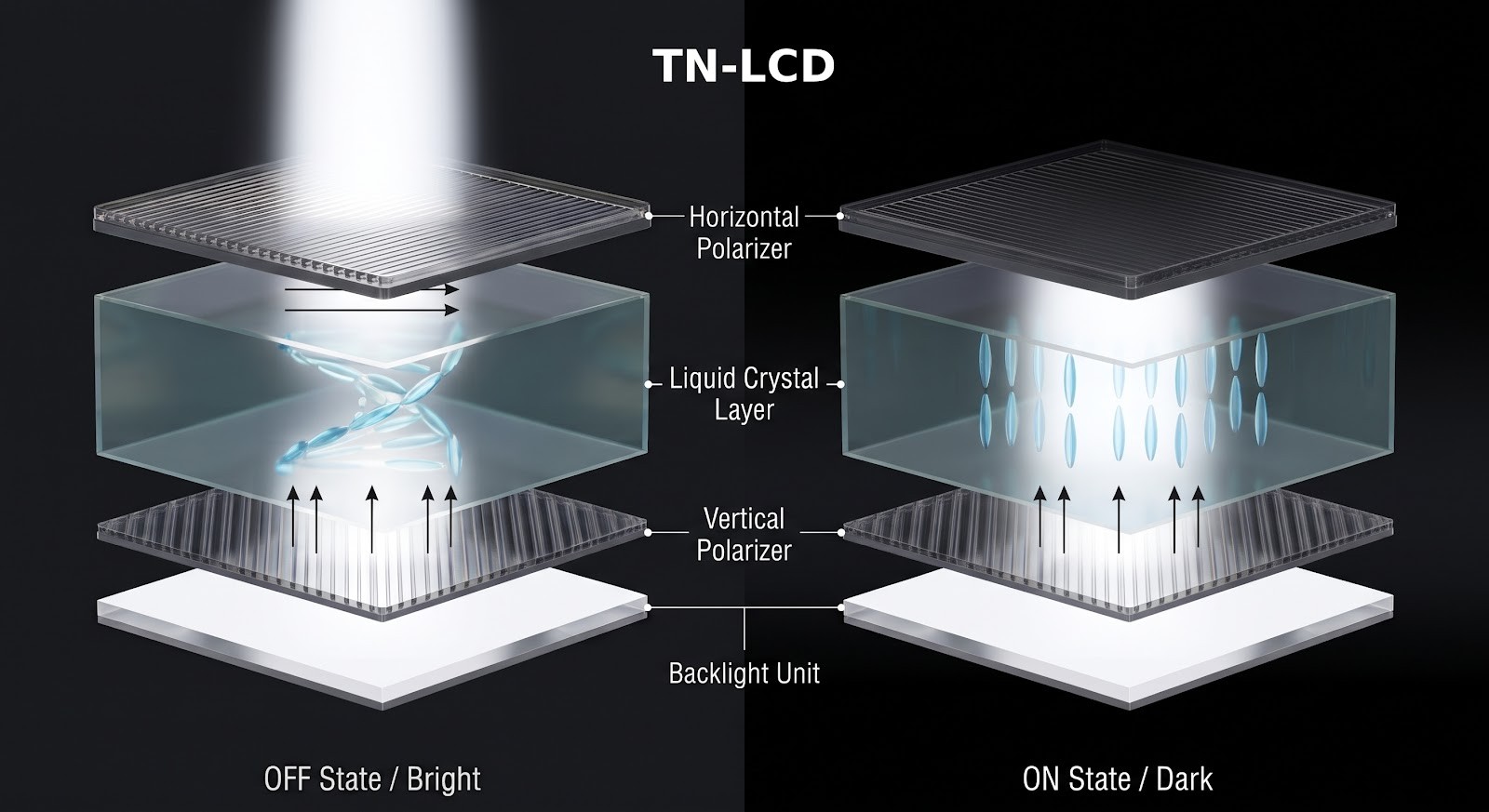
In a Twisted Nematic (TN) cell, nematic liquid crystal molecules are anchored between perpendicular alignment layers to form a natural 90-degree helical twist.
In the unpowered OFF State / Bright shown on the left, white light emitted from the bottom Backlight Unit passes through the Vertical Polarizer to become vertically polarized. As it travels upward through the Liquid Crystal Layer, the 90-degree molecular helix guides the light vector to rotate horizontally. This rotated light matches the orientation of the top Horizontal Polarizer, passing through freely to emerge as a bright beam in Normally White mode.
When voltage is applied in the ON State / Dark on the right, an electric field across the top and bottom ITO electrodes forces the liquid crystal molecules to uncoil and align vertically. The polarized light passes straight through without rotating, causing it to be completely blocked and absorbed by the perpendicular top Horizontal Polarizer to produce a dark screen. Because the helical twist requires minimal physical displacement to unravel, TN achieves class-leading response times; however, its asymmetrical vertical uncoiling creates severe optical phase shifts at off-axis angles, resulting in narrow viewing angles and grayscale inversion. (To learn more about the underlying physics of polarizers, electrodes, and liquid crystal valves, see our complete guide on How Does an LCD Work?).
VA (Vertical Alignment)
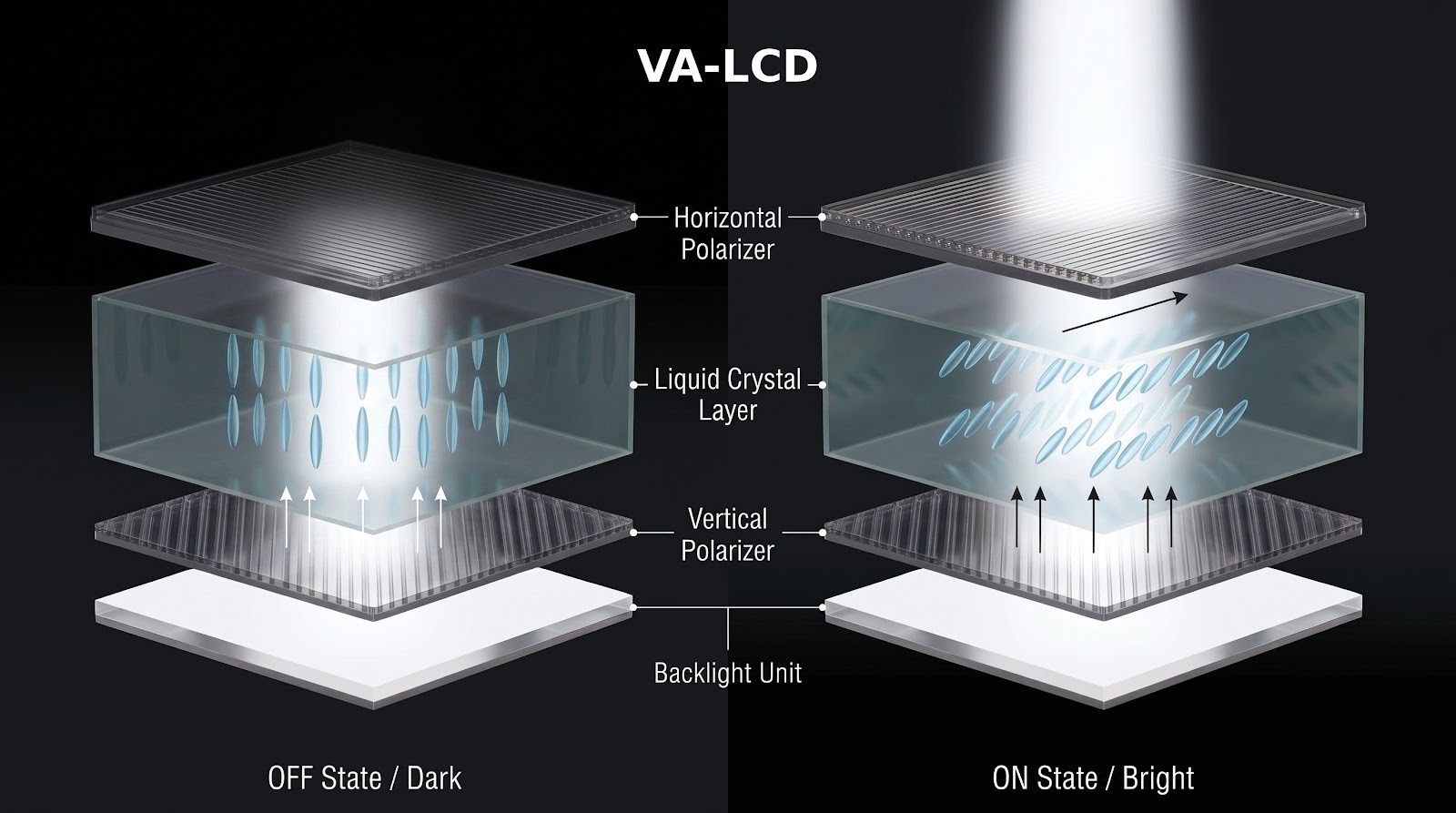
Vertical Alignment (VA) cells, including modern MVA and PVA variants, orient their liquid crystal molecules perpendicular to the glass substrate in their default state.
In the unpowered OFF State / Dark on the left, this vertical molecular orientation introduces virtually zero phase retardation. Light from the Backlight Unit passes through the Vertical Polarizer and travels unaltered through the Liquid Crystal Layer. Because its polarization remains vertical, the light is completely absorbed by the top Horizontal Polarizer. This mechanism prevents nearly all backlight bleed, providing the deep native black levels typical of Normally Black mode.
Once voltage is applied in the ON State / Bright on the right, the electric field causes the liquid crystal molecules to tilt horizontally across multi-domain structures. This controlled tilt alters the polarization angle of the passing light, allowing it to transmit through the top Horizontal Polarizer and exit as a bright, uniform beam. While this tilting significantly expands horizontal viewing angles compared to TN, the mechanical transition of resetting perpendicular molecules across multi-domains requires more time, making VA response times moderate and prone to dark-level smearing.
IPS (In-Plane Switching)
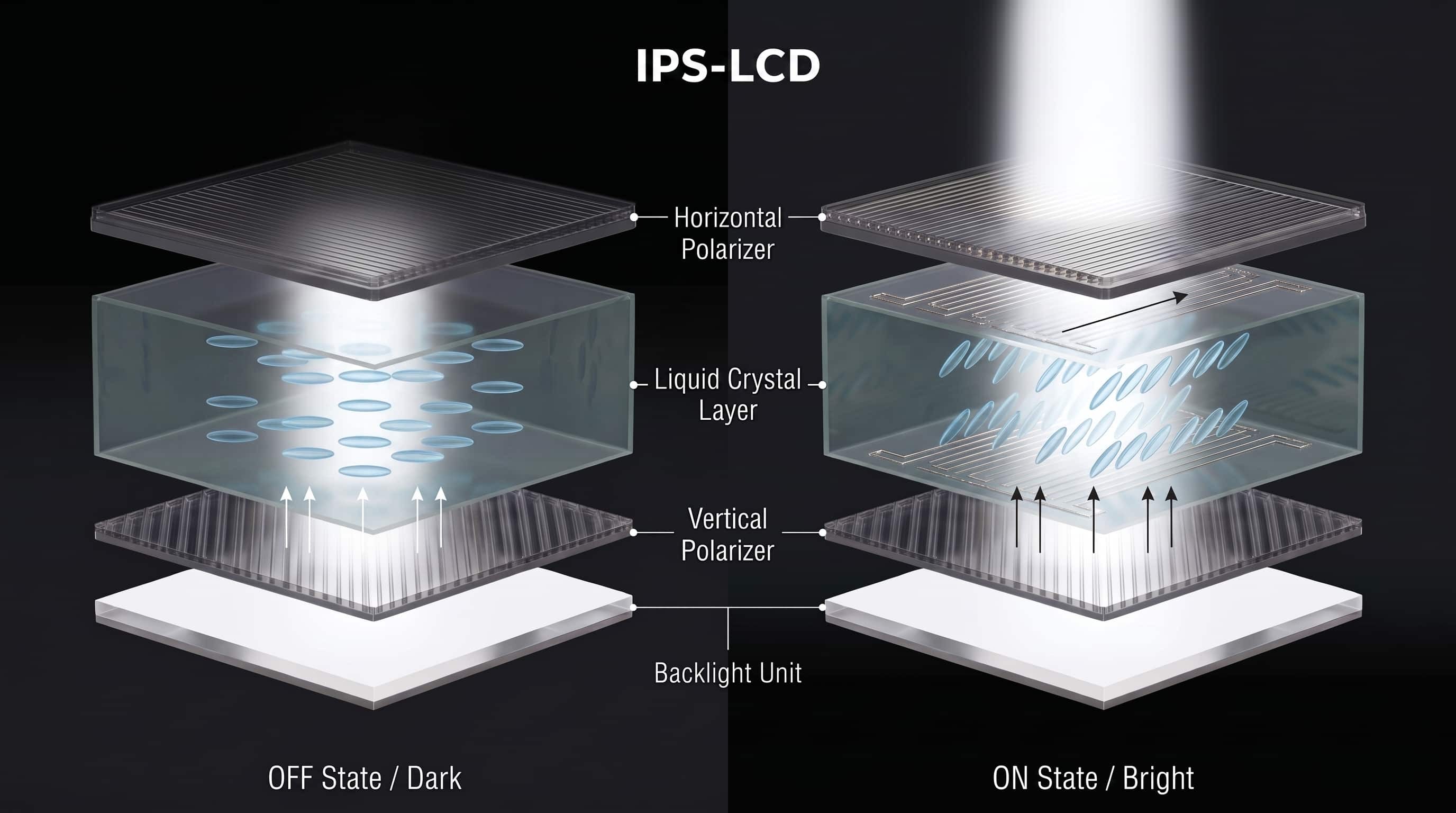
Unlike TN and VA panels that apply vertical electric fields across opposing substrates, In-Plane Switching (IPS) positions both driving electrodes on the bottom glass substrate.
In the unpowered OFF State / Dark on the left, the liquid crystal molecules remain flat and parallel within the plane of the substrate, aligned with the vertical optical axis. Vertically polarized light from the Backlight Unit passes through the Liquid Crystal Layer without rotation and is blocked by the top Horizontal Polarizer, maintaining a deep dark state in Normally Black mode.
When voltage is applied in the ON State / Bright on the right, lateral electrodes generate a horizontal electric field across the cell gap. This field rotates the liquid crystals horizontally within the plane of the panel rather than tilting them upward. Because the molecules rotate parallel to the glass plate, light refracts symmetrically in all directions, delivering ultra-wide 178° viewing angles and flawless color reproduction without color shifting. Furthermore, because the crystals are already resting flat, physical surface pressure does not displace them, making IPS inherently stable under touch contact.
Head-to-Head Performance Benchmark: TN vs. IPS vs. VA
The molecular orientations and electrical switching behaviors detailed above directly translate into the distinct real-world performance metrics of each panel type. Whether an application demands extreme refresh speeds, deep contrast in dark rooms, or uncompromising color consistency across wide viewing angles, each architecture represents a specific engineering trade-off.
| Performance Metric | TN (Twisted Nematic) | VA (Vertical Alignment) | IPS (In-Plane Switching) |
| Viewing Angles | Limitted(~150°) | Wide (~160°) | Very Wide (~178°) |
| Grayscale Inversion | More noticeable | Low | Minimal |
| Static Contrast Ratio | ~1,000:1 | 3,000:1 – 5,000:1 | ~1,000:1–1,500:1 |
| Color Reproduction | Standard | Good | Excellent |
| Pixel Response Time | Very Fast (~1ms GtG) | Moderate (4ms – 8ms GtG) | Fast (1ms – 4ms GtG) |
| Black Level Uniformity | Standard | Excellent | Good |
| Touchscreen Suitability | Limited | Limited | Excellent |
| Production Cost | Lowest | Moderate | Moderate to High |
Viewing Angles & The Grayscale Inversion Phenomenon
The optical limitations of TN displays stem from asymmetric off-axis phase retardation, resulting in a limited viewing angle. This structure makes the grayscale inversion effect more noticeable, causing colors to shift or invert sharply when viewed off-center (typically along the 6 o’clock or 12 o’clock direction).
While VA panels achieve wide viewing angles with low inversion tendencies, IPS displays remain the industry benchmark. By rotating liquid crystals horizontally within the substrate plane, IPS panels achieve very wide viewing angles of approximately 178° with minimal grayscale inversion, preserving color accuracy and gamma curves across nearly all viewing positions.
Contrast Ratios & Black Level Reproduction
VA panels lead the industry in native static contrast ratios, routinely achieving between 3,000:1 and 5,000:1. Because vertically aligned crystals block nearly all backlight transmission in their default unpowered state, VA technology delivers excellent black level uniformity and deep contrast in low-light environments.
In comparison, both TN and standard IPS panels operate around 1,000:1 (with advanced IPS configurations reaching up to 1,500:1). Although IPS black levels are good, diagonal off-axis viewing in dark settings can produce a slight surface glow (IPS glow), whereas TN black levels remain standard and prone to washed-out shadows.
Pixel Response Time, Refresh Rates & Motion Artifacts
Because TN liquid crystals require minimal rotational displacement to modulate light, they deliver very fast native Gray-to-Gray (GtG) response times of around 1ms. This architectural speed allows panels to support ultra-high refresh rates with minimal motion blur, retaining strong appeal for budget and esports-focused applications.
VA panels generally exhibit moderate response times between 4ms and 8ms GtG. Their molecular transition between dark gray and black shades can be relatively sluggish, which may introduce motion smear or trailing during fast-paced sequences.
Modern IPS architectures bridge this gap effectively, offering fast 1ms to 4ms GtG response times. This enables smooth motion handling while preserving excellent color accuracy and broad viewing angles.
Mechanical Pressure & Touch Integration
Applying mechanical force to a TN or VA panel temporarily alters the vertical orientation of the liquid crystals, making their touchscreen suitability limited due to visible surface ripple marks or localized color distortions.
Conversely, IPS liquid crystals rotate horizontally within the plane of the panel, ensuring the molecular structure remains resilient against surface contact. This mechanical stability gives IPS excellent suitability for optically bonded capacitive touchscreens, industrial human-machine interfaces (HMIs), tablets, and interactive embedded devices.
Application & Selection Matrix

Choosing the right display panel involves balancing optical requirements against the target operating environment.
- Competitive Esports & Entry-Level Gaming: TN panels remain relevant where sub-millisecond response times, low input latency, and extreme refresh rates (360Hz to 540Hz) take priority over color accuracy or wide viewing angles.
- Home Theater, Simulation & Media Consumption: VA panels are well-suited for curved desktop monitors, televisions, and simulation rigs, using high static contrast ratios to deliver immersive cinematic depth in low-light settings.
- Graphic Design, Medical Imaging & Touch HMIs: IPS panels remain the benchmark for precision tasks requiring 100% sRGB/DCI-P3 color fidelity, stable 178-degree off-axis viewing, and structural resilience under touch input.
- Industrial & Embedded Systems: Customized IPS and VA TFT modules driven via MIPI-DSI, LVDS, or Parallel RGB interfaces offer wide operating temperature ranges (-30°C to +85°C), long lifecycle availability, and high-brightness backlighting for reliable field operation.
Ready to integrate the ideal display into your next project? Whether you need sunlight-readable IPS panels, high-contrast VA displays, or fully customized TFT LCD modules with integrated touch and custom driver boards, contact our engineering team today for technical datasheets, design support, and rapid prototyping samples.
FAQ
Is IPS always better than TFT?
IPS is not a replacement for TFT; it is a specific type of TFT LCD. An IPS display uses Thin-Film Transistors on the glass backplane to drive horizontally rotating liquid crystals, delivering wider viewing angles and superior color accuracy compared to older TN-based TFT displays.
Why are VA panels commonly used in curved displays?
VA panels have narrow off-axis color consistency compared to IPS panels. Curving the display panel (e.g., 1000R or 1500R) keeps every pixel equidistant and perpendicular to the user's line of sight, preventing edge-contrast degradation and dark-level shifts.
How does LCD compare to newer OLED and QD-OLED technologies?
All TFT LCDs (TN, VA, IPS) rely on an external backlight filtered through liquid crystal valves. OLED and QD-OLED are self-emissive technologies where each individual organic subpixel produces its own light. While OLED offers infinite contrast and instantaneous pixel response times, modern TFT LCDs remain dominant in industrial, automotive, and high-brightness computing environments due to their lower cost, immunity to permanent image retention (burn-in), and high sustained peak luminance.