




The ongoing transition across digital display engineering has introduced significant terminology confusion within commercial hardware and computing markets. Consumer marketing frequently positions LED displays as an entirely separate, next-generation display panel fundamentally distinct from LCD monitors. In reality, standard commercial "LED monitors" are an evolutionary refinement of the active-matrix liquid crystal display platform.
Understanding the underlying physics—from the optical light valve mechanism to solid-state backlight topologies and emissive semiconductor arrays—is essential for engineering teams, AV system integrators, and IT hardware procurement specialists evaluating commercial displays.
The Core Distinction: Light Valves vs. Light Emitters
To address the fundamental question—What is the difference between an LED display and an LCD screen?—engineers classify flat-panel systems into two distinct optical paradigms: non-emissive spatial light modulators (light valves) and self-emissive semiconductor matrices.
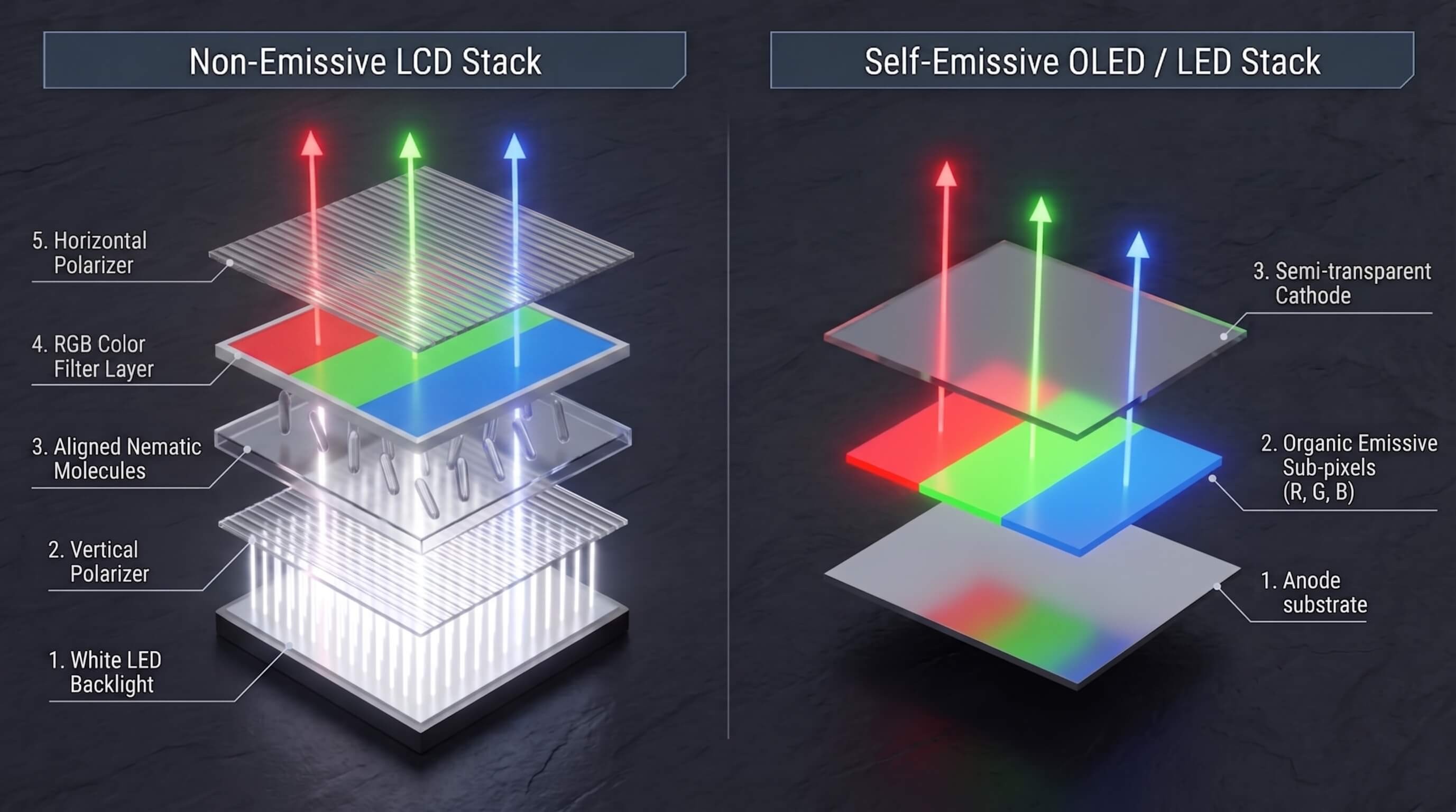
- Liquid Crystal Displays (AM-LCD): Liquid crystals do not generate native photons. Instead, nematic liquid crystals act as an electro-optical light valve. Driven by an active-matrix thin-film transistor (TFT) substrate, the liquid crystal layer changes its molecular director under an applied voltage, modulating phase retardation to pass or block light emitted from an auxiliary Backlight Unit (BLU).(To learn specifically how the underlying physics and layers work, check out our guide on how an LCD works).
- Direct-View LED (dvLED) & MicroLED: True LED screens utilize discrete, self-emissive semiconductor light-emitting diodes arranged in surface-mount device (SMD) matrices. By recombining electrons and electron holes directly within the semiconductor conduction and valence bands, each sub-pixel directly emits monochromatic red, green, or blue light via solid-state electroluminescence.
- The Marketing Shorthand: For desktop monitors, enterprise workstations, and standard digital signage, any product labeled an "LED monitor" is almost universally an LED-backlit LCD panel.
The Backlight Unit (BLU) Evolution: From CCFL Tubes to Solid-State LEDs
To understand how this LED marketing shorthand became an industry standard, one must examine the empirical transition of the Backlight Unit (BLU) itself. The historical shift from legacy LCDs to modern LED displays represents an evolution of the light source, not the liquid crystal panel itself.
Legacy CCFL Backlighting
Early active-matrix LCDs utilized Cold Cathode Fluorescent Lamps (CCFLs) placed horizontally behind the diffuser panel. While CCFL systems provided uniform diffusion, they suffered from significant engineering bottlenecks:
- High power draw requiring bulky high-voltage inverter circuits.
- Accelerated optical degradation with a typical operational lifespan limited to 30,000 to 50,000 hours.
- Structural thickness constraints and environmental hazards due to trace amounts of mercury vapor.
Solid-State LED Backlighting
Modern LCDs utilize solid-state Light Emitting Diodes (LEDs) incorporating phosphor conversion (such as standard White-LED or advanced RG-Phosphor arrays). Transitioning to solid-state semiconductor backlighting achieved major performance milestones:
- Luminous Efficiency: 20% to 30% reduction in power consumption for equivalent luminance levels.
- Form Factor: Elimination of bulky high-voltage inverter modules, enabling ultra-slim chassis profiles and micro-bezel enclosures.
- Operational Lifespan: Mean Time Between Failures (MTBF) extended to 50,000–100,000 hours without catastrophic luminous flux decay.
- Color Gamut: Broader spectral purity, covering higher percentages of the sRGB and DCI-P3 color spaces.
Backlight Topologies: Edge-Lit, Direct-Lit, and Full-Array Local Dimming (FALD)
While solid-state LEDs solved the energy efficiency and lifespan limitations of legacy CCFL tubes, replacing a uniform cylindrical lamp with discrete point-source diodes introduced a new optical challenge: how to distribute light evenly across a two-dimensional liquid crystal plane without introducing hot spots or excessive bulk.
To solve this, display engineers developed three distinct architectural topologies. The physical positioning and clustering of LEDs within the Backlight Unit directly dictate the panel's chassis profile, optical uniformity, peak luminance, and dynamic contrast capabilities.
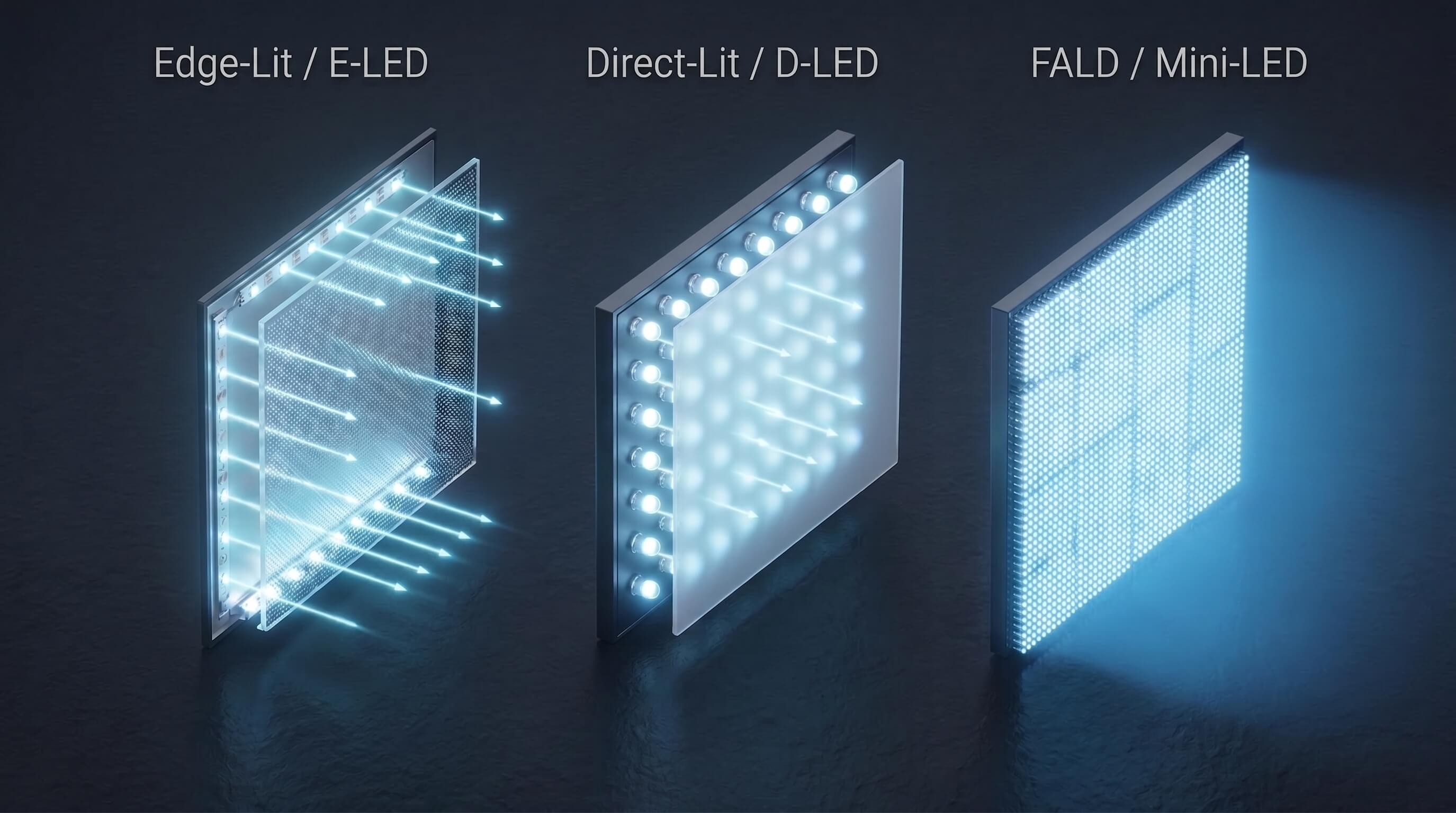
Edge-Lit LED (E-LED)
LED packages are mounted along one, two, or all four perimeter edges of the display frame. Light is injected into a specialized polymethyl methacrylate (PMMA) Light Guide Plate (LGP), which uses microscopic laser-etched dots to redirect photons forward through a diffuser plate and brightness enhancement films (BEF / Prism sheets).
- Advantages: Achieves the thinnest physical form factor; ideal for commercial ultra-slim monitors and entry-level digital menu boards.
- Trade-offs: Prone to perimeter light leakage ("edge bleed") and limited dynamic contrast capabilities.
Direct-Lit LED (D-LED)
LEDs are arranged in a sparse grid directly behind the diffuser plate, firing forward through the liquid crystal layer.
- Advantages: Lower bill-of-materials (BOM) cost with uniform backlight distribution; avoids complex light guide plates.
- Trade-offs: Requires greater physical depth (thicker chassis) to prevent optical hot spots; lacks individual diode addressability.
Full-Array Local Dimming (FALD) & Mini-LED
FALD systems deploy a dense matrix of hundreds or thousands of miniature LED emitters grouped into independently controlled hardware dimming zones.
- Dynamic Contrast Control: By analyzing frame histograms in real-time, the driving ASIC dims zones corresponding to dark scene elements while driving peak current to highlight zones.
- Engineering Impact: Bridges the performance gap with emissive displays, elevating native static LCD contrast ratios (1,000:1–3,000:1) to dynamic ratios exceeding 1,000,000:1 while mitigating edge-bleed artifacts.
Can an LCD Operate Without a Backlight Unit?
The architectural evolution detailed above heavily relies on active, transmissive engineering—optimizing the photon supply from behind the screen. However, because liquid crystal molecules function strictly as light valves and do not possess native emission, an intriguing mechanical alternative emerges: Can the active BLU be bypassed entirely?Engineering reality confirms that an AM-LCD panel can modulate spatial phase and display active images without an integrated electronic backlight, provided an alternative ambient or external illumination source is present."
- Reflective LCDs (R-LCD): These designs remove the active backlight entirely, placing a reflective mirror substrate behind the rear polarizer. Incoming ambient light passes through the front polarizer, modulates through the liquid crystals, bounces off the rear mirror, and passes back to the viewer. This forms the basis of ultra-low-power devices such as digital watches, outdoor signage, and e-paper hybrid monitors.
- Transflective LCDs: These hybrid configurations combine a semi-transparent rear reflector with an auxiliary backlight, providing daylight readability via ambient light while engaging the LED backlight in low-light environments.
- Transparent LCD Showcases: Commercial transparent display boxes remove the integrated backlight enclosure entirely. The ambient environment or internal showcase LED spotlights serve as the transmissive illumination source, allowing viewer optics to see through active, floating UI graphics into physical product display cases.
Architectural Comparison: LED-Backlit LCD vs. Direct-View LED (dvLED)
While modifying the BLU topologies or exploring passive illumination (as seen in R-LCDs) allows LCD technology to stretch its operational boundaries, the matrix still suffers from the inherent structural bottlenecks of physical bezels and light-valve attenuation. When engineering specifications require infinite scaling, full sunlight readability, and absolute seamlessness—such as in enterprise command centers or digital out-of-home (DOOH) deployment—the architecture must shift entirely from non-emissive light modulation to true self-emissive semiconductor matrices.
| Engineering Parameter | LED-Backlit LCD (Edge/FALD) | Direct-View LED (dvLED / MicroLED) |
| Optical Principle | Non-Emissive (TFT Light Valve + BLU) | True Self-Emissive (SMD/COB Diodes) |
| Backlight Light Source | White-LED / Mini-LED Matrix | None (Individual Diodes Form Pixels) |
| Pixel Pitch Density | Extremely High (< 0.1mm in 4K panels) | Coarser to Fine (0.7mm - 2.5mm) |
| Peak Luminance | 250 - 1,500 nits (cd/m²) | 800 - 5,000+ nits (Full Sunlight Readable) |
| Seamless Scalability | Physical Bezels (0.88 mm - 3.5 mm seams) | 100% Seamless Modular Tile Coupling |
| Native Contrast | 1,000:1 - 5,000:1 (Infinite with FALD) | Infinite (True Diode Extinction Black) |
| Optimal Viewing Distance | Close-up Desktop / Detailed HMI (< 1m) | Medium to Long Distance (> 2m - 10 m) |
| Thermal & Power Draw | Lower Thermal Density per Area | Higher Thermal Dissipation & Power Load |
Hardware Selection Criteria
- Desktop Workstations, Engineering CAD, and Control Consoles: LED-backlit LCD monitors (specifically IPS and high-zone Mini-LED panels) remain the gold standard. They provide superior sub-pixel resolution, tight pixel pitch, precise color space alignment, and cost-effective continuous operation.
- Auditoriums, Seamless Video Walls, and Outdoor Signage: Direct-View LED systems are the appropriate choice where extreme peak luminance (> 2,000nits), high ambient sunlight rejection, and bezel-free modular scalability outweigh sub-millimeter pixel density requirements.
- If you are designing custom commercial displays, transparent video walls, high-brightness outdoor signage, or specialized industrial LCD/LED modules, our engineering team can help develop custom optical stack-ups, driver boards, and enclosure prototypes.Contact our engineering team to customize your LCD and LED display solutions.
FAQ
Is an LED monitor better than an LCD monitor for eye strain?
Both display types use liquid crystals to form images, but LED-backlit monitors provide superior high-frequency pulse-width modulation (PWM) or direct DC dimming, significantly reducing screen flicker. Furthermore, modern LED backlights can incorporate hardware-level low-blue-light phosphors, making them gentler on the eyes during extended workstation sessions compared to legacy CCFL LCDs.
What is the lifespan difference between CCFL LCDs and LED-backlit LCDs?
Legacy CCFL backlights typically degrade within 30,000 to 50,000 operational hours and experience noticeable color shifting (yellowing) over time. Solid-state LED backlights boast operational lifespans between 50,000 and 100,000 hours (MTBF) with minimal luminance decay and superior chromatic stability.
Can you convert a direct-lit display into an edge-lit display?
No. The optical architecture differs fundamentally: Direct-Lit displays rely on physical cavity depth and diffuser plates for forward light dispersion, whereas Edge-Lit displays require precision-engineered Light Guide Plates (LGP) with laser-etched dot patterns to redirect light from the chassis perimeter.
Why do Direct-View LED (dvLED) displays have lower pixel density than LCDs?
In dvLED screens, every pixel consists of discrete physical semiconductor diodes (SMD or COB packages). Packing millions of individual diodes onto a small panel (like a 27-inch 4K screen) poses severe thermal dissipation, micro-assembly, and yield-rate challenges. LCDs achieve ultra-high pixel density easily because sub-pixel apertures are etched via microscopic photolithography on a single glass substrate.