




An OLED display creates an image with millions of tiny pixels that produce their own light. Unlike an LCD, it does not need a separate backlight behind the screen.
A 1920 × 1080 OLED display, for example, contains 2,073,600 logical pixels. Each pixel is usually made up of several colored subpixels—commonly red, green, and blue—which work together to produce its final color.
Inside each subpixel is a small OLED light-emitting element. At its simplest, this element consists of an anode, a cathode, and several organic layers between them. The two electrodes inject electrical charges into the organic layers. When those charges meet in the emissive layer, their energy is released as visible light.
Producing light is only part of the process. Each subpixel is also connected to a driving circuit in the TFT backplane. The TFT circuit regulates the current supplied to the OLED element, controlling how brightly that subpixel emits.
By combining different brightness levels of red, green, and blue, one pixel can reproduce many colors. The same process happens across millions of pixels, turning electrical image data into text, photographs, graphics, and video.
How an OLED Subpixel Produces Light
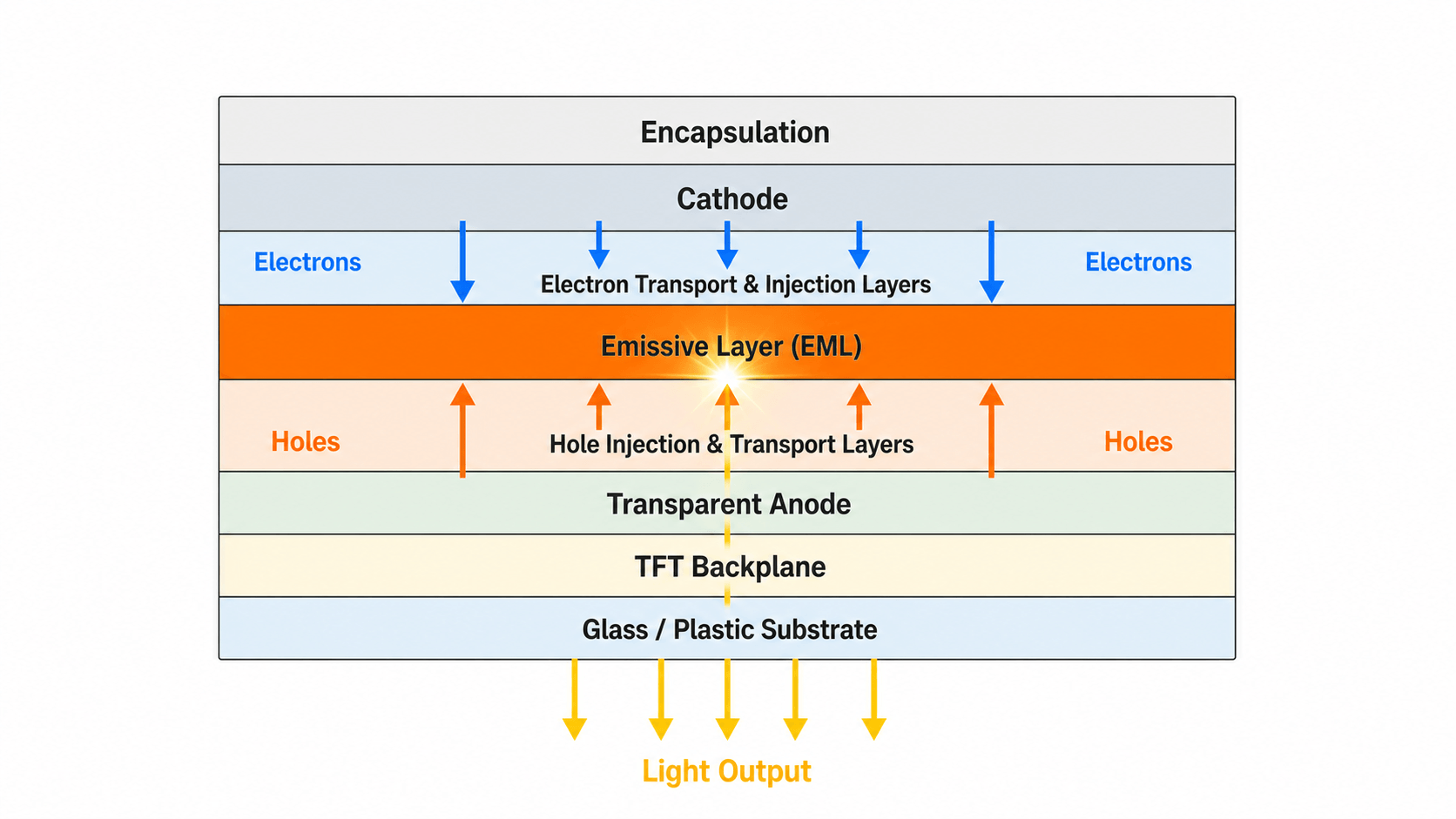
An OLED subpixel contains organic functional layers placed between an anode and a cathode. This light-emitting structure is formed above the TFT backplane and substrate, then sealed by encapsulation to protect the sensitive materials.
When voltage is applied, the anode supplies positively charged carriers called holes, while the cathode supplies electrons. Transport materials guide them toward the Emissive Layer (EML).
When the electrons and holes meet in the EML, they recombine and release energy as visible light. This process is called electroluminescence. Because it takes place inside each subpixel, an OLED display can generate an image without a shared backlight.
The emissive material helps determine the color of the light, while the TFT circuit regulates the current and controls its brightness.
This is the basic process behind OLED light generation. For a closer look at where each layer sits, what it does, and which materials are used, read OLED Display Structure Explained: Layers, Pixels and Materials.
How TFT Circuits Build the Image
The organic layers create light, but they do not decide what the image should look like. That job belongs to the display electronics and the TFT backplane.
Each OLED subpixel is connected to a small driving circuit. The display controller assigns a brightness value to the subpixel, and the TFT circuit regulates the current needed to produce that output.
More current generally makes the subpixel brighter. Reducing the current makes it dimmer, while stopping the current switches it off. The TFT circuit therefore controls light intensity, but it does not create the red, green, or blue color itself.
The display controller continuously updates the subpixel values across the screen, allowing the OLED display to reproduce still images and moving video.
How RGB Subpixels Produce Color
A color pixel commonly contains red, green, and blue subpixels. The final color depends on the relative intensity of all three.
For example, red and green light can combine to produce yellow. Changing their brightness ratio can move the visible result toward red, orange, yellow, or green. Adding different amounts of blue expands the range of possible colors further.
When all three subpixels emit at similar intensities, the pixel may appear white or gray, depending on its overall brightness. When the relevant subpixels are switched off in an opaque OLED, the pixel appears black.
By continuously adjusting the output of the red, green, and blue subpixels, each pixel can reproduce many colors and brightness levels. Repeating this control across millions of pixels creates the complete image.
How Many Colors Can an OLED Display Produce?
There is no single answer to how many colors an OLED display can produce. The result depends on factors such as bit depth, driver electronics, emissive materials, calibration and the supported input signal.
An 8-bit RGB system, for example, provides 256 levels for each red, green, and blue channel. Combining those values gives approximately 16.7 million possible RGB combinations.
That number describes the available digital combinations, not necessarily the display’s visible color accuracy. Accurate reproduction also depends on the panel materials, calibration and signal processing.
Common OLED Subpixel Arrangements
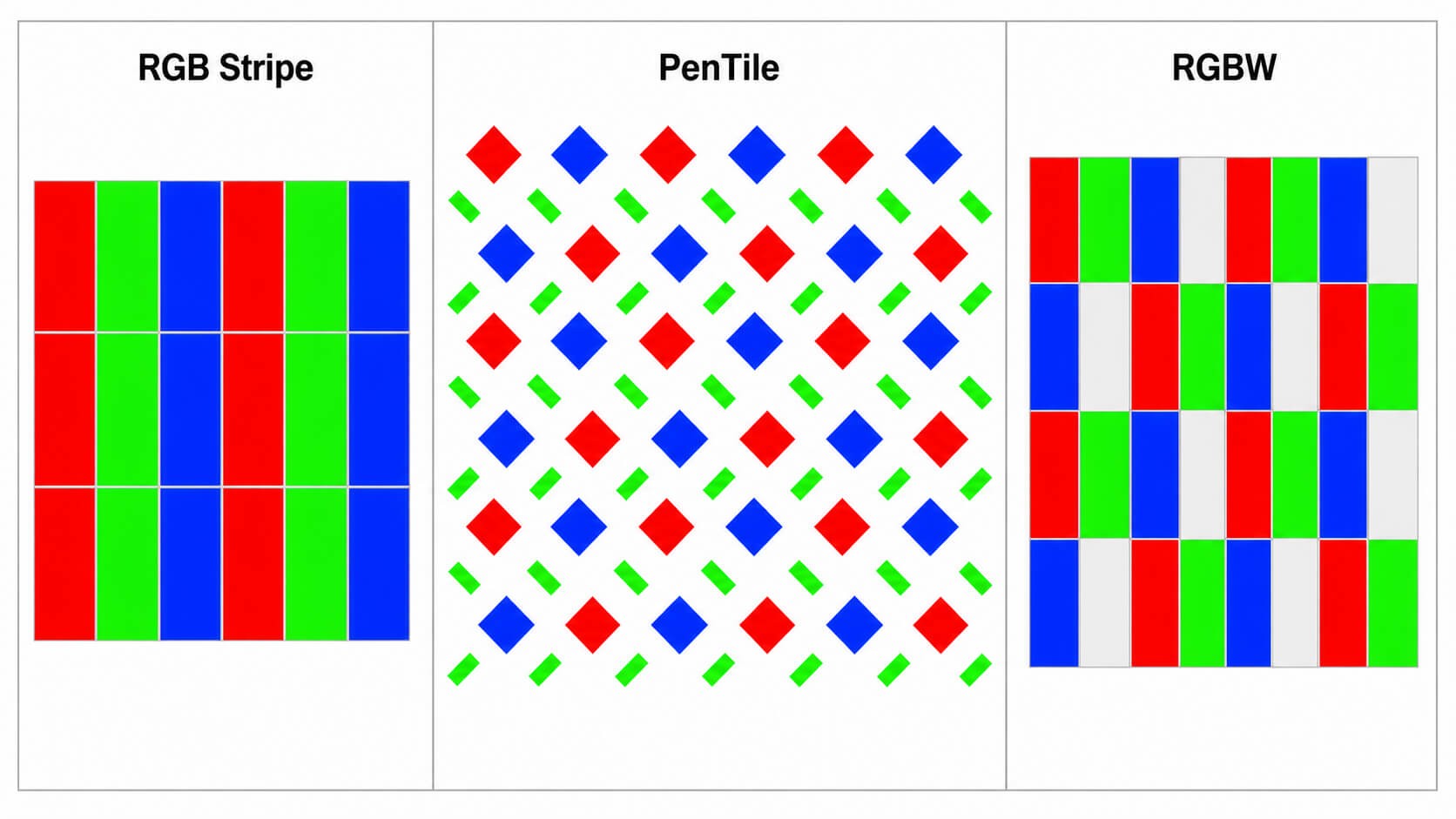
Red, green and blue subpixels do not always sit in the same pattern. Different arrangements use the available panel area in different ways and can affect image detail, brightness and text rendering.
RGB Stripe
In an RGB stripe layout, each logical pixel normally contains separate red, green and blue subpixels arranged in a regular repeating pattern.
Because each pixel has a complete RGB set, the structure provides predictable rendering of text, fine lines and edges. It is straightforward for the display system to map image data to the physical subpixels.
PenTile
A PenTile layout shares some physical subpixels between neighboring logical pixels instead of placing a complete red, green and blue set inside every pixel.
In the common RGBG arrangement, red, green, blue and green subpixels repeat across the panel. This means the panel contains more green subpixels than red or blue ones.
The arrangement takes advantage of the fact that human vision is especially sensitive to green light, which contributes strongly to perceived brightness and detail. It may also allow manufacturers to enlarge the blue subpixels or reduce their driving load, helping to manage the faster aging of blue OLED materials.
The trade-off is a lower physical subpixel count than a full RGB stripe layout at the same stated resolution. At close viewing distances, fine text and high-contrast edges may look less smooth or show slight color fringing. Higher pixel density and effective subpixel rendering can make these effects less noticeable.
RGBW
An RGBW layout adds a white subpixel to the red, green and blue subpixels, forming a repeating four-component pattern.
The white subpixel provides additional luminance, particularly when the screen displays white, gray or other bright content. The colored subpixels continue to provide the required color information.
RGBW can increase brightness and reduce the load on the colored subpixels. However, if the display relies heavily on white output, highly saturated colors may appear less vivid at high brightness levels.
Conclusion
An OLED display produces an image by coordinating millions of self-emitting subpixels. Electrical charges meet inside the emissive material and generate light, while TFT circuits regulate the brightness of each subpixel.
Different intensities of red, green, and blue combine to create the required colors. RGB Stripe, PenTile, and RGBW arrange these color components differently, but they all follow the same fundamental process: individual OLED subpixels generate light, and the display electronics control their output to form the complete image.
FAQ
Does an OLED display need a backlight?
No. Each OLED subpixel produces its own light, so the display does not require the separate backlight used by an LCD.
Does the TFT backplane produce color?
No. The emissive system determines the color of each subpixel. The TFT circuit regulates the current and controls its brightness.
What is the difference between a pixel and a subpixel?
A pixel represents one point in the final image. It is commonly represented by several colored components called subpixels, such as red, green, and blue.
Does every OLED pixel have three independent subpixels?
Not necessarily. An RGB Stripe layout normally provides separate red, green, and blue subpixels for each logical pixel. PenTile and some other arrangements share physical subpixels between neighboring logical pixels.