




An LCD needs a separate backlight because its liquid-crystal layer does not emit light. For a complete explanation of the optical stack and image-forming process, see How Does an LCD Work?.
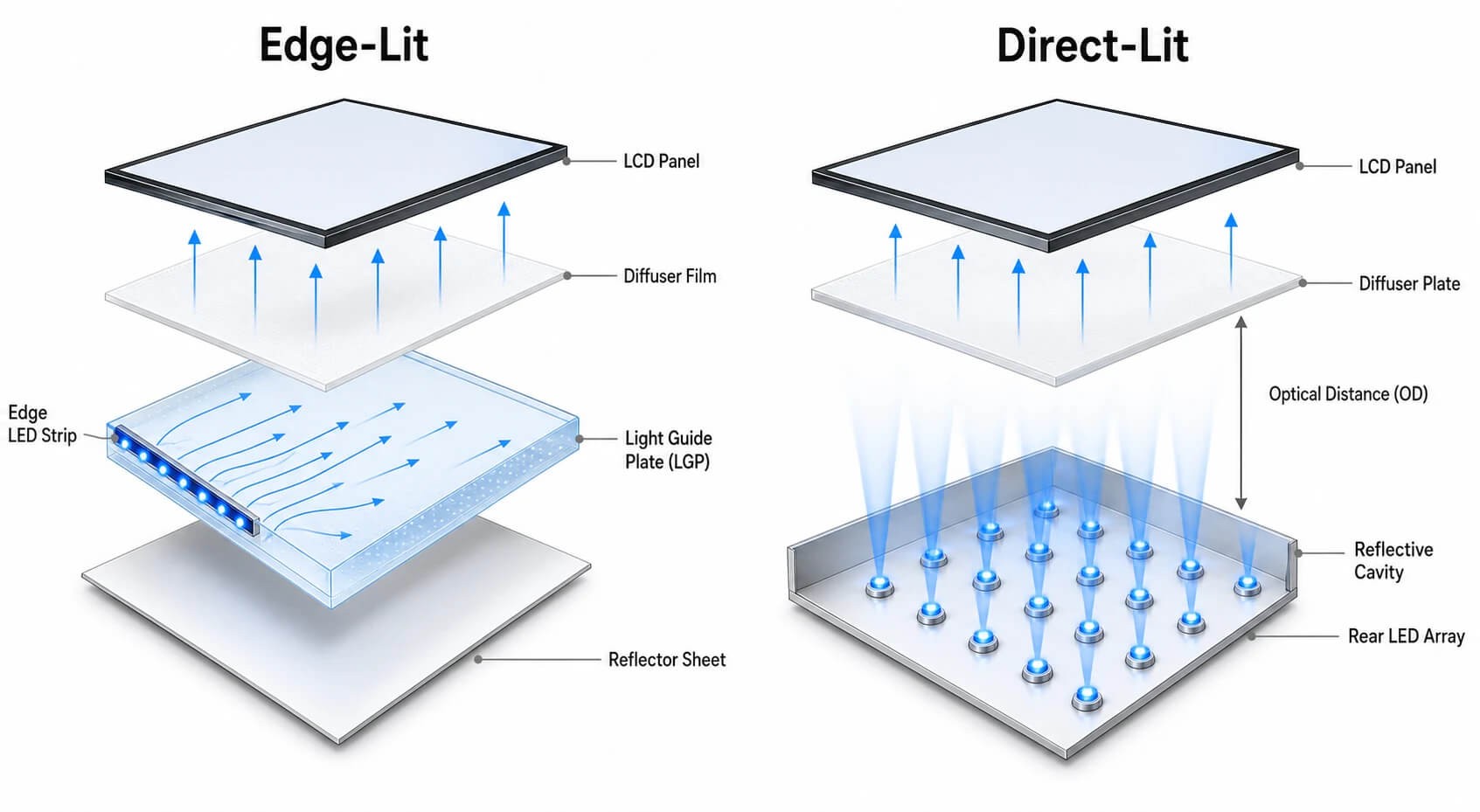
The difference between edge-lit and direct-lit LCD backlights begins with LED placement. Edge-lit systems position LEDs around the panel perimeter and distribute their light through a light guide plate. Direct-lit systems place an LED array behind the active display area.
This structural choice affects display thickness, brightness uniformity, thermal behavior, local-dimming capability, power consumption, and cost. Neither system is universally better: the appropriate design depends on the display size, content, installation space, and expected operating conditions.
What Is an Edge-Lit LCD Backlight?
An edge-lit backlight mounts LED strips along one or more sides of the display. The LEDs emit light into a light guide plate, or LGP, which redirects the light toward the LCD panel.
A reflector sheet returns escaped light in the useful direction, while diffuser and prism films improve uniformity and forward luminance. Because the LEDs are positioned around the perimeter rather than across the rear surface, edge-lit displays can use a relatively shallow enclosure.
This thin structure is useful for wall-mounted displays, narrow kiosks, retail fixtures, and other installations with limited depth. Edge-lit systems may also use fewer LEDs, helping control weight, component count, and cost.
The main engineering challenge is moving light evenly from the edges to the center. The extraction pattern inside the LGP must compensate for optical losses as light travels across the panel. If the light guide, LED output, film alignment, or frame pressure is inconsistent, the display may show bright edges, dark centers, clouding, or corner glow.
These effects become more difficult to control as the display area increases. A larger light guide must transport light over a greater distance while maintaining consistent luminance and color.
What Is a Direct-Lit LCD Backlight?
A direct-lit backlight positions LEDs in rows or an array behind the LCD panel. The light travels through a reflective mixing cavity, diffuser plate, and optical films before reaching the liquid-crystal layer.
Since light sources are distributed behind the image area, Direct-Lit provides a stronger foundation for brightness uniformity. It is particularly useful when large white, gray, or single-color backgrounds need to remain visually consistent.
The trade-off is enclosure depth. Light emitted by each LED initially forms a concentrated bright region. Neighboring light fields must overlap before reaching the diffuser, or individual hotspots and dark gaps may remain visible.
The space required for this mixing is called optical distance, or OD. A wider LED pitch generally requires a longer OD. Reducing the distance normally requires denser LEDs, wider-angle lenses, or stronger diffusion.
Each approach has consequences. More LEDs increase component count and thermal density, while stronger diffusion can reduce optical efficiency. Direct-Lit displays therefore cannot be made arbitrarily thin without changing the LED layout, lens design, optical films, or acceptable uniformity level.
Edge-Lit vs Direct-Lit Comparison
| Engineering factor | Edge-Lit | Basic Direct-Lit | Full-Array Local Dimming |
| LED placement | Along panel edges | Behind the panel | Behind the panel |
| Light distribution | Light guide plate | Rear mixing cavity | Rear mixing cavity |
| Main depth constraint | LGP and edge assembly | LED pitch and optical distance | Optical distance and zone hardware |
| Uniformity challenge | Balancing edge-to-center light | Mixing individual LED sources | Mixing light while limiting zone spill |
| Local dimming | Limited or coarse | Usually absent or basic | Independently controlled zones |
| Thermal concentration | Mainly around the frame | Distributed across the rear | Distributed with added driver heat |
| Typical design priority | Thinness and cost | Uniform illumination | Local contrast and HDR |
These are architectural tendencies rather than guaranteed performance levels. A carefully engineered edge-lit display can be more uniform than a poorly designed direct-lit model.
Why Optical Distance Matters
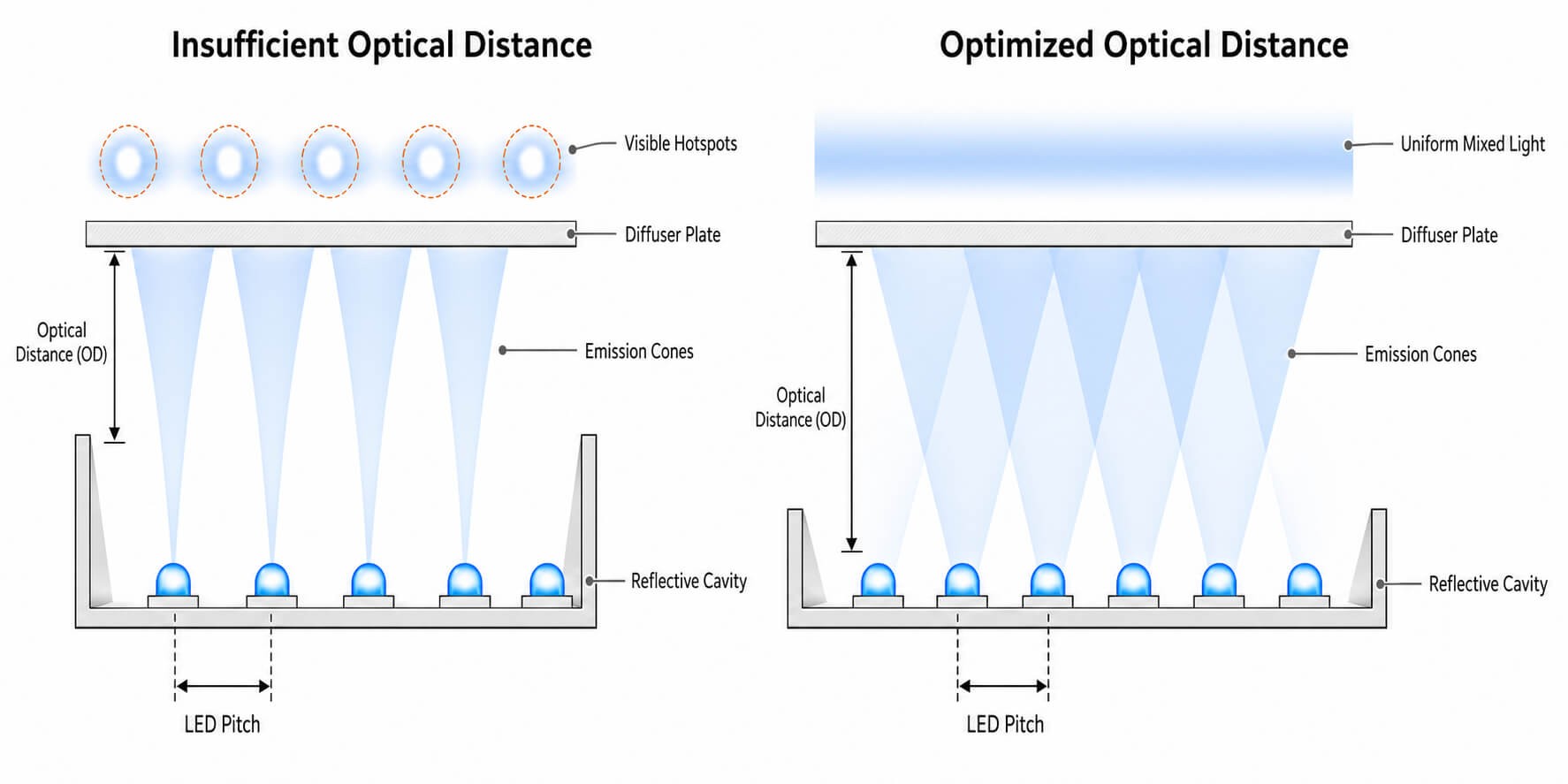
Optical distance is a major physical constraint in direct-lit displays.
If the LED array sits too close to the diffuser, the light does not have enough space to mix. The result may be a visible grid of bright and dark regions. Increasing the distance gives neighboring LED light fields more room to overlap, producing a smoother surface.
Reducing OD while preserving uniformity normally requires smaller LED pitch, more LEDs, wider lenses, or more advanced diffusion. This can increase cost, power density, thermal load, or manufacturing complexity.
Edge-lit systems avoid the same rear mixing-distance requirement because light is distributed inside the LGP. Their thickness is instead determined by the light guide, optical films, LED-strip geometry, frame, and thermal path.
This explains why Edge-Lit remains practical for slim displays even when Direct-Lit offers better large-area uniformity potential.
Brightness Uniformity and Backlight Artifacts
Brightness uniformity describes how consistently luminance is maintained across the display surface.
In an edge-lit LED backlight, uniformity depends strongly on the LGP extraction pattern and the balance of the perimeter LED strips. Variations can appear as edge glow, center dimness, clouding, or corner brightness.
In a direct LED backlight, uniformity depends on LED pitch, optical distance, lens shape, reflective-cavity design, and diffuser performance. An insufficient mixing distance can reveal the underlying LED array.
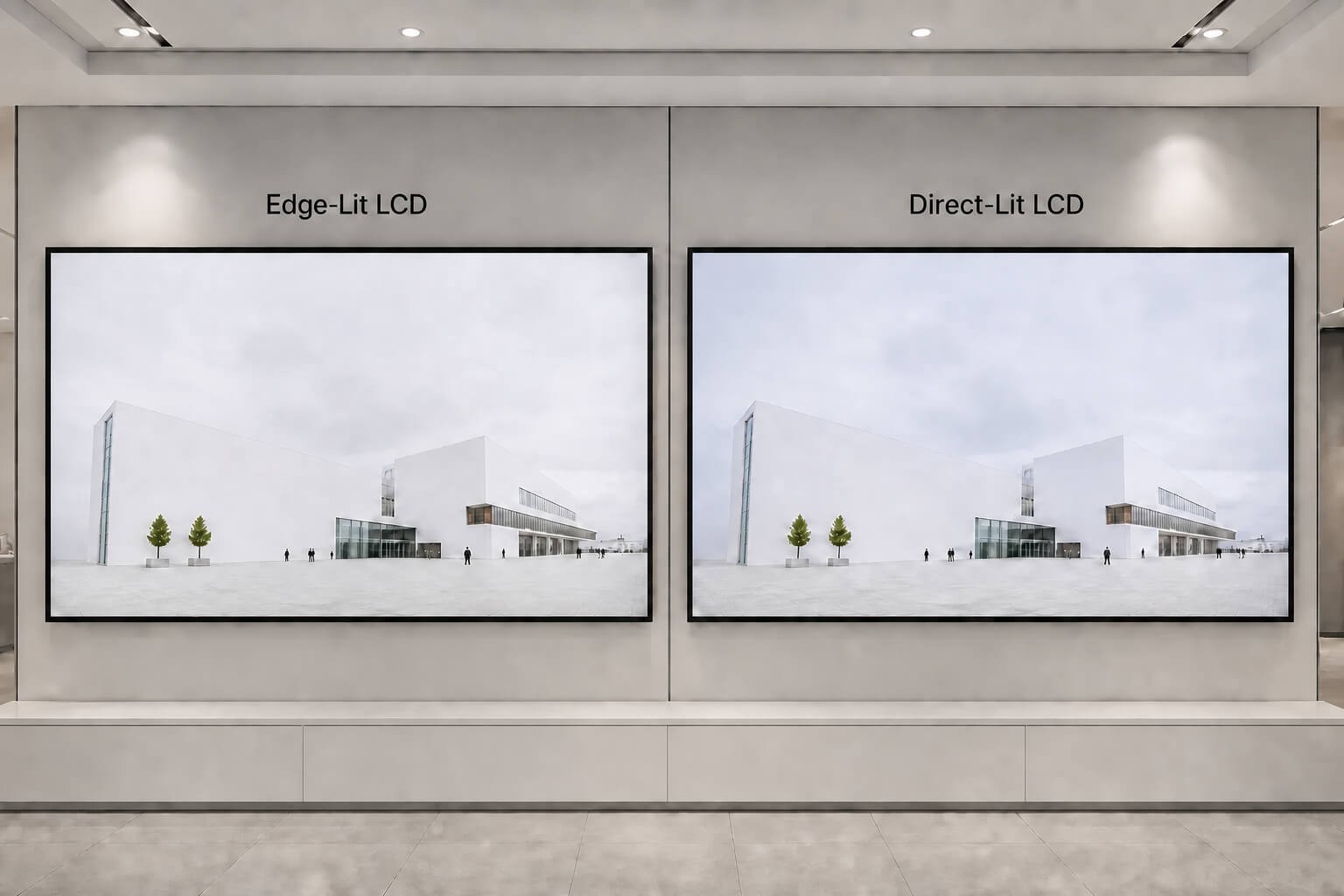
These differences are especially visible on commercial content with large white or gray areas. Menus, information screens, dashboards, and retail graphics often expose subtle luminance variation more clearly than complex video.
Backlight bleed is related but not identical to general non-uniformity. It refers to unintended light visible near an edge or another part of the panel. Frame pressure, assembly tolerances, optical-film alignment, and incomplete light blocking can all contribute to it.
Backlight architecture influences the risk, but it is not the only cause.
Direct-Lit vs Full-Array Local Dimming
Direct-Lit describes where the LEDs are placed. Local dimming describes how they are controlled.
A basic direct-lit display may operate the entire rear LED array as one light source. When an image contains bright and dark regions at the same time, the backlight stays active behind both. The LCD panel must block the unwanted illumination in the dark area.
Full-array local dimming, or FALD, divides the rear backlight into independently controlled zones. The display can lower output behind dark image regions and increase it behind highlights.
This improves scene-dependent contrast, but performance depends on zone size, zone count, LCD native contrast, diffuser spread, and the dimming algorithm. If one zone contains both a bright object and a dark background, excess light may spread around the object.
This effect is known as blooming. When it creates a visible glow around a bright object, it is often described as haloing.
Mini-LED uses smaller LEDs and can support denser arrays with more local-dimming zones. It may provide finer brightness control, but the Mini-LED label alone does not guarantee low blooming or strong HDR performance.
Contrast, Black Level, and HDR
Native contrast is mainly determined by the LCD panel and its ability to block light. The liquid-crystal mode, polarizers, cell structure, and viewing angle all affect the result.
Moving LEDs from the edges to the rear does not automatically improve black level. A basic Direct-Lit system without local dimming continues illuminating the entire panel, including areas intended to appear dark.
FALD can reduce light behind selected dark regions, improving scene-dependent contrast. However, light still spreads within the optical stack, and each zone is normally larger than an individual pixel.
HDR performance therefore depends on more than the words Edge-Lit, Direct-Lit, or Full-Array. Meaningful HDR requires suitable luminance, native panel contrast, local-dimming precision, tone mapping, and signal processing.
For information displays and menu boards, uniformity may be more important than HDR. FALD becomes more relevant for media presentations with bright highlights and dark backgrounds.
Power and Thermal Behavior
Power consumption depends on display size, LED efficiency, target luminance, driver design, image content, and operating settings. Backlight placement determines how light is distributed, while the driver regulates its output. For a closer look at duty cycle, switching frequency, and brightness regulation, see how PWM controls an LCD backlight.
Edge-lit systems may use fewer LEDs, but those LEDs must provide enough output to compensate for losses in the light guide plate. Direct-lit systems may contain more LEDs, although their distributed layout can reduce the distance that light travels before reaching the panel.
FALD may save power in dark content by lowering selected zones. A bright full-screen image activates more of the array and produces a different power result. Power figures are therefore meaningful only when the brightness and image conditions are defined.
Thermal behavior also differs between the two structures. Edge-lit systems concentrate LED heat around the frame. During long operating periods, excessive edge temperature can accelerate LED degradation and disturb the balance of light entering the LGP.
Direct-lit systems spread LEDs across the rear surface, but a larger array and more complex drivers can increase total heat. High-brightness and full-array systems still need an effective thermal path through the rear enclosure.
The relevant question is not simply which backlight runs cooler. It is whether the complete display controls LED and driver temperatures under its intended brightness, ambient temperature, and operating schedule.
Choosing the Appropriate LCD Backlight
Neither Edge-Lit nor Direct-Lit is universally better. The appropriate LCD backlight depends on the mechanical design, required brightness uniformity, thermal conditions, power limits, and expected operating schedule.
Edge-Lit backlights use a light guide plate to distribute light from LEDs positioned along the panel edges. This structure is well suited to slim displays, but light-guide design and heat concentration near the bezel can affect uniformity and long-term performance.
Direct-Lit backlights place an LED array behind the LCD panel. They can provide more direct control over light distribution, although adequate optical distance is needed for proper light mixing. Reducing this distance too far may produce visible bright spots or non-uniform luminance.
Direct-Lit should not be confused with Full-Array Local Dimming. A standard Direct-Lit system adjusts the backlight as a whole, while FALD divides the LED array into independently controlled local dimming zones to improve black levels and HDR performance.
The final choice should therefore be based on the complete display system rather than the backlight label alone. Display thickness, luminance uniformity, thermal management, contrast requirements, power consumption, serviceability, and installation conditions must all be considered together.
If you are evaluating an LCD display for a specific installation, contact RusinDisplay to discuss the required brightness, operating environment, installation depth, content, and expected operating schedule.
FAQ
Is Direct-Lit always better than Edge-Lit?
No. Direct-Lit provides a stronger foundation for uniform illumination, but the final result depends on LED pitch, OD, diffuser design, panel quality, calibration, and thermal control.
Is Full-Array the same as Direct-Lit?
Full-Array is a Direct-Lit architecture, but not every Direct-Lit display has local dimming. A basic rear LED array may still operate as one backlight.
Can an Edge-Lit LCD support local dimming?
Yes, but the LGP spreads light laterally, limiting how precisely small image regions can be controlled. Edge-lit dimming generally operates over broader strips or regions.
Does Edge-Lit always consume less power?
No. LED count is only one factor. Luminance, optical efficiency, panel size, driver design, content, and brightness settings determine actual consumption.
Is Mini-LED the same as FALD?
Mini-LED is commonly used to create denser full-array backlights. It can support more zones, but performance still depends on optical design, dimming algorithms, thermal control, and the LCD panel.