




Commercial displays are usually designed around standard formats such as 16:9. This format works well for general signage, monitors and video content, but many real-world installation environments are not built around a standard rectangle.
A retail shelf may have only limited vertical space available for digital content. A subway carriage may offer a long horizontal area above passenger seating. Industrial equipment may require a display that fits into a narrow control section without changing the machine structure.
In these projects, the challenge is not simply selecting a larger screen. The display format itself becomes part of the engineering requirement.
A stretched bar LCD display provides an ultra-wide, low-profile solution for locations where traditional LCD screens cannot use the available space efficiently. By matching the screen shape to the installation environment, businesses can add digital information without redesigning the surrounding structure.
Why Standard LCD Formats Do Not Always Work in Commercial Projects
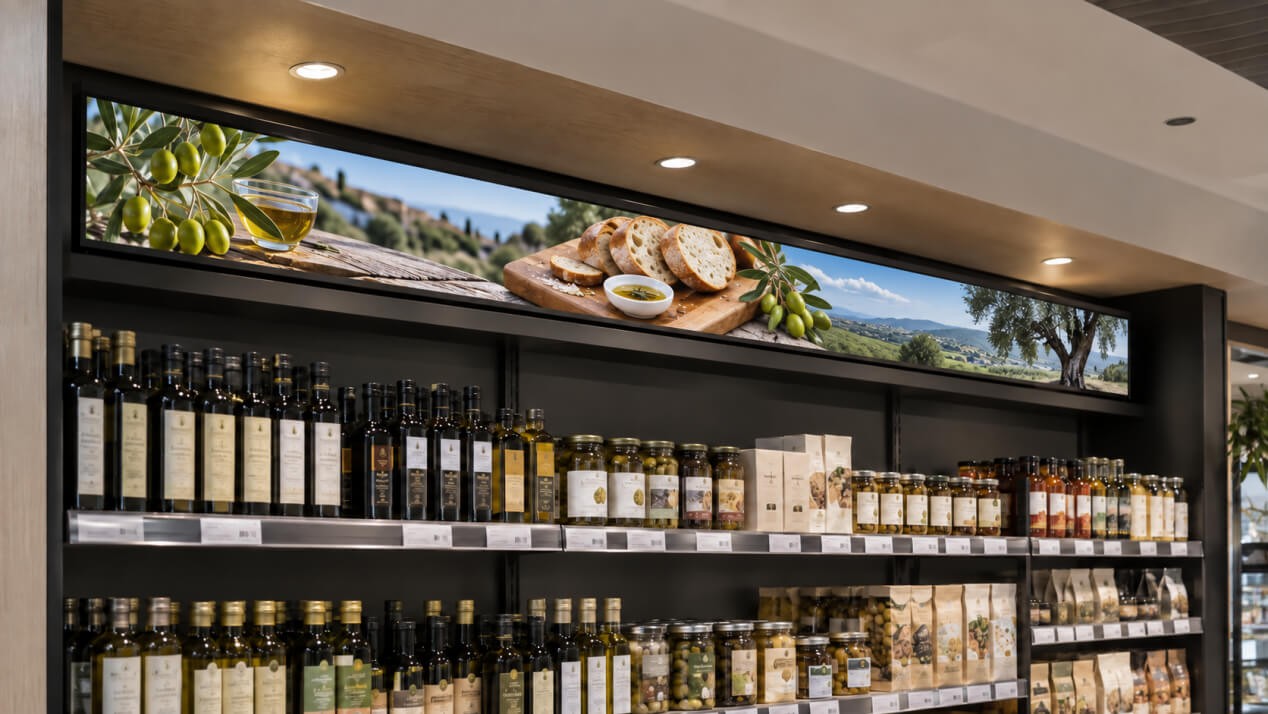
Traditional LCD displays are optimized around common aspect ratios because they support a wide range of general applications. However, commercial environments often have fixed layouts that cannot easily accommodate standard screens.
For example, a retail fixture may prioritize product visibility, leaving only a narrow horizontal area for digital content. A transportation interior may have sufficient width but very limited height because the available space is already occupied by lighting, luggage areas or structural components.
Installing a conventional display in these locations can create several problems:
- unused mounting space;
- poor visual integration;
- unnecessary structural modifications;
- reduced product or passenger space.
A stretched LCD display approaches the problem from a different direction. Instead of adapting the environment to a standard screen, the display format is designed around the available installation area.
What Is a Stretched Bar LCD Display?
A stretched bar LCD display is an ultra-wide LCD screen with a narrow vertical profile and a customized aspect ratio.
Unlike conventional commercial monitors, which usually follow fixed proportions, stretched LCD displays are developed for applications where horizontal information presentation is more important than traditional screen height.
Typical installations require a combination of:
- extended horizontal viewing area;
- compact vertical dimensions;
- application-specific resolution;
- integration with commercial display systems.
The result is a display format that can deliver digital content in locations where a normal 16:9 monitor would be too large, visually unbalanced or physically impossible to install.
Where Stretched Bar LCD Displays Create the Most Value
The strongest applications for stretched LCD displays are not determined by industry alone. They are defined by environments where available space and information requirements do not match standard screen formats.
Retail Shelf and Product Display Applications
Retail environments are one of the clearest examples.
Modern stores increasingly use digital content to communicate product information, promotions and brand messaging, but shelf areas are already highly optimized for merchandise.
A traditional monitor may occupy too much vertical space or interfere with product visibility. A shelf edge LCD screen can integrate into the existing shelf structure while providing dynamic digital content close to the purchasing decision point.
Compared with electronic shelf labels (ESL), stretched LCD displays serve a different purpose. ESL systems focus on simple information updates such as pricing, while LCD-based shelf displays support richer content including images, promotional videos and branded visual communication.
This makes stretched LCD suitable for retail projects where digital engagement is more important than simple text updates.
Transportation and Passenger Information Displays
Transportation systems often contain long horizontal areas that naturally match the geometry of stretched displays.
Inside trains, subway cars and public facilities, available installation locations are usually determined by existing architecture rather than display requirements.
A long narrow LCD format can provide:
- route information;
- station updates;
- passenger announcements;
- advertising content.
Compared with large LED systems designed for long-distance viewing, stretched LCD displays are better suited for close-range viewing where text clarity and detailed information are important.
Industrial and Embedded Display Applications
Industrial equipment creates another type of display challenge.
Machines, control panels and specialized equipment often have fixed dimensions that leave little flexibility for adding a standard monitor.
A custom stretched LCD display can be designed around the available opening, allowing manufacturers to integrate visual interfaces without changing the overall equipment structure.
These applications often require additional customization, including enclosure design, mounting solutions and interface compatibility.
Why Stretched LCD Projects Usually Require Custom Engineering
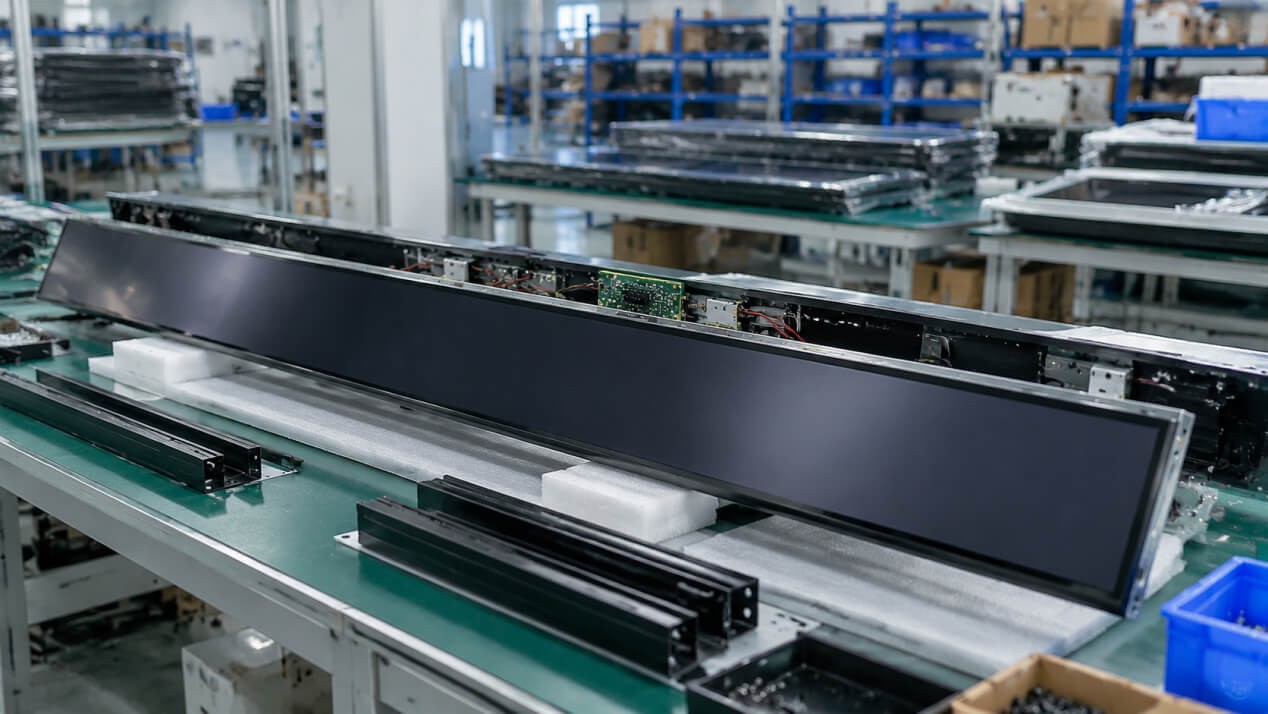
A stretched bar LCD display is rarely just a different screen size. Commercial projects often require custom display solutions that combine panel selection, electronics integration and mechanical design.
The LCD panel selection determines which dimensions, resolutions and aspect ratios are practical for production. Ultra-wide formats may require specific panel availability and customized resolution planning.
The display electronics also need to support the selected format. Controllers, video inputs and content systems must handle the unusual resolution correctly to avoid image distortion or incorrect scaling.
Mechanical design is equally important. A shelf display, transportation monitor and industrial interface may use similar LCD technology but require completely different housings, mounting methods and environmental protection.
For this reason, stretched LCD solutions are often developed as complete display systems rather than standalone panels.
Stretched LCD vs Standard LCD, LED and ESL: Choosing the Right Technology
Different display technologies are designed for different project requirements.
| Project Requirement | Recommended Display |
| General commercial signage | Standard LCD |
| Narrow installation space with dynamic content | Stretched Bar LCD |
| Large outdoor advertising and long viewing distance | LED Display |
| Simple price information updates | ESL |
A stretched LCD display is particularly valuable when three conditions exist:
- The installation space has unusual dimensions.
- The audience views the content relatively close.
- Detailed information or visual content is required.
When these conditions are not present, other display technologies may provide a more suitable solution.
How to Select a Stretched Bar LCD Display
RusinDisplay provides customized stretched LCD display solutions, including panel selection, structural integration and application-specific designs for retail, transportation and industrial projects.
Installation Dimensions
The available width, height and mounting depth determine the possible display format.
Projects with long horizontal areas may require an ultra-wide stretched LCD monitor, while embedded equipment may require a more compact custom ratio.
Viewing Distance and Content Requirements
The viewing distance affects resolution requirements.
Applications displaying detailed text, such as transportation information systems or industrial interfaces, require sufficient pixel density.
Marketing displays may place more emphasis on visual impact and content presentation.
System Integration
Commercial stretched displays often need to work with additional systems, including:
· Android platforms;
· CMS software;
· media players;
· custom mounting structures.
A successful installation requires the display hardware and surrounding system to work together.
Common Stretched Bar LCD Applications
| Application | Typical Purpose |
| Retail shelves | Product information and promotional content |
| Subway and train interiors | Passenger information and advertising |
| Elevators | Compact digital signage |
| Industrial equipment | Embedded control interfaces |
| Public facilities | Information and wayfinding displays |
Conclusion
Across retail shelves, transit carriages, and industrial control consoles, the design challenge is ultimately the same: rigid architectural boundaries leave no room for conventional 16:9 displays. Stretched bar LCDs solve this conflict by adapting directly to the existing structural envelope, delivering dynamic visuals without requiring disruptive modifications.
Because tight physical spaces leave little margin for error, locking in the correct aspect ratio, resolution, and mounting mechanics early in the project is critical to smooth installation and long-term reliability.
For projects requiring unusual dimensions or application-specific designs, RusinDisplay works with customers to develop customized commercial display solutions.
FAQ
What is a stretched bar LCD display?
A stretched bar LCD display is an ultra-wide LCD screen with a narrow height designed for commercial environments where standard display formats cannot fit efficiently.
What are stretched LCD displays used for?
Stretched LCD displays are commonly used in retail shelves, transportation systems, industrial equipment, digital signage and public information applications.
Is a stretched LCD the same as a cropped standard LCD?
No. Commercial stretched LCD solutions usually require customized panel selection, resolution configuration, controller support and mechanical integration.
Can stretched bar LCD displays be customized?
Yes. Custom stretched LCD displays can be developed with specific dimensions, aspect ratios, mounting structures and system configurations.
What is the difference between stretched LCD and ESL?
ESL systems are designed for low-power electronic price updates, while stretched LCD displays support richer visual content such as images, animation and video.