




A self-adhesive transparent LED display film is a thin PET-based display that bonds directly to glass. The LEDs and drivers sit within the film, so the installation does not need a conventional LED cabinet or heavy support frame.
It suits shop windows, glass curtain walls, showrooms and atriums where an opaque screen would block daylight or the view. The glass remains transparent around the illuminated pixels, although the film and circuit pattern remain visible at close range.
RusinDisplay supplies Transparent LED Film in P4, P5, P6, P8 and P10 versions. The standard film is 2.5 mm thick, weighs no more than 3.5 kg/m² and uses a self-adhesive backing for direct glass installation.
Install It on the Inside Face of the Glass
The film is installed on the room side of the glass and faces outward through the window. RusinDisplay Transparent LED Film carries an IP30 rating, so it is not intended for the rain-exposed exterior face.
Dark tint, reflective coatings and laminated glass can reduce the light that reaches an outdoor viewer. Check the complete glass build-up rather than choosing brightness from the film specification alone. A sample viewed through the project glass is especially useful for sunlit or highly reflective façades.
Which Pixel Pitch Should You Choose?
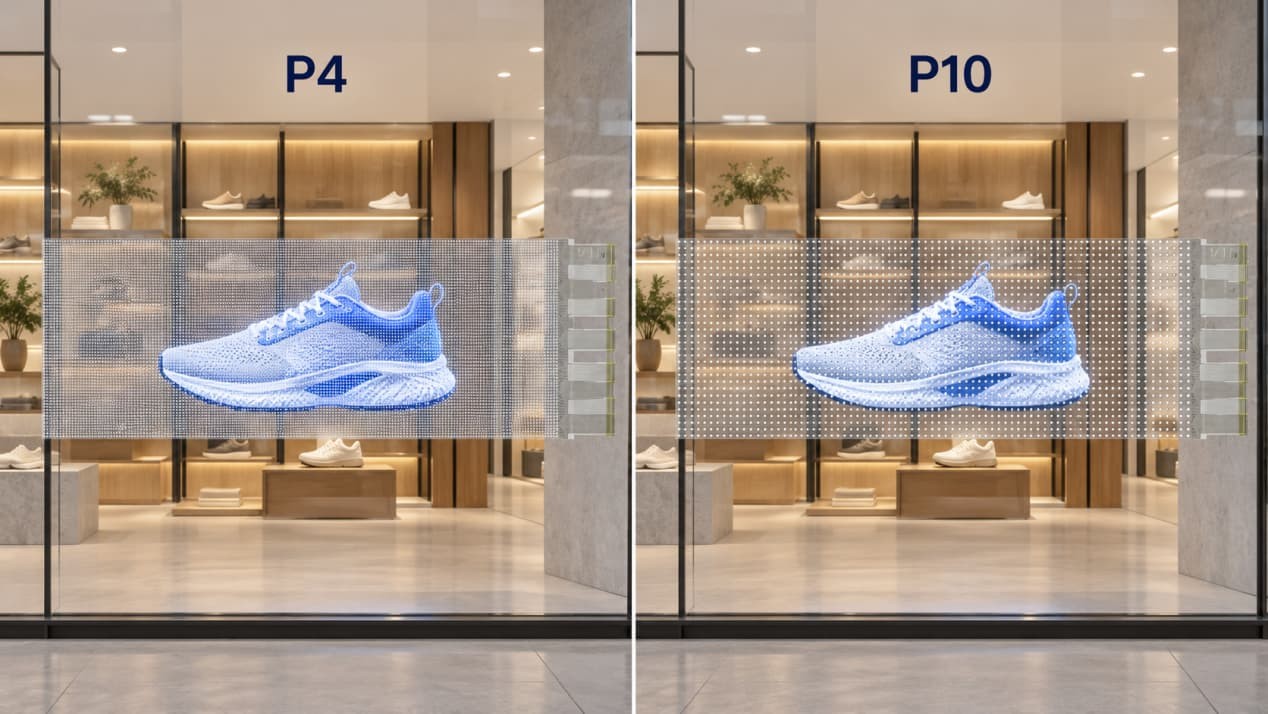
Pixel pitch controls image detail and pixel density. Finer pitches suit closer viewing and detailed product imagery. Coarser pitches favor transparency and larger graphics viewed from farther away.
| Model | Pixel pitch | Pixel density | Brightness | Transparency |
| RUS-LED-TLF-P4 | 4 × 4 mm | 62,500 px/m² | ≥1,500 nits | ≥85% |
| RUS-LED-TLF-P5 | 5 × 5 mm | 40,000 px/m² | ≥2,000 nits | ≥85% |
| RUS-LED-TLF-P6 | 6 × 6 mm | 27,556 px/m² | ≥3,000 nits | ≥85% |
| RUS-LED-TLF-P8 | 8 × 8 mm | 15,625 px/m² | ≥3,500 nits | ≥85% |
| RUS-LED-TLF-P10 | 10 × 10 mm | 10,000 px/m² | ≥3,500 nits | ≥90% |
Choose P4 when people will see detailed content from relatively close range. Choose P8 or P10 when an open view through the glass and long-distance impact matter more than fine detail. P5 and P6 cover the middle ground.
The brightness requirement comes from the window conditions, even though the film stays indoors. Daylight and reflections on the outer glass can wash out the picture. P6, P8 and P10 provide the higher-output options in this range, but the final choice should still be checked through the actual glazing.
How the Film Fits the Glass
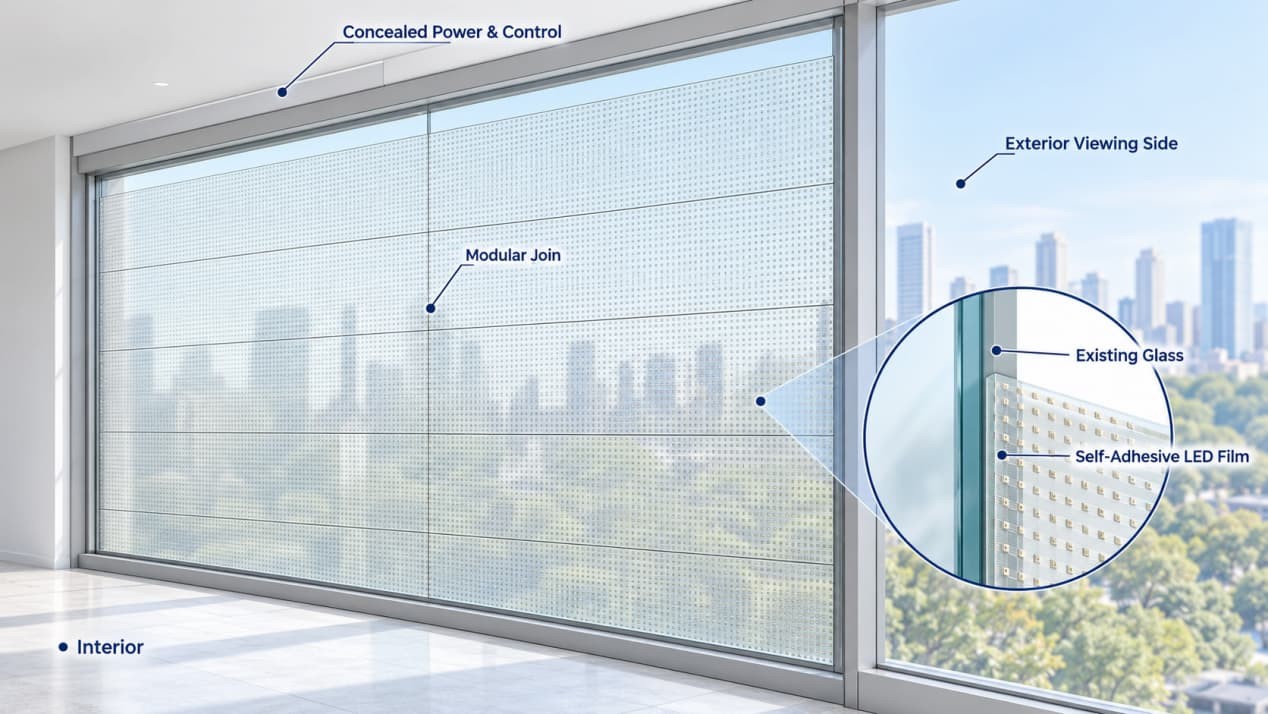
Standard modules are 240 mm high and come in lengths of 1,000, 1,200 or 1,500 mm. They can be joined horizontally and vertically, allowing the display area to follow the window dimensions and content format.
Cutting is limited to preset cutting lines. Installers cannot trim freely around every fitting or irregular corner, so custom shapes must be planned against the permitted cut positions before production.
The film can bend for suitable curved-glass installations, subject to a review of the actual radius. Power boxes, control hardware and cable routes need a concealed location nearby. Reserve that space in the ceiling, mullion or surrounding joinery before the glass installation is finalized.
Transparent LED Film vs. Holographic LED Film
Both types use self-adhesive transparent modules and support modular assembly across larger glass areas. The main difference is how visible the display structure remains.
Transparent LED Film covers P4 through P10, with 85% to 90% transparency. Its broader pitch range suits retail windows, architectural glazing and branded display areas.
Holographic LED Film is 2 mm thick and reaches 92% to 95% transparency in P3.91, P6.25 and P10.42 versions. Choose it when keeping the display structure as unobtrusive as possible is the priority. “Holographic” describes the floating visual effect on transparent glass; the product remains an LED film rather than a volumetric hologram.
What RusinDisplay Needs to Prepare a Layout
Provide the glass width and height, site photographs, indoor mounting face and main viewing direction. Viewing distance, daylight exposure, glass tint and content type are enough to narrow the pixel pitch and brightness options.
The drawing should also mark space for power, control hardware and maintenance access. RusinDisplay can then arrange the modules around the glazing instead of forcing a standard rectangle into the opening.
For a custom Transparent LED Film layout, send RusinDisplay the glass dimensions, site photographs and expected viewing distance. The team can recommend a pitch and prepare a module plan around the available glazing.
FAQ
Can self-adhesive transparent LED display film be installed outside?
No. RusinDisplay Transparent LED Film is installed on the interior face of the glass and viewed from outside through the window. Its standard IP30 construction is not designed for direct rain exposure.
Can transparent LED film be cut to any shape?
No. It can only be trimmed along preset cutting lines that avoid the LEDs and conductor paths. Irregular layouts should be planned before production.
How do I choose between P4 and P10?
P4 provides higher pixel density for closer viewing and more detailed content. P10 leaves more open space between pixels, making it suitable when transparency and longer-distance viewing are more important.
Can multiple LED film modules form a larger display?
Yes. Standard modules can be joined horizontally and vertically across a larger glass area. The glass dimensions, mullion positions and content ratio should be considered when planning the module layout.
Can the film be installed on curved glass?
The flexible film can follow suitable curved surfaces, but the glass radius must be reviewed before production. Flexibility does not mean the film can be folded sharply or fitted to every compound curve.
What is the difference between Transparent LED Film and Holographic LED Film?
Transparent LED Film offers P4 to P10 options with 85%–90% transparency. Holographic LED Film is thinner and offers 92%–95% transparency, making the display structure less noticeable on the glass.