




I. How Instrument Panels Evolved from Mechanical Gauges to Digital Clusters
Vehicle instrument panels have shifted from simple mechanical indicators to fully digital information systems. Early dashboards relied on physical needles and static backlighting to display speed, RPM, and fuel levels. These systems were durable but limited in flexibility.
Hybrid clusters introduced small LCD modules into analog layouts. This allowed digital readouts while retaining mechanical components.
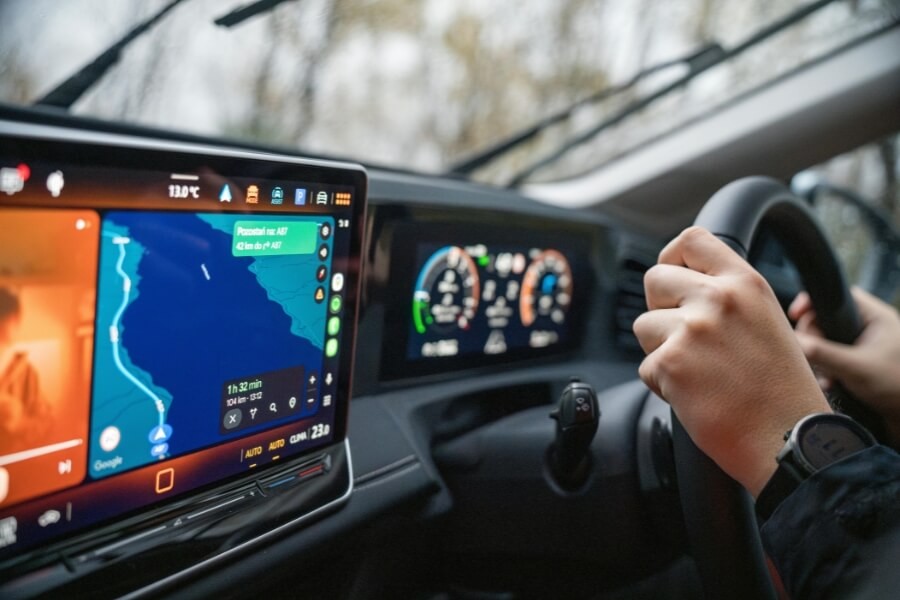
Today, the Digital Instrument Cluster Display, or ICD, replaces mechanical parts entirely. A single LCD or OLED panel now functions as the central Human Machine Interface within the cockpit. The display is no longer just an indicator. It is an adaptive control and information platform.
This evolution improves clarity and design freedom. More importantly, it improves how drivers access and prioritize information in real time.
II. TFT LCD vs OLED – Choosing the Right Technology for Instrument Panels
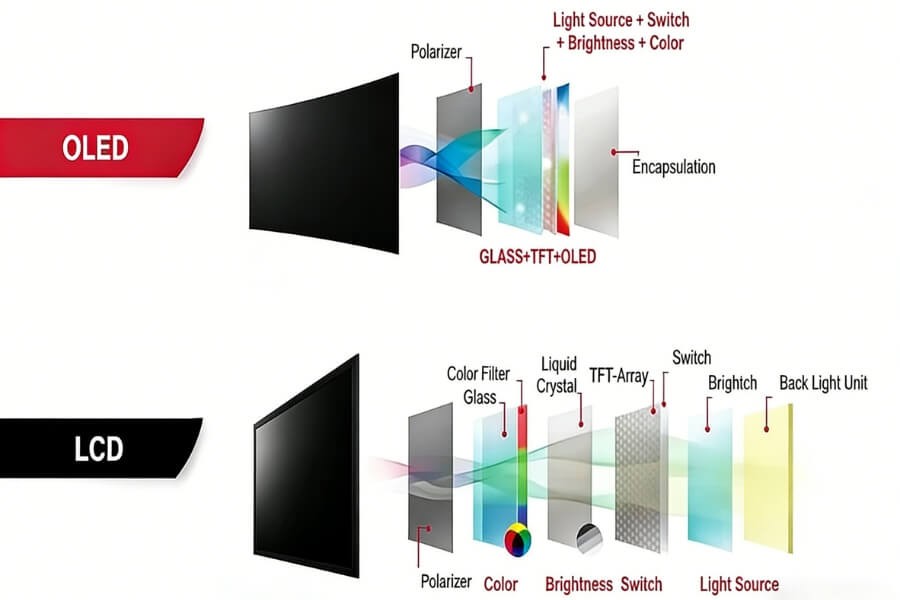
Modern instrument clusters primarily rely on two display technologies. Each serves different performance and design priorities.
TFT LCD – Proven Stability and High Brightness Performance
Thin Film Transistor LCD remains the most widely adopted automotive solution.
Key advantages include:
- Mature supply chain and cost efficiency
- High brightness capability, typically 1000 to 1500 nits for sunlight-readable applications
- Stable operation across wide temperature ranges, often -40°C to 85°C
High brightness ensures visibility under direct sunlight. Without sufficient luminance, display content appears washed out and reduces safety. For open vehicles such as ATVs, UTVs, and marine systems, 1200 nits or higher is often required.
TFT LCD also supports long backlight lifetime and predictable aging behavior. This reduces maintenance risk over extended vehicle use.
Limitations include reliance on a backlight structure and moderate contrast performance compared to emissive displays. Complex curved or irregular shapes require additional structural design considerations.
OLED – High Contrast and Design Freedom
OLED panels emit light at the pixel level.
Key strengths include:
- True black levels and high contrast
- Wide viewing angles
- Fast response time for smooth motion rendering
- Flexible substrate compatibility for curved clusters
OLED is ideal when interior design integration and visual impact are top priorities. It supports seamless dashboard curvature and ultra-thin profiles.
However, projects must consider:
- Higher material and manufacturing cost
- Risk of image sticking under prolonged static display
- Brightness limitations compared to high-power TFT LCD
OLED suits high-end or design-driven models. TFT LCD remains the dominant choice for reliability-focused and cost-controlled programs.
Technology Convergence – The Role of Transparent OLED
Transparent OLED introduces a new interface concept. It allows digital data to overlay physical materials without fully blocking visibility.
In automotive environments, this supports layered visual design. In commercial environments, it enables virtual content to coexist with physical products.
This shift moves displays from flat information surfaces toward integrated spatial interfaces.
III. What Makes a Digital Instrument Cluster Reliable and Effective
A digital cluster must do more than display graphics. It must operate reliably in demanding environments while maintaining clear readability.
Flexible Layout and Real-Time Information Control
Digital clusters enable fully reconfigurable layouts.
Drivers can switch between sport, eco, or comfort modes. Each mode reorganizes information hierarchy.
If a critical event occurs, such as sudden tire pressure loss, the system can immediately prioritize warning content. Color, size, and layout adjust automatically. This improves response time and enhances safety.
Mechanical gauges cannot dynamically change information priority. Digital systems can.
Brightness, Contrast, and Environmental Stability
Optical performance directly affects safety.
Key requirements include:
- Automatic brightness adjustment through ambient light sensors
- Smooth transition from low luminance at night to high luminance in daylight
- Support for Positive and Negative display modes
Positive mode improves daytime readability. Negative mode reduces glare during night driving.
For instrument panels, recommended brightness ranges are:
- 800 to 1000 nits for enclosed vehicle cabins
- 1200 nits or higher for open or high-glare environments
Contrast ratio also matters. Higher contrast improves symbol clarity when ambient light interferes.
Environmental stability is equally important. Displays must withstand wide temperature variation, continuous vibration, UV exposure, and humidity changes. Reliable bonding structures and anti-glare surface treatments reduce reflection and maintain readability.
Integrated Touch and Multi-System Data Display
Touch-enabled clusters reduce mechanical button complexity.
A single region can operate as climate control in one state and navigation display in another. This improves space utilization and simplifies wiring.
Modern clusters integrate:
- Speed, RPM, fuel, battery data
- ADAS alerts
- Navigation maps
- Multimedia systems
- Rear and surround camera feeds
Centralized display improves information management and reduces dashboard clutter.
Automotive-Grade Optical and Durability Requirements
Automotive displays must meet strict performance standards.
Critical parameters include:
- Uniform luminance across the entire panel
- Accurate color reproduction for warning symbols and navigation cues
- Stable viewing angles without color shift
- Low flicker to prevent eye fatigue
- Fast response time for smooth transitions
Common defects such as Mura, pixel failure, line defects, or light leakage must be tightly controlled. Consistent optical quality directly affects driver perception and trust.
How Display Performance Is Tested and Verified
Accurate measurement ensures consistency from development to mass production.
Two primary methods are used:
- Imaging photometers or colorimeters for uniformity, defect detection, and spatial analysis
- Spot spectroradiometers for gamma and flicker measurement
Combining both provides a complete validation system. Imaging systems capture full-screen data in a single measurement. Spot instruments offer high-speed temporal accuracy.
Reliable testing ensures that performance under laboratory conditions translates to real-world operation.
IV. How Instrument Display Technology Extends to Commercial Environments
The engineering principles behind instrument panel LCDs apply beyond automotive environments. High reliability, high brightness, and stable color performance are equally important in commercial spaces.
Examples include:
- Ultra-narrow bezel LCD video walls in retail environments
- Transparent OLED displays integrated into storefront windows
- Modular LCD and fine-pitch LED systems in corporate showrooms
- Digital signage in hospitality spaces
In both automotive and commercial projects, the objective is the same. Information must remain clear under varying ambient conditions.
AI-enabled systems can further enhance interaction. Sensors and algorithms adjust content dynamically based on audience presence or context.
Transparent display technology supports hybrid physical-digital environments. It enables layered visual communication without blocking structural elements.
V. The Future of Instrument Panel Displays
Display technology is moving toward deeper integration with control systems. Lower latency improves real-time data feedback. AI-driven layout optimization enhances safety and usability.
In commercial applications, real-time analytics guide adaptive content strategies.
Flexible OLED, Transparent OLED, and emerging Micro-LED technologies suggest a future where surfaces function as intelligent interfaces. As manufacturing matures, advanced display experiences will become more cost-accessible. The long-term balance between reliability, brightness, durability, and cost will determine technology adoption across segments.
FAQ
Q1: What is a Digital Instrument Cluster Display and how does it differ from traditional gauges?
A Digital Instrument Cluster Display replaces mechanical needles and static dials with programmable LCD or OLED panels. It allows fully reconfigurable layouts, integrates navigation and safety alerts, and dynamically adjusts information priority. Unlike traditional gauges, it centralizes multiple systems into one adaptive visual interface.
Q2: Why do automotive displays require brightness levels above 1200 nits?
Automotive displays must remain readable under direct sunlight. When brightness is too low, ambient light reduces contrast and washes out critical information. A brightness level around 1200 nits or higher ensures stable visibility in open or high-glare environments, improving driver safety and response time.
Q3: Is OLED better than LCD for instrument panels?
Each technology serves different priorities. TFT LCD provides high brightness, long lifetime, and cost stability, making it suitable for reliability-focused programs. OLED offers superior contrast, fast response, and flexible design options. The choice depends on performance requirements, environmental conditions, and project budget.
Q4: How should commercial projects choose between LCD video walls and Transparent OLED?
LCD video walls work best for full-surface, high-impact visual environments. Transparent OLED is suitable when digital content must coexist with physical objects or architectural structures. The selection depends on whether the goal is immersive visual dominance or layered physical-digital integration.
Q5: What optical parameters define high-quality display performance?
Key performance metrics include brightness, luminance uniformity, contrast ratio, color accuracy, viewing angle stability, and effective anti-glare treatment. Low flicker and stable response time are also critical to ensure consistent readability and long-term visual reliability.
RUSINDISPLAY provides professional OLED, Transparent Display, and Indoor LCD solutions engineered for stable brightness, optimized contrast, and long-term reliability. Our systems support demanding environments across automotive-inspired and commercial applications. With advanced optical design, integration expertise, and responsive technical support, RUSINDISPLAY helps clients implement display systems that balance performance, durability, and cost efficiency while delivering measurable visual impact.