




Why Backlight Control Determines Commercial Display Performance
In commercial environments, display performance is not defined by brightness alone. Retail video walls, digital signage columns, and interactive LCD systems must deliver stable contrast, accurate color reproduction, long viewing comfort, and controlled energy consumption.
All of these outcomes depend on one fundamental factor — how precisely the LED backlight is controlled.
Pulse Width Modulation, or PWM, is the core mechanism that regulates LCD backlight brightness. When properly engineered, PWM stabilizes image quality, protects visual comfort, and improves system efficiency.
At RUSINDISPLAY, PWM calibration is treated as a structural design parameter rather than a secondary feature. Whether deployed in modular LCD video walls or large-format interactive displays, backlight control is engineered to ensure uniform brightness, flicker stability, and predictable long-term operation.
How PWM Controls LCD Backlight Brightness
How PWM Actually Works in LCD Backlights
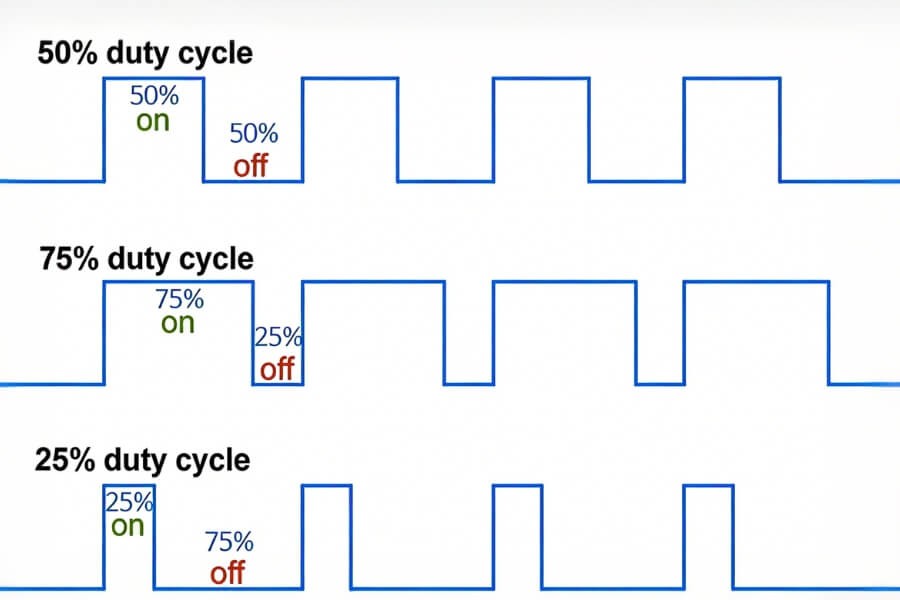
PWM regulates brightness by switching the LED backlight on and off at high speed. The switching occurs fast enough that the human eye perceives continuous illumination.
Brightness is controlled by adjusting the duty cycle — the percentage of time the LED remains ON during each cycle. A higher duty cycle increases average current and perceived brightness, while a lower duty cycle reduces it.
The instantaneous current amplitude does not change. This ensures consistent LED color temperature across the dimming range, which is critical in commercial environments where brand colors must remain accurate.
Choosing the Right PWM Frequency for Flicker-Free Viewing
PWM frequency directly influences visual stability.
- Below 50 Hz, visible flicker occurs
- 60–240 Hz represents early-generation implementations
- Professional commercial LCD systems typically operate above 1 kHz
- Premium systems may exceed 20 kHz to eliminate perceptible flicker
For high-traffic retail spaces and exhibition halls where viewers observe screens for extended periods, frequency selection affects comfort and fatigue.
Higher frequency reduces flicker visibility, but it also increases switching complexity and potential EMI. In large LCD projects, PWM frequency should be evaluated during specification and procurement rather than after installation.
Why Duty Cycle Resolution Affects Image Smoothness
PWM resolution determines how finely brightness can be adjusted.
10-bit PWM provides 1024 brightness levels.
16-bit PWM enables ultra-smooth grayscale transitions.
Higher resolution reduces visible stepping in dark environments such as museums or luxury retail settings. It also improves gradient uniformity in background graphics.
In commercial LCD video walls, this directly impacts perceived image refinement and brand presentation quality.
PWM vs Analog Dimming — Which Is Better for Commercial LCDs
Analog dimming adjusts LED brightness by reducing current amplitude. While simple, this method often shifts color temperature at lower brightness levels.
PWM maintains constant current during the ON phase and changes only the time proportion. This preserves color consistency across brightness variations.
For commercial LCD installations where visual consistency defines brand experience, PWM dimming is the more reliable approach.
Designing a Reliable PWM Backlight System for Large LCD Displays
Why LCD Backlights Require Dedicated LED Drivers
LED backlights require stable constant-current regulation. Microcontroller output pins cannot deliver the necessary current levels.
Without proper current control, small variations in forward voltage can cause large brightness fluctuations. A dedicated driver ensures stable current, predictable brightness, and long LED lifetime.
In high-duty-cycle commercial installations such as airport signage or control centers, this reliability is essential.
Using MOSFET-Based Drivers in Mid-Size LCD Systems
For moderate-current applications, a MOSFET-based switching circuit can be used.
Key design considerations include:
- Selecting devices with low RDS(on)
- Controlling switching speed to minimize oscillation
- Reducing EMI through gate resistor optimization
- Managing thermal behavior under continuous operation
This approach suits mid-size LCD displays where system simplicity and cost balance are required.
Multi-Channel Driver ICs for Large Commercial Displays
Large-area LCD panels and modular video walls require multi-channel constant-current drivers.
These solutions ensure uniform current distribution across zones and enable local dimming capability. They improve large-screen luminance consistency.
Common architectures include Boost converters for multi-LED strings and Buck converters for efficient high-voltage supply handling.
Digital interfaces such as I²C or SPI allow centralized brightness management across display networks.
In RUSINDISPLAY modular LCD systems, driver architecture is selected based on panel size, segmentation strategy, and installation environment. This ensures uniform brightness across tiles, stable performance under 24/7 operation, and predictable long-term maintenance cycles.
Smart Backlight Control — Moving Beyond Basic PWM Dimming
Hardware PWM vs Software PWM
Hardware-based PWM generation provides stable timing and zero CPU overhead. It ensures consistent dimming precision in commercial systems.
Software-generated PWM offers flexibility but increases processing load and timing variability.
For mission-critical display installations, hardware PWM is the preferred solution.
Dynamic Backlighting — Improving Contrast and Reducing Power Consumption
Dynamic backlighting adjusts brightness according to displayed content.
Dark image regions receive reduced backlight intensity, while bright regions receive increased intensity. This improves perceived contrast and enhances visual depth without changing the LCD panel itself.
Dynamic backlight control can reduce backlight power consumption by 20–50 percent depending on content patterns. In large LCD video walls operating continuously, this directly lowers operating costs.
At RUSINDISPLAY, intelligent content-driven backlight strategies are integrated into system architecture. Backlight behavior responds to content, environmental input, and interaction signals rather than static brightness commands alone.
How Advanced PWM Is Applied in Commercial Environments
Museum and Exhibition Installations
In exhibition spaces using Transparent OLED displays, current modulation ensures balanced brightness and ambient light integration.
Unlike LCD systems where PWM regulates backlight, OLED panels modulate current at the pixel level. Precise current control allows smooth transitions between display emphasis and transparency preservation.
This ensures digital overlays do not overpower physical artifacts.
Luxury Retail and Flagship Stores
In freestanding digital LCD installations, PWM integrates with motion sensors and content triggers.
When visitors approach, brightness increases gradually to attract attention. During idle periods, brightness reduces to conserve energy.
This approach increases engagement while managing operational costs.
Large Conference Rooms and Command Centers
In control centers with large LCD video walls, brightness uniformity is critical for extended viewing sessions.
Multi-channel PWM drivers combined with calibration ensure consistent luminance across all modules.
Uniform backlight control reduces visual hotspots and improves long-duration readability.
Future Trends in PWM Backlight Technology
AI-driven adaptive dimming will analyze ambient light conditions, viewer positioning, and content characteristics in real time.
Ultra-high-frequency PWM above 20 kHz will become increasingly common in premium commercial systems to eliminate flicker perception concerns.
Hybrid dimming strategies — combining PWM and DC modulation at low brightness levels — will improve comfort while maintaining color stability.
For Transparent OLED systems, precision current control will increasingly regulate both brightness and perceived transparency states, enabling adaptive day-night operation.
FAQ
Q1: Our digital billboard shows banding when filmed. Is PWM the cause?
Yes. Banding typically occurs when camera shutter timing conflicts with PWM frequency. Commercial-grade displays reduce this risk by using high-frequency PWM or synchronization techniques to ensure smooth on-camera performance.
Q2: Should PWM frequency matter when selecting a commercial display?
Yes. Higher PWM frequency reduces visible flicker and long-term viewing fatigue. For retail, exhibition, or control room environments, frequencies above 1000 Hz are recommended for improved comfort and stability.
Q3: Does dynamic backlighting reduce energy consumption in large LCD video walls?
Yes. Dynamic backlighting adjusts brightness based on content, lowering power usage during darker scenes. In 24/7 installations, this significantly reduces long-term operating costs.
Q4: Is PWM relevant for Transparent OLED displays?
Yes. While LCD systems regulate LED backlight, OLED panels control pixel current directly. Precise current modulation remains essential for stable brightness and transparency balance.
Q5: How is brightness consistency maintained across modular LCD walls?
Brightness uniformity is achieved through high-precision multi-channel constant-current drivers combined with centralized calibration systems that synchronize PWM control across all display modules.
RUSINDISPLAY delivers professional OLED, Transparent Display, and Indoor LCD solutions engineered with optimized backlight control, calibrated PWM strategies, and system-level brightness management. Our display systems are designed for long-term commercial deployment, stable luminance uniformity, and predictable operating performance. By combining intelligent control architecture with practical installation expertise, RUSINDISPLAY supports retailers, integrators, and commercial operators in building visually consistent and energy-efficient display environments that perform reliably over time.