




As digital displays continue to shape commercial environments, industrial systems, and outdoor information platforms, LCD technology remains a core solution across multiple industries. However, display readability, power consumption, and environmental adaptability depend heavily on one critical optical component—the LCD polarizer.
Different polarizer types determine how an LCD panel uses light. This directly affects performance under sunlight, power efficiency, color quality, and long-term system reliability. This article explains how Reflective, Transflective, and Transmissive LCD polarizers work, where each type performs best, and how these choices influence real-world display projects.
Why LCD Displays Need Polarizers
Liquid Crystal Displays do not emit light on their own. Visibility depends entirely on how light interacts with the liquid crystal layer. Polarizers control the direction and behavior of that light so images become visible to the viewer.
There are two primary light sources involved in LCD operation.
- Ambient light—sunlight or indoor lighting entering from the front of the display
- Backlight—integrated LED light sources positioned behind the LCD panel
The polarizer determines whether a display relies on ambient light, backlight, or a combination of both. This decision directly affects power consumption, sunlight readability, color performance, thermal behavior, and overall system cost.
Understanding Reflective, Transflective, and Transmissive LCDs
Reflective LCD Polarizers — Designed for Bright Environments
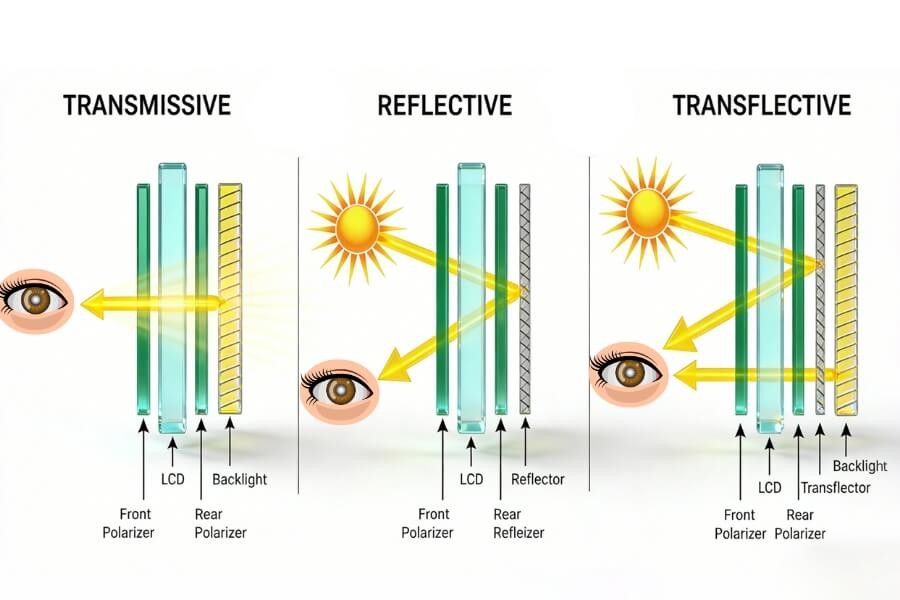
A reflective LCD uses a mirror-like reflective layer bonded behind the liquid crystal layer. Ambient light enters from the front, passes through the liquid crystal layer, and is reflected back toward the viewer. No backlight is required.
The core structure consists of a front polarizer, liquid crystal layer, and a reflective layer replacing the rear polarizer.
Reflective LCDs offer ultra-low power consumption, excellent sunlight readability, and a thin, lightweight structure without a backlight module. However, they are unreadable in low-light or dark environments unless external lighting is provided. Viewing angles are narrower, and color depth and contrast are limited.
Typical applications include e-readers, calculators, portable GPS devices, smart watches, and outdoor indicators or industrial meters used exclusively in bright environments.
Transmissive LCD Polarizers — Built for Backlit Image Quality
A transmissive LCD allows backlight illumination to fully pass through the liquid crystal layer toward the viewer. Visibility depends almost entirely on the backlight, while ambient light contributes little and may reduce contrast.
Its structure includes a front polarizer, liquid crystal layer, rear polarizer, and an LED backlight module.
Transmissive LCDs deliver high image quality with strong brightness, contrast, and color saturation. They also provide wide viewing angles and stable performance in indoor and low-light environments. The trade-offs include higher power consumption due to continuous backlight operation, reduced readability in direct sunlight, and potential glare from reflective glass surfaces.
Common applications include smartphones, tablets, televisions, computer monitors, indoor digital signage, control rooms, POS systems, and medical monitoring displays.
Transflective LCD Polarizers — Balancing Sunlight and Backlight
A transflective LCD integrates a semi-reflective layer called a transflector. This layer reflects part of the ambient light while allowing part of the backlight to pass through, enabling dual operating behavior.
The structure consists of a front polarizer, liquid crystal layer, transflective layer, and LED backlight module.
In bright environments, transflective LCDs operate mainly in reflective mode, allowing the backlight to be reduced or turned off. In low-light environments, they rely on backlight illumination similar to transmissive displays.
This design enables consistent readability across changing lighting conditions while balancing energy efficiency. The compromise is reduced color saturation compared with pure transmissive displays, higher manufacturing complexity, and optical design constraints caused by reflected light passing through the liquid crystal layer twice.
Transflective LCDs are widely used in industrial handheld terminals, outdoor mobile devices, vehicle navigation systems, and marine, aviation, military, or medical field equipment.
LCD Polarizer Comparison and Selection Guide
| Feature | Reflective | Transflective | Transmissive |
|---|---|---|---|
| Primary light source | Ambient light | Ambient and backlight | Backlight |
| Power consumption | Very low | Low to moderate | High |
| Sunlight readability | Excellent | Excellent | Poor without ultra-high brightness |
| Low-light readability | Poor | Good | Excellent |
| Color and contrast | Limited | Moderate | Excellent |
| Viewing angle | Narrow | Moderate | Wide |
| Thickness and weight | Thinnest | Moderate | Thickest |
| Cost | Low | High | Moderate |
| Best environment | Constant bright outdoor | Mixed indoor and outdoor | Controlled indoor lighting |
Selection guidance.
- Choose reflective when the device operates exclusively in bright outdoor conditions and power efficiency is critical.
- Choose transmissive when visual quality is the priority and lighting conditions are controlled.
- Choose transflective when devices move between indoor and outdoor environments and require consistent readability with balanced power usage.
How Polarizer Choice Impacts Modern Display Systems
LCD Solutions Designed Around Real Use Scenarios
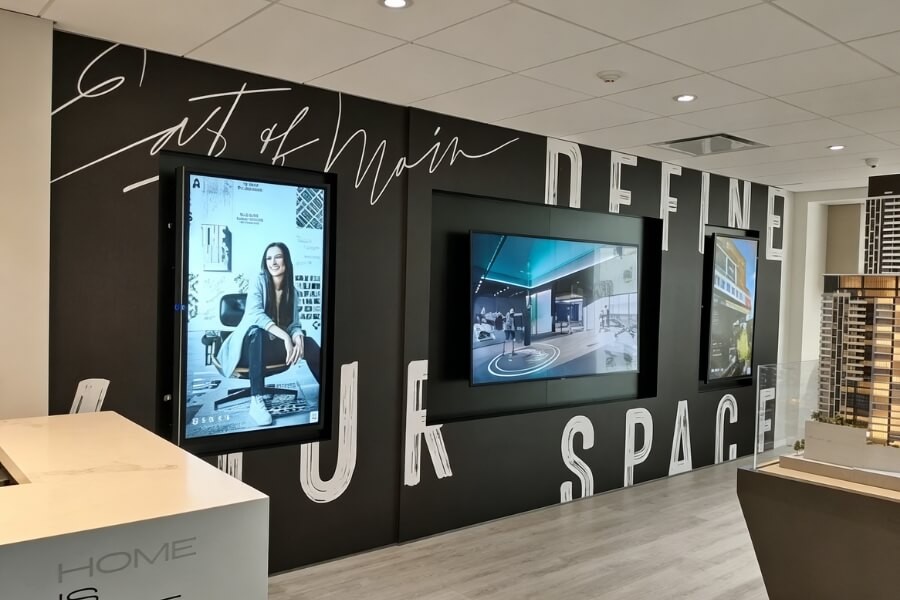
Modern LCD systems are increasingly delivered as integrated platforms rather than standalone panels. Interactive signage, wall-mounted displays, and freestanding units now combine touch interfaces, sensors, and content management systems to support retail spaces, corporate lobbies, and exhibition environments.
Where LCD and Display Technologies Are Heading
Display systems are becoming more adaptive. Real-time analysis of ambient light allows backlight levels to be adjusted dynamically, improving energy efficiency and viewing comfort. Transparent display technologies are also expanding how screens can be integrated into physical spaces without blocking visibility.
How Different Industries Use LCD Technologies
Retail and advertising environments often rely on high-brightness transmissive or transflective LCD signage designed for continuous operation. Industrial control systems benefit from transflective or high-brightness transmissive panels that maintain readability across varied lighting. Exhibition and showroom spaces increasingly combine transparent displays for visual impact with LCD video walls for detailed content delivery.
FAQ
Q1: Our devices operate mainly indoors but are occasionally used outdoors. Which LCD type is best?
Transflective LCDs are the most suitable option. They deliver stable readability indoors using backlight illumination and remain visible outdoors by reflecting ambient light. This dual behavior allows consistent performance across changing lighting conditions while keeping power consumption under control for portable or mixed-use devices.
Q2: Why are transflective LCDs more expensive than transmissive LCDs?
Transflective LCDs use semi-reflective optical layers that must precisely balance light reflection and transmission. This added optical complexity increases material requirements, manufacturing difficulty, and quality control standards. The higher cost reflects improved flexibility and reliability across variable lighting environments rather than higher image performance alone.
Q3: Can outdoor digital signage display full-color images in direct sunlight?
Yes. Ultra-high brightness transmissive LCDs above 1500 nits can overcome strong sunlight, though at the cost of higher power consumption. High-quality transflective TFT-LCDs offer an alternative by maintaining readability through reflected ambient light while reducing energy use in bright outdoor conditions.
Q4: Are reflective LCDs unusable at night or in dark environments?
Reflective LCDs rely entirely on ambient light and cannot generate visible images in darkness. In low-light conditions, they require external illumination. Some designs integrate front lighting systems that guide light across the display surface, improving nighttime readability without introducing a full backlight.
Q5: Is polarizer type the most important factor when selecting LCD video walls?
Lighting conditions are one of the most critical factors. In controlled indoor environments, transmissive LCDs deliver better image quality. For window-facing or semi-outdoor installations, high-brightness or transflective displays combined with anti-glare treatments are essential to maintain consistent visibility and viewing comfort.
Professional Display Solutions from RUSINDISPLAY
Choosing the right LCD polarizer is not just a component decision. It directly affects readability, power consumption, and long-term reliability in real operating environments. In commercial and industrial projects, these choices must perform consistently across changing light conditions and extended usage cycles.
RUSINDISPLAY supports this process by delivering professional OLED, Transparent Display, and Indoor LCD solutions built around real installation scenarios. From high-brightness indoor signage to systems operating across mixed lighting environments, our display solutions are engineered to balance optical performance, stability, and integration efficiency.
With experience supporting more than 120 global brands, RUSINDISPLAY focuses on helping businesses deploy displays that perform reliably in practice, not just on specification sheets. Through rapid 3D scene creation, steady technical support, and a Tech in Nature design philosophy, we help translate display technology decisions into scalable, long-term visual systems.