




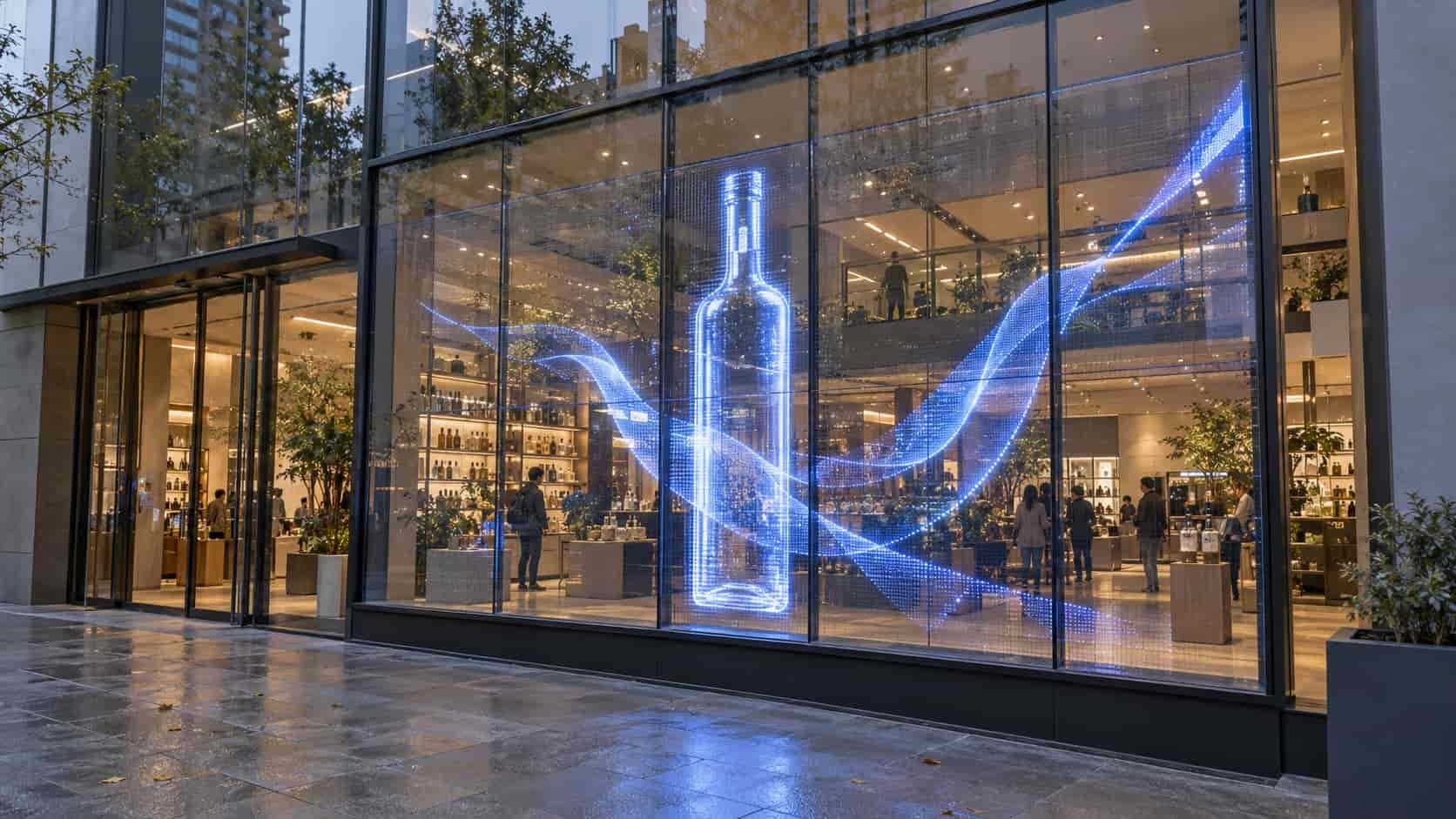
An LED mesh screen is built from narrow LED strips separated by open gaps. The screen can show video while allowing daylight and objects behind it to remain visible.
Its appearance depends on three related specifications. Horizontal and vertical pixel pitch determine the physical resolution. The strip arrangement affects transparency. Viewing distance decides how easily people can see the individual LEDs and spaces between them.
What Is an LED Mesh Screen?
A rigid LED mesh screen combines LED strip modules, aluminium cabinets, power supplies, receiving cards and a control system. The cabinets connect to create a larger transparent LED wall.
Because much of the surface remains open, these screens suit glass curtain walls, shop windows, atriums, exhibitions and stage backgrounds where an opaque LED wall would block the view or too much natural light.
Here, LED mesh screen means a rigid display assembled from framed strip modules. PET display film applied directly to glass and flexible LED curtains use different structures and installation methods.
How Does Pixel Pitch Change LED Mesh Screen Resolution?
Pixel pitch is the center-to-center distance between adjacent LED pixels. In a specification such as P2.8 × 5.6, the first number describes horizontal spacing and the second describes vertical spacing, both in millimeters.
On a horizontal LED strip, P2.8 × 5.6 places adjacent pixels 2.8 mm apart from left to right. The pixel rows are spaced 5.6 mm apart vertically. Where each strip carries one row of pixels, this is also the distance between the pixel-row centers on neighboring strips. It is not the clear gap between strips: the strips themselves occupy part of that space.
These three indoor cabinets all measure 1,000 × 1,000 mm, yet their pixel counts differ substantially:
| Pixel Pitch | Cabinet Resolution | Pixel Density |
| P2.8 × 5.6 | 352 × 176 px | 61,952 px/m² |
| P3.125 × 3.125 | 320 × 320 px | 102,400 px/m² |
| P3.91 × 7.82 | 256 × 128 px | 32,768 px/m² |
P2.8 × 5.6 has the smallest horizontal pitch, but its 5.6 mm vertical spacing leaves fewer LED rows. P3.125 uses a 3.125 mm pitch in both directions and therefore reaches 102,400 pixels per square meter—the highest density of the three.
Now apply those cabinet figures to a 4 m × 3 m screen made from twelve cabinets:
- P2.8 × 5.6: 1,408 × 528 pixels
- P3.125 × 3.125: 1,280 × 960 pixels
- P3.91 × 7.82: 1,024 × 384 pixels
That is the actual image grid available to the content. A 4K video will play, but the controller must scale it to the screen’s physical resolution. Sending a higher-resolution file cannot restore text or image detail that the LED grid cannot reproduce.
Why Does Pixel Pitch Affect LED Mesh Screen Transparency?
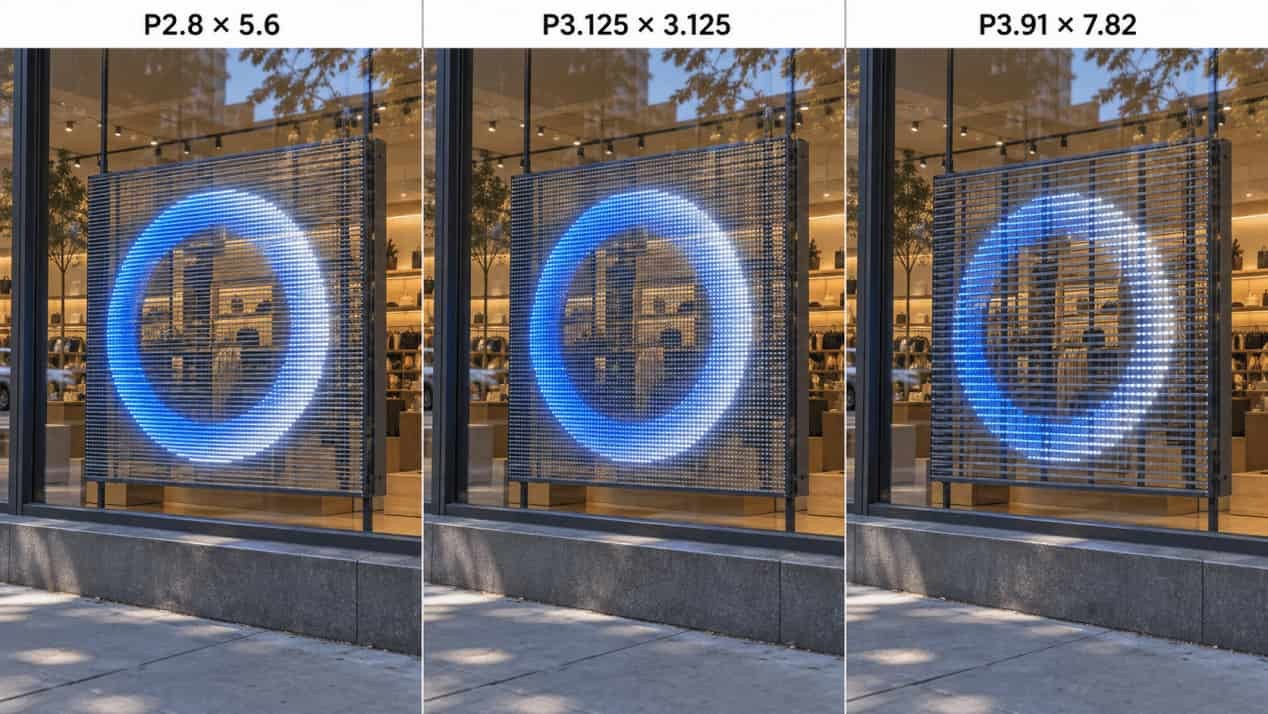
Wider spacing between LED rows usually leaves more open area. Pitch is only part of the calculation, however. LED strip width, circuit layout, pixel packages, wiring and cabinet borders also block light.
The difference is visible in the rated transparency of the same three configurations:
| Pixel Pitch | Pixel Density | Rated Transparency |
| P2.8 × 5.6 | 61,952 px/m² | ≥75% |
| P3.125 × 3.125 | 102,400 px/m² | 60% |
| P3.91 × 7.82 | 32,768 px/m² | 70% to ≥75%, depending on configuration |
P3.125 packs in the most pixels and has the lowest transparency at 60%. That trade-off favors text, faces and detailed product images viewed from relatively close positions.
P3.91 × 7.82 reduces the density to 32,768 px/m² and leaves 70% to at least 75% of the area open. More of the glass and architecture remains visible, but content has to work within a coarser pixel grid.
P2.8 × 5.6 takes a different route. Its narrow horizontal spacing retains more detail across the width, while the wider vertical spacing helps it reach at least 75% transparency. This is why the first number in an asymmetrical pitch specification cannot describe the screen on its own.
How Should LED Mesh Screen Viewing Distance Be Evaluated?
People notice pixel gaps most at close range. Move farther away and the individual points begin to merge into a more continuous image.
RusinDisplay’s indoor configurations list the following viewing references:
| Configuration | Published Viewing Reference | Cabinet Resolution |
| P2.8 × 5.6 | ≥3 m | 352 × 176 px |
| P3.125 × 3.125 | >3 m | 320 × 320 px |
| P3.91 × 7.82, 2,000 cd/m² | ≥3 m | 256 × 128 px |
| P3.91 × 7.82, 4,000 cd/m² | 5–12 m | 256 × 128 px |
For an audience standing roughly 3 meters away, P3.125 supplies 320 horizontal and 320 vertical pixels in every square meter. It has considerably more vertical detail than a P3.91 × 7.82 cabinet with 256 × 128 pixels.
The lower density of P3.91 × 7.82 becomes less obvious at 5–12 meters. Large type, bold shapes, broad areas of color and video can work well at that range. Small interface text and detailed specifications will not.
The two P3.91 × 7.82 entries also show why pitch cannot set viewing distance by itself: both have the same pixel grid, but their listed application ranges differ. Brightness, total screen size, content and placement still matter.
Test the proposed artwork at the finished screen resolution and from the positions people will actually use. Include the smallest essential text, a face or product image, fine edges and motion. Abstract animation alone is a poor test because it hides many resolution problems.
What Other Specifications Affect an LED Mesh Screen?
The indoor configurations discussed here cover 2,000 to 5,000 cd/m²:
- P3.91 × 7.82: 2,000 or 4,000 cd/m²
- P3.125 × 3.125: 4,500 cd/m²
- P2.8 × 5.6: 5,000 cd/m²
Brightness helps the image compete with daylight and other ambient light. It does not add pixels or make the screen more transparent.
The cabinets measure 1,000 × 1,000 × 75 mm and weigh about 6.5–10 kg/m², depending on the configuration. Their IP30 rating makes them indoor products, including installations behind glass that face outdoor viewers. A screen exposed directly to weather needs an outdoor-rated structure.
LED modules are serviced from the front. Power supplies and receiving cards require access from the rear, so the supporting structure has to provide a usable maintenance space behind the screen.
Which LED Mesh Screen Configuration Fits the Application?
Start with the completed screen resolution rather than the pitch name.
P3.125 suits close-view content that needs more image detail. P2.8 × 5.6 combines finer horizontal detail, high brightness and at least 75% transparency. P3.91 × 7.82 is a practical option for larger displays viewed from farther away, provided the artwork uses large graphics, movement and short messages.
A full-size cabinet or representative sample will reveal more than a specification sheet. Show the real content from the planned viewing positions and check whether the essential message remains readable while the required sightline through the display is preserved.
RusinDisplay offers rigid indoor LED mesh screens in P2.8 × 5.6, P3.125 × 3.125 and P3.91 × 7.82. For a flexible display applied directly to glass, consider self-adhesive transparent LED display film; for an outdoor LED mesh screen, contact RusinDisplay to discuss the installation and weather-protection requirements.