




From science fiction to real-world deployment, holographic and transparent display technologies are reshaping how people perceive and interact with digital information. This article explains how immersive visual systems work, where they already deliver value today, and why they are becoming a practical foundation for next-generation spatial computing interfaces.
Why Traditional Screens Fall Short – An Introduction to Immersive Displays
Why Flat Screens Don’t Match How Humans See
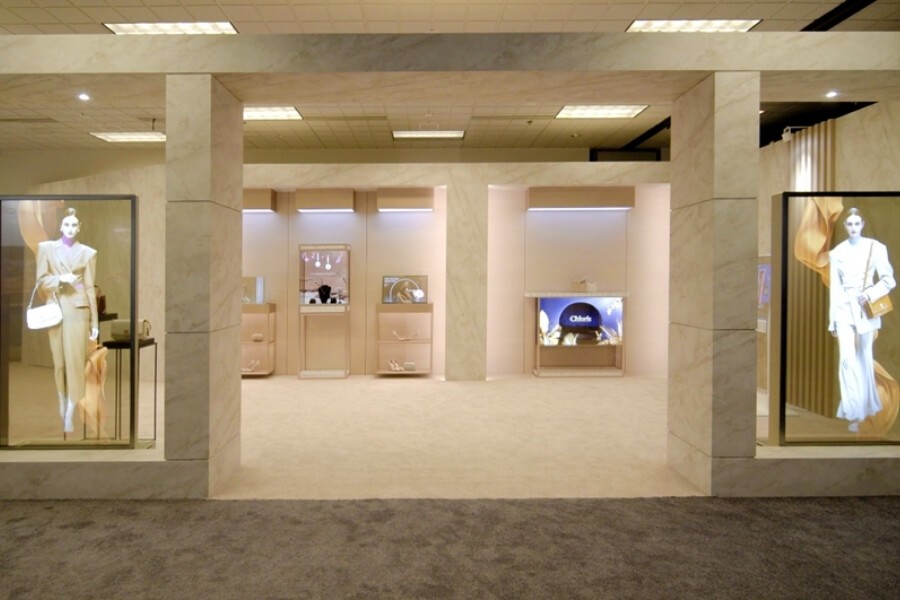
Most digital displays remain flat surfaces. They present information in two dimensions, while human vision interprets the world through depth, perspective, and spatial context. This difference limits how naturally people understand spatial information, especially in environments where physical objects and digital data must coexist.
Immersive display technologies address this gap by placing digital content into real space rather than confining it to a rectangular frame.
Two Ways Immersive Displays Break the Screen Boundary
Holography
Holographic displays aim to reconstruct the light field of an object so images appear to occupy real space. Because depth cues are generated optically rather than simulated, viewers do not need glasses, and visual fatigue is reduced during longer viewing sessions.
Transparent Displays
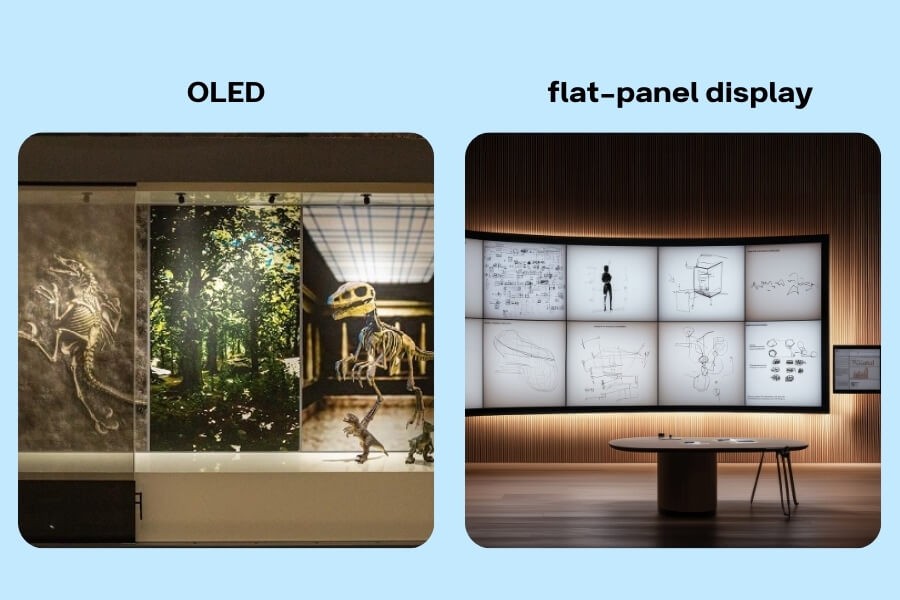
Transparent display technologies, led by Transparent OLED, allow digital information to appear directly on glass surfaces while preserving visibility of the environment behind them. This makes them well suited for scenarios where spatial awareness, safety, or architectural openness must be maintained.
The Common Goal – Blending Digital Content Into Real Space
Although their technical approaches differ, both technologies pursue the same outcome. They reduce the separation between physical environments and digital information, enabling more intuitive interaction, faster comprehension, and stronger engagement.
As immersive systems move from concept installations to operational environments, Transparent OLED displays have emerged as a practical medium for integration. Their self-emissive structure delivers clear imagery without blocking natural light or sightlines. As a specialist in this field, RUSINDISPLAY focuses on developing Transparent OLED display systems that are engineered for real commercial spaces rather than controlled lab conditions.
How Immersive Displays Actually Work – From Light to Experience
Holography Explained – Turning Light Into Spatial Images
The Science Behind Holographic Images
Holography relies on laser interference and diffraction. A laser beam is divided into an object beam and a reference beam. Their interference pattern is recorded and later illuminated, reconstructing the original light waves and producing an image with true spatial depth.
Because depth information is encoded optically, holographic images change naturally with viewing angle, supporting a more realistic perception of space.

Different Types of Holographic and “Hologram-Like” Displays
- True Holography Reconstructs complete light fields and delivers the most realistic spatial imagery. However, it requires extreme computational power and remains difficult to scale beyond experimental or niche installations.
- Volumetric Displays Generate visible points within a physical volume using rotating surfaces or plasma excitation. These displays allow multi-angle viewing but are often limited in resolution and installation flexibility.
- Pepper’s Ghost Illusion Uses reflective glass and controlled lighting to create floating visual effects. It is cost-effective and widely used for stages and museums, but it does not produce real volumetric depth.
- Autostereoscopic Displays Direct different images to each eye using optical layers. They eliminate glasses but restrict viewing angles and are sensitive to viewer position.
Transparent OLED – Displaying Information Without Blocking Reality
How Transparent OLED Creates Images on Glass
Transparent OLED displays use self-emissive pixels that produce light independently. When a pixel is inactive, it remains transparent. This structure allows digital content to appear while preserving visibility of physical objects behind the display.
Higher Transparency improves spatial awareness and maintains natural lighting, which is critical in architectural, retail, and public-facing environments.
Why Transparent OLED Outperforms Other Transparent Display Options
- Compared with Transparent LCD Transparent OLED does not require a backlight. This results in thinner structures, higher Transparency, and stronger contrast, especially in controlled indoor lighting.
- Compared with Projection Films Self-emissive images maintain color accuracy and brightness without dependence on external projectors. This reduces installation complexity and improves long-term operational stability.
Why Transparent OLED Fits Augmented Reality So Well
Transparent OLED functions as a visual layer rather than a barrier. Digital information aligns directly with physical objects, reducing cognitive load and improving interpretation speed in real environments.
Delivering consistent performance in Transparent OLED projects requires system-level design. RUSINDISPLAY integrates modular display structures, precise alignment control, interactive sensing, and unified content management. This approach ensures that transparent displays remain stable, readable, and maintainable throughout long-term operation.
Where Immersive Displays Are Already Changing Real Projects
Retail and Commercial Environments
Holography enables attention-focused experiences such as floating product visuals and volumetric brand elements.
Transparent OLED supports smart storefront windows, layered product information, and immersive navigation while preserving openness and architectural intent. This makes it suitable for premium retail environments where visibility and design continuity matter.
Automotive and Transportation Displays
Transparent OLED is increasingly used in AR head-up displays. Navigation cues and safety alerts align with real road conditions, reducing reaction time without obstructing the driver’s view. Side windows can also function as adaptive information surfaces without compromising passenger awareness.
Museums, Education, and Live Experiences
Holography supports historical reenactments and immersive performances.
Transparent OLED enables layered interpretation of artifacts, combining physical exhibits with contextual information while preserving visual access to original objects.
Healthcare and Professional Visualization
Holography supports three-dimensional imaging for analysis and training.
Transparent OLED allows medical data and design overlays to be viewed while maintaining direct sight of patients, instruments, or physical prototypes. This improves accuracy and reduces workflow disruption.
The Future of Meetings and Remote Collaboration
Holographic and light-field displays represent a long-term vision for spatial telepresence. Today, Transparent OLED already supports collaborative environments by displaying shared content without isolating participants from one another.
Current Limitations and What Will Shape the Next Stage
What Still Limits Immersive Display Adoption Today
- Holography is constrained by computational demand, data volume, and cost, particularly for large-scale or high-resolution systems.
- Transparent OLED must balance pixel density with Transparency and requires specialized content strategies to fully utilize its spatial advantages.
- Shared challenges include interaction standardization, long-term viewing comfort, and cross-platform content compatibility.
Key Trends Defining the Future of Immersive Displays
- Technology convergence will combine light-field computation with transparent displays to enhance depth perception within real spaces.
- Hardware evolution will drive thinner, lighter, and more flexible displays that integrate directly into architecture.
- Intelligent interaction will use AI to optimize content, brightness, and spatial alignment in real time.
- Wider adoption will extend immersive displays from premium projects into standardized intelligent environments over the next five to ten years.
Looking ahead, RUSINDISPLAY views immersive display technology as an interface that should feel natural rather than dominant. By advancing Transparent OLED hardware alongside AI-driven interaction, spatial audio, and integrated content creation, the company focuses on building display systems that support long-term reliability, operational efficiency, and meaningful spatial experiences.
FAQ
Q1: What is the difference between holography and 3D movies?
3D movies simulate depth using binocular disparity and usually require glasses, while images remain on a flat screen. Holography reconstructs light fields, creating images with real spatial presence that can be viewed without eyewear and from multiple angles, offering a more natural perception of depth and space.
Q2: What is holographic projection, and do hologram displays require special glasses?
Holographic projection creates the illusion of three-dimensional images by reconstructing or simulating light behavior in space. True holographic displays do not require glasses, while some hologram-like systems use optical illusions. The viewing method depends on the underlying technology rather than a single standard approach.
Q3: Do Transparent OLED displays block objects behind them when active?
No. Transparent OLED displays only emit light from active pixels. Non-emissive areas remain transparent, allowing viewers to see digital content and physical objects at the same time. This makes them suitable for environments where visibility, spatial awareness, and natural lighting must be preserved.
Q4: What is the biggest barrier to adopting immersive display technologies today?
The main barriers are system cost, content availability, and technical maturity. High-end immersive displays require investment, and purpose-built content is still developing. Adoption often depends on whether the technology can deliver long-term operational value rather than short-term visual impact.
Q5: Is Transparent OLED suitable for standard TVs or computer monitors?
Generally no. Transparent OLED is designed for spatial integration and interaction rather than maximum image density. Its strengths lie in commercial displays, exhibitions, and experiential environments where blending digital information with real space is more important than replacing conventional screens.
Q6: How should organizations begin planning an immersive visual project?
Start with the experience goal rather than the display technology. Define how the audience should interact with the space, then assess environmental conditions, operational needs, and maintenance requirements. Working with solution providers early helps align hardware, content, and spatial design for reliable implementation.