




Introduction: Why OLED and LCD Matter in Today’s Displays
In commercial displays, architectural projects, digital signage, and integrated AV systems, the oled vs lcd screen decision directly influences long-term performance, installation planning, and total operating cost. These two technologies dominate the visual industry, yet their structural differences lead to very different behaviors in real environments.
There is no universal winner in the oled vs lcd comparison. Instead, system designers and project managers must understand the oled lcd difference to match each technology to operational requirements, viewing conditions, and durability expectations.
This industry-focused guide explains the oled and lcd difference from a technical and application perspective so project teams can make accurate, confident choices.
How OLED and LCD Work in Simple Terms
1. LCD (Liquid Crystal Display)
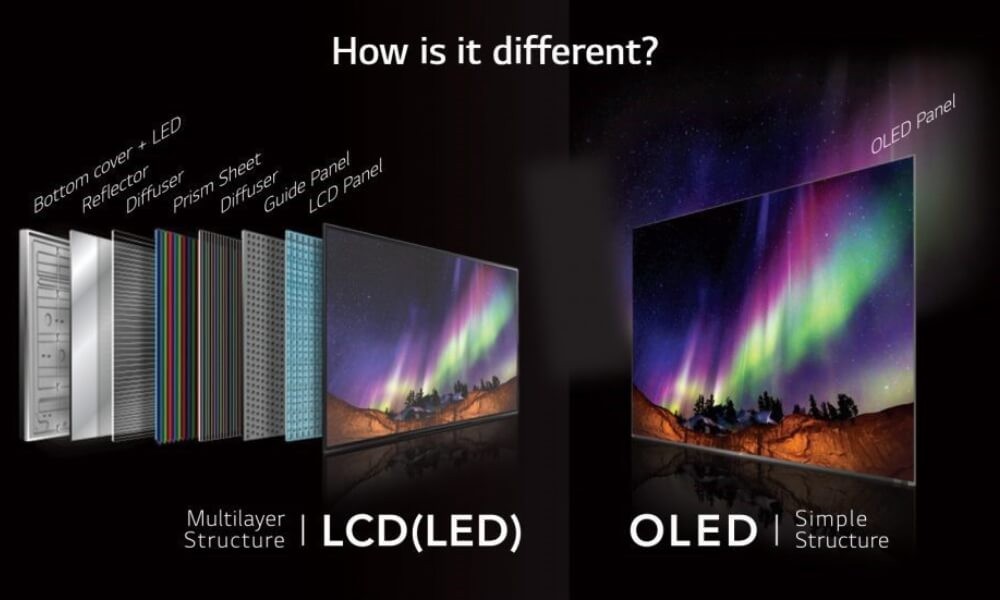
In most commercial applications referenced as lcd vs. oled or lcd v oled, an LCD panel uses a structured LED backlight behind a liquid-crystal layer. These crystals act like controllable shutters that regulate how much light passes through RGB filters.
Because LCD depends on a backlight module, its performance is influenced by light uniformity, optical film structure, and thermal behavior within the installation environment.
Key engineering characteristic:
A layered architecture with a fixed light source. This simplifies brightness control but limits black-level performance in high-contrast applications.
2. OLED (Organic Light-Emitting Diode)
OLED panels emit light on a per-pixel basis. Each pixel contains organic materials that illuminate when voltage is applied. This is the primary structural distinction found in oled display vs lcd systems and drives most of the visible performance advantages.
With no backlight, OLED modules are thinner, lighter, and capable of curved or flexible designs—useful for creative retail installations or space-constrained environments.
Key engineering characteristic:
Self-emissive pixels deliver superior contrast but rely on organic materials that age differently based on brightness load and content type.
OLED vs LCD: A Complete Side-by-Side Comparison
The following comparison summarises performance across professional environments, informed by multiple oled vs lcd test evaluations and field installations.
| Comparison Area | OLED Advantages | LCD Advantages | Industry Conclusion |
|---|---|---|---|
| Contrast and Black Levels | Pixel-level emission enables true black with no haloing. | Backlight causes elevated blacks and blooming. | OLED leads for premium visual impact and dark-room installations. |
| Brightness | Lower full-screen brightness in sustained output. | Stronger global brightness ideal for ambient light. | LCD leads in bright lobbies, atriums, and outdoor-adjacent areas. |
| Color Performance | High perceived color depth due to deep blacks. | Excellent color with Quantum Dot backlights. | OLED slightly ahead; advanced LCD competes well. |
| Viewing Angles | Consistent from extreme angles. | Contrast and color shift off-axis. | OLED leads for wide open seating layouts. |
| Response Time | Near-instant transitions. | Slower crystal movement causes blur. | OLED leads for motion-critical content. |
| Power Consumption | Efficient in darker interfaces. Varies by content. | Predictable due to fixed backlight behavior. | Depends on content; LCD often more stable in bright content cycles. |
| Burn-In Risk | Pixel aging can occur with static UI elements. | Minimal risk due to uniform backlight. | LCD leads for control rooms and static-content displays. |
| Lifespan | Organic materials degrade over time. | Longer, more predictable aging curve. | LCD leads for long-hour operations. |
| Structure & Flexibility | Ultra-thin; supports curved surfaces. | More rigid due to backlight. | OLED leads for design-centric installations. |
| Cost | Higher production cost. | Lower price and mature supply chain. | LCD leads in cost-driven deployments. |
| Blue Light Behavior | Less harmful wavelength output. | Relies on filters that may reduce color accuracy. | OLED slightly ahead for eye comfort in close-range use. |
These findings inform practical decisions about is oled or lcd better, is oled better than lcd, and is lcd or oled better, especially in commercial and professional use cases.
Choosing the Right Screen for Phones, Laptops, and TVs
This section reframes device categories from a professional application perspective—helping integrators and facility managers identify where each technology performs best.
1. Smartphones (For Enterprise Mobility & Field Staff)
Choose OLED if your team needs:
- Superior readability in controlled indoor lighting
- High-contrast content for visualization tasks
- Wide viewing angles for collaborative usage
- Lower consumption in dark UI modes
Choose LCD when:
- Devices are frequently used outdoors
- Long-term uniformity is important
- Cost efficiency drives fleet deployment
2. Laptops (For Office, Creative, and Engineering Teams)
Choose OLED for:
- Creative work involving color-critical output
- Presentations or visual demos where contrast matters
- Environments benefiting from thin, lightweight hardware
Choose LCD for:
- Long static windows common in office workflows
- High refresh-rate performance for engineering tools
- Extended daily use with minimal aging concerns
- Organizations scaling hundreds of devices
3. Televisions (For Commercial AV and Public Environments)
Choose OLED for:
- Hospitality or retail areas with controlled lighting
- High-impact content demanding cinematic contrast
- Design-forward projects requiring slim installations
Choose LCD for:
- Bright common areas and ambient-light-heavy lobbies
- 24/7 signage with static brand elements
- Cost-efficient large-format deployments
- Spaces requiring maximum lifetime stability
These scenarios reflect common lcd led oled decision points in AV integration and commercial display planning.
Common Questions About OLED and LCD
Q1: Will OLED always burn in?
Burn-in is possible when static elements stay on screen for long periods, but modern pixel-shifting and compensation tools reduce this risk significantly. With normal content rotation, most OLED panels operate for years without visible retention.
Q2: Why do some premium devices still use LCD?
High-end LCD panels deliver strong brightness, stable long-term performance, and no burn-in risk. They remain preferred for devices with static interfaces, extended daily use, or environments requiring consistent full-screen luminance.
Q3: Is OLED more harmful to the eyes?
OLED emits less short-wave blue light and often provides better visual comfort. Some models use PWM dimming at low brightness, which may affect sensitive users, but overall eye impact depends more on viewing habits than panel type.
Q4: Why does a 1080p OLED appear less sharp?
Many OLED panels use PenTile sub-pixel layouts, which reduce effective pixel density compared to RGB LCDs. Visual sharpness may appear lower at the same resolution, especially for text, though higher-resolution OLED panels offset this effect.
Q5: Why is OLED limited in full-white brightness?
OLED requires every pixel to generate maximum light output in white scenes, increasing heat and power load. LCD backlights maintain high brightness more efficiently, making LCD better for sustained full-screen white content.
Q6: Which technology will dominate the future?
Both continue to evolve. OLED improves brightness, efficiency, and lifespan, while LCD advances through Mini-LED and quantum-dot designs. Each will remain relevant depending on installation needs, cost, and operational patterns.
Q7: Which is better OLED or LCD display?
OLED delivers deeper blacks, wider viewing angles, and stronger contrast, making it ideal for controlled-light environments. LCD offers higher brightness, lower cost, and superior durability for static or long-hour applications. The best choice depends on usage.
Q8: Which lasts longer OLED or LCD?
LCD typically lasts longer due to uniform backlight aging and non-organic components. OLED pixels age at different rates, especially blue, which gradually reduces brightness. For long-hour or static content, LCD offers more predictable lifespan.
Q9: Is OLED worth paying more for?
OLED is worthwhile for projects prioritizing contrast, design flexibility, and high-impact visuals. For bright spaces, long runtimes, or budget-sensitive installations, LCD provides better value and lower long-term maintenance cost.
Why Rusin?
RUSINDISPLAY delivers professional OLED and Transparent Display solutions with reliable performance and modern design flexibility. Our systems help brands and integrators create engaging visual installations while supporting stable operation, efficient integration, and long-term technical service. Through AI-assisted interaction and refined engineering, we provide display solutions that connect innovation with real-world commercial environments.