




Why TFT Still Leads in Commercial Display Projects
In commercial environments, display systems must operate reliably for long hours while maintaining consistent brightness and image stability. Performance predictability often matters more than peak visual contrast.
TFT LCD remains one of the most widely adopted technologies in digital signage, video walls, kiosks, and retail installations. Its balance of cost efficiency, brightness control, and operational durability makes it a dependable solution for large-scale commercial projects.
When stability, scalability, and lifecycle management are priorities, TFT remains a practical foundation technology.
What Makes TFT Suitable for Large-Scale Commercial Displays
TFT stands for Thin Film Transistor. It refers to an Active Matrix LCD structure where each pixel is controlled by an independent transistor.
Independent pixel control improves refresh speed and image consistency. In commercial advertising and information systems, this prevents flicker and ensures stable visual output across extended operation periods.
Unlike Passive Matrix displays that scan rows or columns, TFT addresses each pixel individually. This enables higher resolution and sharper graphics, which directly affect text clarity and brand presentation in public environments.
How TFT Structure Impacts Real-World Performance
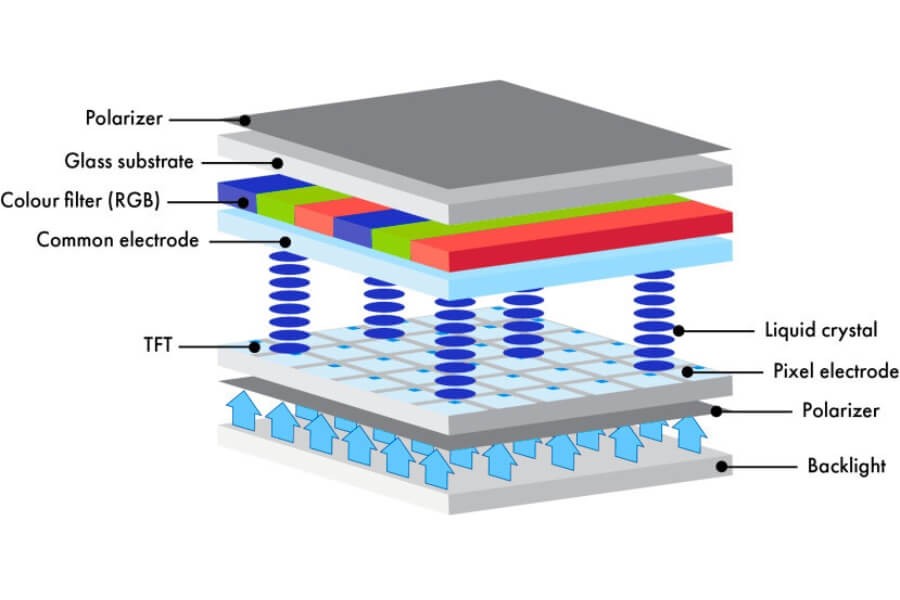
A standard TFT LCD module consists of:
- Two glass substrates
- A liquid crystal layer
- A Color Filter layer
- A TFT transistor array
- An LED Backlight Unit
The liquid crystal layer modulates light instead of generating it. This means brightness performance depends heavily on backlight design.
Higher brightness improves visibility in storefront windows, airports, and transportation hubs. However, increased brightness also raises power consumption and thermal load, requiring proper heat management in commercial installations.
Structure determines stability. Backlight determines visibility.
Key Specifications That Influence Commercial Display Quality
Brightness and Ambient Light Performance
Retail storefronts and public venues often experience strong ambient lighting. Panels below 700 nits may appear washed out under these conditions.
High-brightness TFT panels, typically exceeding 1500 nits for semi-outdoor use, maintain readability. Brightness directly determines whether advertising content attracts attention or loses impact.
Contrast Ratio and Visual Clarity
Typical TFT contrast ratios are around 1000:1, depending on panel type.
Contrast affects how clearly text and graphics appear against backgrounds. Insufficient contrast reduces legibility from a distance, especially in high-traffic commercial environments.
While OLED achieves deeper blacks, calibrated TFT panels deliver stable and consistent contrast suitable for most signage systems.
Viewing Angle and Public Visibility
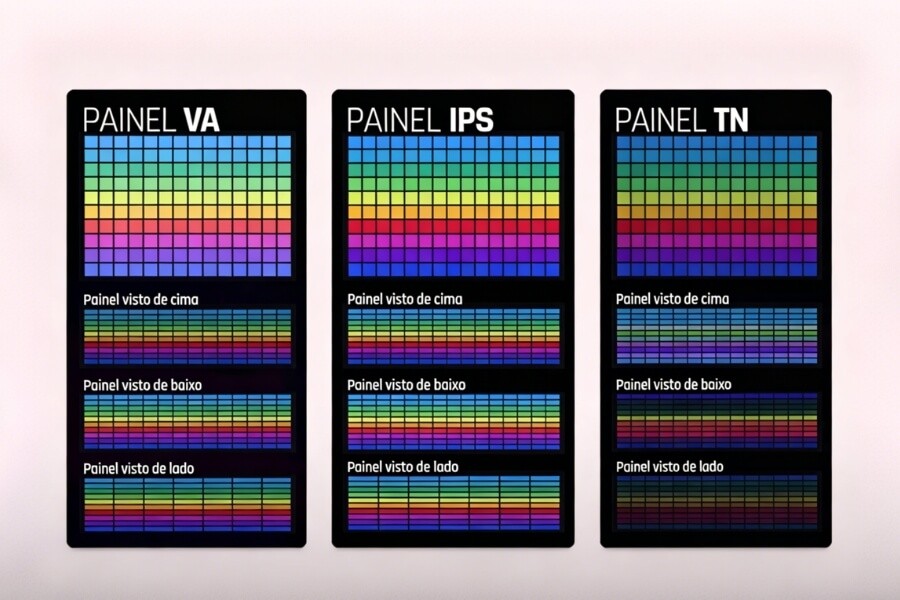
In malls, exhibition halls, and transit centers, viewers approach screens from multiple directions.
- TN panels offer narrower viewing angles
- IPS panels provide wide-angle visibility and color consistency
- VA panels deliver stronger contrast with moderate angle performance
For public-facing digital signage, IPS panels are often preferred because they maintain visual consistency across wide viewing zones.
Response Time and Motion Performance
Most commercial TFT panels operate between 5 and 25 milliseconds.
For video playback and animated content, this range supports smooth performance. Motion clarity influences perceived quality in advertising environments.
Lifespan and Continuous Operation
Commercial display systems often run 16 to 24 hours daily.
LED Backlight Units typically support 30,000 to 50,000 hours of operation. With effective thermal design and stable power management, overall system lifespan can reach five to ten years.
Long service life reduces maintenance cycles and protects operational budgets.
Choosing the Right TFT Panel Type
TN – Speed and Cost Efficiency
TN panels provide fast response times and lower cost. They are suitable for budget-sensitive projects where viewing angle is not critical.
IPS – Balanced Performance for Public Installations
IPS panels deliver wider viewing angles and improved color accuracy.
For retail environments, airports, and interactive kiosks, IPS panels ensure consistent image quality across multiple viewing positions.
VA – Enhanced Contrast for Visual Depth
VA panels produce deeper blacks and stronger contrast.
They are often selected for video walls and installations where visual depth enhances presentation quality.
Panel selection should align with installation environment, viewing distance, and content type.
TFT vs OLED in Commercial Installations
OLED technology offers self-emissive pixels and extremely high contrast. However, commercial systems frequently display static content such as menus or branding elements for extended periods.
Prolonged static content increases burn-in risk in OLED panels.
TFT LCD handles long-term static display more predictably. For large-format advertising walls and continuous operation environments, TFT remains a stable and cost-effective option.
When transparency and premium visual layering are priorities, OLED becomes attractive. When durability and lifecycle stability matter most, TFT is often the practical solution.
Where TFT Performs Best in Commercial Environments
Digital Signage Networks
Retail chains, corporate buildings, and transportation hubs rely on TFT LCD digital signage for consistent brightness and operational stability.
Predictable maintenance schedules and manageable power consumption are critical in these installations.
Video Walls and Control Centers
TFT modules can be tiled into large-format video walls with narrow bezels.
This structure supports command centers, exhibition spaces, and event stages where continuous operation and reliability are essential.
Interactive Kiosks and Self-Service Terminals
High-brightness TFT panels integrated with capacitive touch systems create durable interactive platforms.
Touch responsiveness, brightness stability, and long operational hours are key factors in these environments.
How TFT Technology Is Evolving for Modern Commercial Spaces
Mini-LED Backlight
Mini-LED backlighting improves local dimming performance.
Better dimming enhances contrast and brightness uniformity, narrowing the visual gap between TFT LCD and OLED in commercial applications.
IGZO Backplane Technology
Oxide semiconductors such as IGZO increase electron mobility.
Higher mobility reduces power consumption and supports higher resolution, directly influencing long-term operating costs.
TFT as a Micro-LED Driving Backplane
TFT technology increasingly serves as a driving layer for Micro-LED displays.
This integration combines high brightness, long lifespan, and precise pixel control, demonstrating that TFT remains foundational in next-generation display systems.
When Transparent Display Solutions Should Be Considered
Standard TFT LCD relies on a backlight, which limits Transparency.
Transparent TFT LCD reduces or repositions the backlight to create semi-transparent effects, though overall transparency remains lower than self-emissive solutions.
Transparent OLED achieves higher light transmission because it does not require traditional backlighting.
In luxury retail windows, museums, and showcase environments, Transparent OLED delivers stronger visual layering. In cost-controlled projects, transparent TFT LCD provides a more economical alternative.
Technology selection should align with ambient lighting, visual objectives, and budget constraints.
Is TFT the Right Choice for Your Commercial Project
For large-scale digital signage systems, kiosks, and high-brightness retail installations, TFT LCD offers:
- Stable long-term operation
- Scalable size options
- Controlled lifecycle cost
- Proven reliability in continuous use environments
Understanding installation conditions, content type, and operational hours will determine whether TFT, Transparent LCD, or OLED is the optimal solution.
FAQ
Q1: What is the difference between TFT and IPS?
IPS is a panel type within TFT technology. It improves viewing angles and color accuracy compared to traditional TN panels, making it more suitable for public-facing commercial displays.
Q2: Can a TFT screen be clearly seen in sunlight?
Standard TFT panels require high brightness, typically above 1000 nits, for sunlight readability. Semi-outdoor installations often use high-brightness panels or transflective designs to maintain visibility.
Q3: Which is better for large advertising displays, TFT or OLED?
TFT offers lower cost, stable long-term operation, and reduced burn-in risk. OLED provides higher contrast and visual depth but comes at a higher cost and requires careful content management.
Q4: How long does a TFT display typically last?
Commercial TFT displays generally support 30,000 to 50,000 backlight hours. With proper thermal design and stable operation, overall system lifespan can reach five to ten years.
Q5: Can TFT displays be used outdoors?
Yes, when designed properly. Outdoor systems require brightness above 1500 nits, weatherproof enclosures, temperature control, and automatic brightness adjustment for stable performance.
RUSINDISPLAY specializes in advanced display solutions across TFT LCD, Transparent LCD, and Transparent OLED technologies. We evaluate installation environments, brightness requirements, operational schedules, and visual goals before recommending system architecture.
Our team integrates display hardware, structural engineering, and interactive technologies into cohesive commercial solutions. Whether the project requires high-brightness digital signage or next-generation transparent showcase displays, RUSINDISPLAY delivers engineered systems designed for long-term performance and visual impact.