




Why Display Technology Matters in Modern Commercial Spaces
Display technology has moved far beyond basic information output. In modern commercial spaces, it functions as the primary interface connecting people, content, and physical environments.
From digital signage in retail stores to interactive installations in museums and data visualization walls in corporate lobbies, display selection directly affects visual impact, communication clarity, and long-term operating cost. Color LCD display technology has evolved into a diverse ecosystem, while OLED introduces new possibilities through self-emissive and flexible structures.
Based on RUSINDISPLAY’s experience delivering commercial display systems across retail, exhibition, and public environments, this guide focuses on practical selection logic rather than theoretical specifications. It explains how Color LCD display technology and OLED compare in real projects, how to evaluate LCD vs OLED for commercial displays, and how to choose reliable commercial display solutions aligned with operational goals.
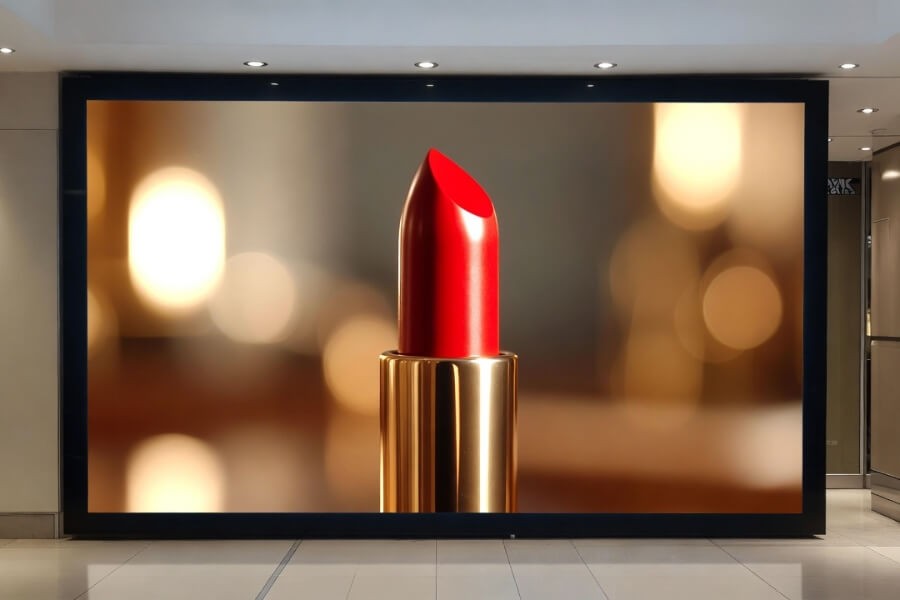
Understanding Color Display Technologies – How LCD and OLED Work
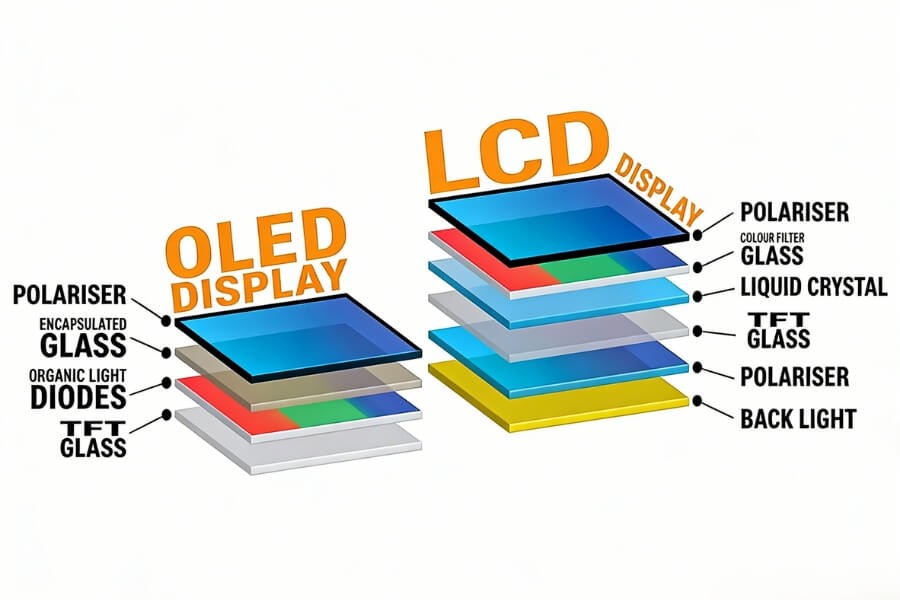
Different display behaviors originate from different light-control structures. Understanding these fundamentals helps decision makers interpret performance differences with confidence.
LCD Technology Explained – Panel Structures and Display Behavior
How LCD Panels Produce Color Images
LCD panels do not emit light on their own. They rely on an LED backlight to generate white light, which passes through a liquid crystal layer. By adjusting liquid crystal alignment under voltage, each pixel controls how much light passes through its red, green, and blue subpixels, forming a full-color image through optical filtering.
Key LCD Panel Types and Their Real-World Differences
Choosing the right LCD panel type directly affects color stability, viewing angle, and long-term usability in commercial displays.
TN – Twisted Nematic
TN panels prioritize speed and cost efficiency. They offer extremely fast response times and low manufacturing cost, but sacrifice color accuracy and viewing angle stability. This makes them suitable for entry-level or speed-focused applications rather than shared commercial viewing environments.
VA – Vertical Alignment
VA panels are designed for higher contrast and deeper black levels. By aligning liquid crystal molecules vertically, they achieve stronger native contrast than TN or IPS panels. This makes VA a practical choice when black depth matters more than wide viewing angles.
IPS – In-Plane Switching
IPS panels are the preferred option for commercial displays that require consistent color and wide viewing angles. In-plane crystal rotation keeps brightness and color stable from different directions, making IPS suitable for multi-viewer environments such as retail floors, exhibition halls, and control rooms.
Advanced LCD Technologies for Higher Color and Brightness
Advanced LCD variants address specific limitations of standard panels in high-demand commercial scenarios.
AFFS – Advanced Fringe Field Switching
AFFS enhances IPS technology by improving light transmission and viewing-angle stability. This makes it suitable for professional environments where image consistency and precision are critical.
Quantum Dot Enhanced LCD
Quantum Dot LCD expands color gamut and brightness by converting part of the blue backlight into highly pure red and green light. This technology enables wider color coverage and improved HDR performance, making it a key option for large-format commercial displays.
OLED Display Technology – Self-Emissive Design and Visual Impact
OLED is best suited for commercial displays where contrast, visual depth, and design flexibility are top priorities.
OLED panels use self-emissive pixels that produce light independently. This structure allows each pixel to turn fully off, creating true black levels and near-infinite contrast. Fast response times and stable viewing angles further enhance visual clarity.
Because OLED layers can be applied to flexible or transparent substrates, this technology enables curved surfaces and transparent installations that are difficult to achieve with backlit LCD systems.
Special LCD Technologies for Outdoor and Variable Lighting Environments
Transflective LCD is designed for environments with unpredictable lighting conditions.
By combining reflective and transmissive optical layers, transflective LCDs remain readable under direct sunlight without relying on high backlight power. In darker conditions, the backlight activates to maintain visibility. This dual-mode operation reduces power consumption and improves readability in outdoor and automotive applications.
LCD vs OLED – Which Display Technology Fits Large Commercial Screens
When comparing LCD vs OLED for commercial displays, performance differences must be evaluated in terms of reliability, scalability, and operating behavior rather than image quality alone.
Image Quality Differences That Matter in Commercial Displays
OLED delivers unmatched contrast for dark and immersive content. Pixel-level light control enables true black and strong HDR effects, enhancing visual depth in artistic and brand-focused installations.
High-end LCD focuses on consistency and predictability. With IPS panels and Quantum Dot enhancement, LCD delivers stable color performance across long operating hours and large screen sizes.
Reliability, Burn-In Risk, and Long-Term Stability
LCD is the safer choice for static content and continuous operation. LCD panels do not suffer from burn-in and age predictably over time, making them suitable for menus, dashboards, and fixed-layout signage.
OLED requires careful content planning. Static high-brightness elements can cause image retention over time, especially in 24/7 commercial environments.
Power Consumption in Real Display Scenarios
OLED efficiency depends on content. Dark scenes consume less power, while bright or white-heavy layouts increase energy use.
LCD power consumption remains stable. Backlight brightness determines energy use, which simplifies planning for long-term operation.
Display Size, Form Factor, and System Scalability
LCD remains the most practical solution for ultra-large video walls. Mature splicing technology and narrow bezels allow scalable installations at reasonable cost.
OLED enables thinner and transparent designs, but large-format systems involve higher cost and integration complexity.
Cost Differences and Budget Planning
LCD offers stronger cost control for large-scale projects. A mature supply chain and standardized formats reduce acquisition and maintenance cost.
OLED is positioned for premium applications. Its value lies in visual impact and design freedom rather than cost efficiency.
How to Choose the Right Display Technology for Your Project
Effective commercial display solutions begin with clear priorities.
Start With Your Display Goal
Premium visual impact and brand expression favor OLED solutions.
Long-term reliability and controlled operating cost point toward IPS or Quantum Dot LCD.
Ultra-large seamless displays are best served by LCD video wall systems.
Understand Content Type and Usage Patterns
Dynamic video and dark visual themes highlight OLED advantages.
Static layouts and fixed UI elements favor LCD to avoid burn-in risk.
Continuous operation environments benefit from LCD longevity.
Match Display Technology to the Installation Environment
Strong ambient light requires high-brightness or transflective LCD.
Wide viewing angles benefit from OLED or IPS LCD.
Transparent or futuristic design concepts are enabled by transparent OLED.
Balance Initial Cost and Long-Term Operation
Technology selection should consider lifespan, maintenance exposure, and total operating cost rather than initial price alone.
Beyond the Screen – How Display Systems Are Evolving
Modern commercial display solutions integrate hardware, software, and data into unified systems.
From Screens to Intelligent Display Systems
Interactive technologies combine displays with touch, AI vision, and motion sensing. Cloud-based CMS platforms enable centralized content control. IoT integration transforms displays into real-time data visualization tools.
How Commercial Displays Are Used in Real Spaces
Retail environments use transparent OLED for layered storytelling. Corporate showrooms rely on large LCD video walls for immersive narratives. Hospitality spaces use displays as dynamic design elements rather than static screens.
Key Display Technology Trends to Watch
Mini-LED backlight LCD is emerging as a strong alternative to OLED. By improving contrast through precise local dimming, Mini-LED narrows the gap with OLED while retaining LCD advantages such as long lifespan and zero burn-in risk.
AI-driven content adaptation allows displays to adjust messaging based on time, audience behavior, and environment. Display-as-a-Service models integrate hardware, software, content, and support into long-term solutions.
Conclusion
Selecting the right display technology means balancing visual performance, reliability, cost, and spatial creativity. No single technology fits every scenario. A clear understanding of Color LCD display technology, combined with realistic evaluation of LCD vs OLED for commercial displays, allows decision makers to select commercial display solutions that deliver long-term value.
RUSINDISPLAY Perspective
These conclusions reflect how RUSINDISPLAY approaches commercial display system design—balancing image quality, reliability, and operational stability across diverse environments. RUSINDISPLAY delivers professional OLED, Transparent Display, and Indoor LCD solutions with rapid 3D scene creation and long-term technical support. Through AI-driven interaction and a Tech in Nature design philosophy, we create display systems that integrate naturally into modern commercial spaces.
FAQ
Q1: Is transparent display technology suitable for retail storefronts, and how is it maintained?
Transparent OLED works well for storefronts where visual impact and openness matter. It allows digital content to overlay physical products without blocking visibility. Maintenance focuses on surface protection and content planning. Avoid long-term static high-brightness elements, and rely on professional system design and support to ensure stable performance over time.
Q2: What is the most reliable and cost-effective option for video walls larger than 100 inches?
For ultra-large video walls, LCD splicing systems with ultra-narrow bezels remain the most mature and economical choice. They support continuous operation, predictable aging, and flexible scaling. Compared with large-format OLED, LCD video walls offer better cost control, easier maintenance, and long-term stability for public and enterprise spaces.
Q3: How can displays remain readable under strong sunlight or very bright environments?
High ambient light requires displays designed for brightness and light control. High-brightness outdoor LCD panels above 2,500 nits maintain visibility in direct sunlight. Transflective LCD is another effective option, using reflected ambient light to improve readability while reducing backlight power consumption.
Q4: What are the key technology trends shaping commercial large displays in the coming years?
Mini-LED backlight LCD improves contrast and HDR while preserving long lifespan. Transparent and flexible OLED expands design possibilities. AI and IoT integration transforms displays into intelligent nodes that adapt content based on data, environment, and audience behavior rather than static playback schedules.