




A Practical Guide to Modern See Through Screens
Transparent displays are playing a growing role in retail design, transportation systems, architecture and emerging AR devices. Understanding how transparent display technology works helps project teams choose the right system for real environments. This guide explains the main technologies behind transparent displays, the visual effects they create and how each type performs in different conditions.
What Is Transparent Display Technology
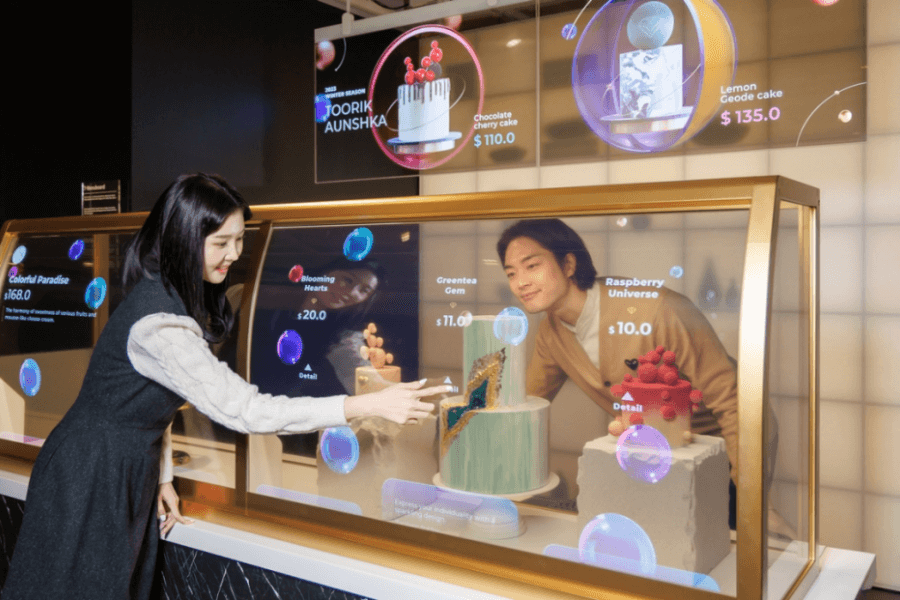
A transparent display shows digital content while allowing the viewer to see through the panel. It blends information with the background so the physical environment stays visible. This makes transparent displays useful when digital layers are needed without blocking light or sightlines.
Common Uses
- Vehicle and aircraft head up displays
- Augmented reality devices
- Retail showcases and interactive windows
- Storefront advertising
- Building façade media
- Stage and event visual effects
Transparent displays work best when digital content must appear without acting as a solid surface.
How Transparent Display Technology Works Across Different Systems
Transparent displays rely on different optical approaches. Some control how much ambient light passes through the panel, while others emit their own light and leave open areas between pixels. These differences determine transparency, brightness and overall viewing comfort.
Below is a clear breakdown of transparent screen technology and how each system works.
Transparent LCD and How It Works
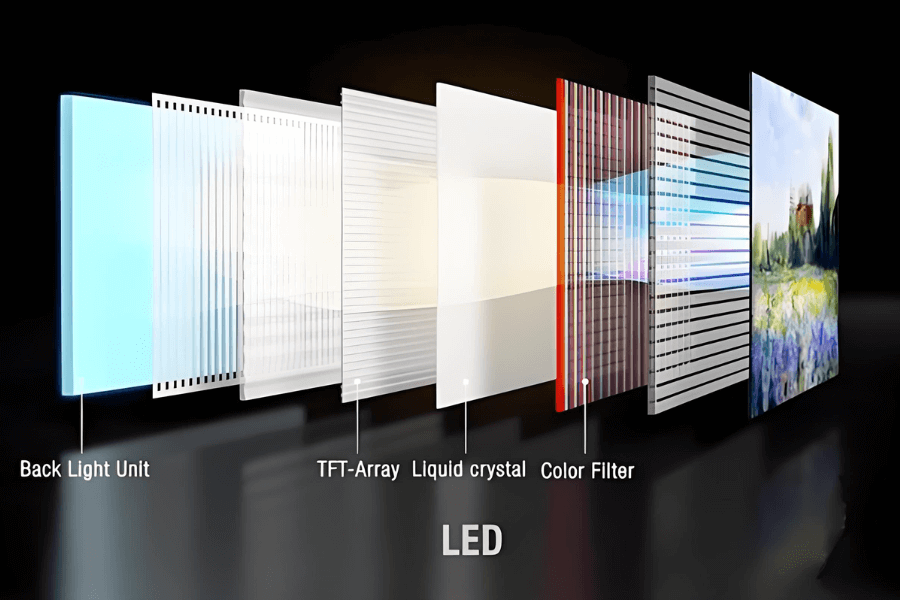
Transparent LCDs are absorptive systems. They do not produce light on their own. The liquid crystal layer and its polarizers control how much ambient light moves through the panel.
When the backlight is removed, indoor or natural light becomes the illumination source. The liquid crystals rotate to allow or limit this incoming light, forming an image while the viewer still sees the background.
Key Traits
- Lower cost than emissive technologies
- Dependent on ambient lighting
- Polarizers reduce brightness and can limit clarity
- Cannot show pure white because the panel does not generate light
- Typical transparency near fifty percent
Transparent LCDs work well in display cases and retail windows where moderate transparency and cost efficiency are important.
Transparent OLED and How It Works
Transparent OLEDs are emissive displays. Each pixel produces its own light through a stack that includes a transparent anode, transport layers, an emissive layer and a thin transparent cathode. All layers must remain clear so light can move through inactive regions.
This structure produces bright, high contrast images that appear to float over the background. When pixels turn off, they become transparent, which is why the display cannot show deep black on its own.
Key Traits
- No backlight required
- Thin and lightweight
- Strong contrast and wide viewing angles
- Flexible form factors are possible
- Off pixels turn transparent rather than black
Transparent OLED suits premium environments such as smart windows, AR devices and retail installations where visual impact matters.
Transparent LED and MicroLED and How They Work
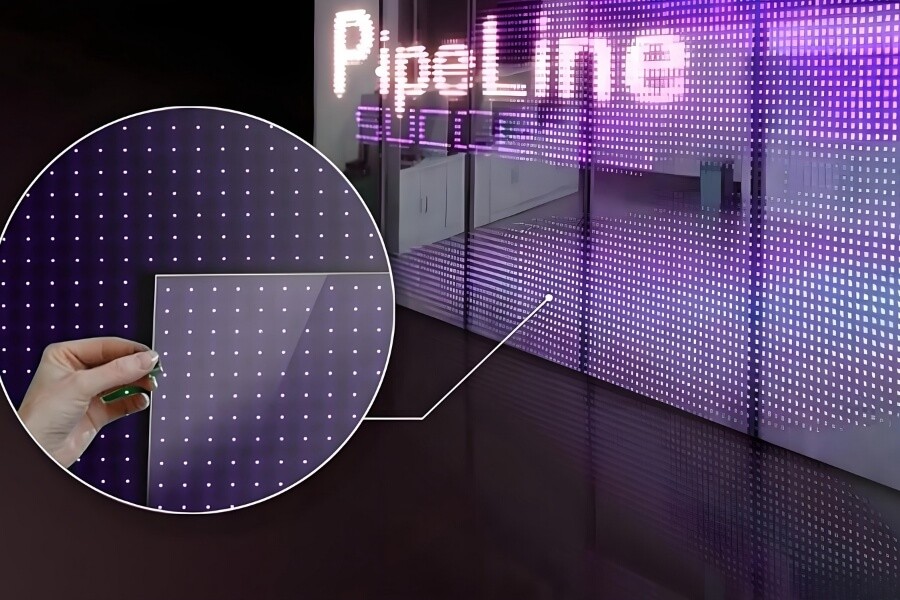
Transparent LED and MicroLED displays also use emissive pixels. Diodes are mounted on a clear substrate, leaving open space between them. These open areas create transparency, while each diode emits its own high brightness output.
This architecture provides strong visibility even in direct sunlight and supports large formats for architectural surfaces.
Key Traits
- Very high brightness often reaching 7500 nits
- Fast response time
- Strong performance over long viewing distances
- Ideal for glass façades, atriums and stage designs
- Off pixels appear transparent rather than black
This type of display is commonly selected for exterior media walls and performance environments.
Other Transparent Options Including TASEL
TASEL displays use thin film electroluminescent technology. An inorganic phosphor layer is positioned between two transparent electrodes. When voltage is applied, the phosphor emits light.
Key Traits
- High transparency near eighty percent
- Resistant to moisture, temperature changes and UV exposure
- Long operating life due to inorganic materials
- Typically limited to single color output
TASEL systems are used in automotive HUDs and industrial applications where reliability and environmental stability are critical.
Passive Transparent Displays and How They Work
Passive transparent displays rely on projection rather than self emitting pixels. A transparent panel containing resonance nanoparticles selectively scatters light from a projector, creating the image.
Key Traits
- Low cost
- Easy to scale to large surfaces
- Image depends heavily on projector brightness
- Suitable for temporary or artistic installations
This method avoids complex electronics but requires controlled lighting to maintain clarity.
What Influences Transparency, Visibility and Image Quality
Understanding how transparent display technology works also involves reviewing the factors that affect clarity and viewing comfort.
Important Factors
Pixel pitch
Smaller pixel pitch improves resolution but reduces transparency. Larger pixel pitch increases openness but lowers detail.
Brightness
High brightness is essential for sunlit environments. Transparent LED provides the strongest output.
Transparency level
Most systems range from twenty to eighty percent depending on structure and materials.
Color quality
OLED and LED offer stronger color performance. LCD is more limited because it only modulates incoming light.
Engineering Challenges
Black and white reproduction
OLED and LED cannot create true black because off pixels turn transparent. LCD cannot create pure white without a backlight.
Material limitations
Transparent electrodes such as ITO are brittle, and organic layers in OLED are sensitive to heat and moisture.
Environmental conditions
Temperature, humidity and direct sunlight influence long term stability.
Manufacturing cost
Transparent OLED remains expensive due to complex materials and deposition processes.
Where Transparent Displays Are Used
Different technologies fit different environments. The table below summarizes common applications.
| Application | Suitable Technology | Reason |
|---|---|---|
| Retail windows | OLED or LCD | Combines product visibility with digital content |
| Building façades | LED or projection | Adds media capability without blocking views |
| Vehicle HUD | TASEL or OLED | Presents driving data without obstructing the road |
| AR devices | OLED or micro displays | Supports real world overlays with high clarity |
| Stage effects | Transparent LED | Produces holographic style visuals |
| Public transit windows | OLED or LCD | Shows maps and announcements on glass surfaces |
| Smart homes | OLED | Enables transparent TVs and smart glass systems |
How the Technology Will Evolve
Transparent display technology will expand as new materials improve performance and reduce cost.
Key Developments
- New electrode materials including graphene and nanowires for added durability
- Integrated transparent touch sensors and embedded interaction components
- Greater affordability as production scales
- New use cases in wearables, healthcare and educational environments
Transparent displays will complement traditional screens rather than replace them. Their value lies in adding information while preserving visibility and natural light.
FAQ
Q1: Are transparent displays truly transparent?
Yes. Transparent displays use pixel gaps, clear electrodes and low absorption materials to let natural light pass through the panel so viewers can see both digital content and the background.
Q2: Which is better for transparency OLED or LCD?
OLED offers higher contrast and slimmer designs, while LCD supports lower cost and larger sizes. The right choice depends on brightness needs, installation scale and project budget.
Q3: Can transparent screens show full black?
OLED and LED cannot display deep black because off pixels turn transparent. LCD cannot create pure white without a backlight. Some systems combine layers to improve grayscale performance.
Q4: Are transparent screens visible in sunlight?
High brightness transparent LED remains readable outdoors. LCD relies on ambient light so visibility may decrease in strong sunlight or reflective environments.
Q5: Are transparent displays easy to maintain?
Maintenance depends on the system. Projection based solutions require less upkeep, while OLED and LCD need protection from dust, moisture and environmental stress.
Q6: Do transparent displays consume much power?
Power use varies. OLED depends on image content. LCD without backlight uses minimal energy. LED systems draw more power due to their high brightness output.
Q7: Can transparent screens support touch interaction?
Yes. Transparent displays can integrate capacitive touch layers or infrared frames to create interactive surfaces without blocking the background.
Q8: Will transparent displays replace conventional screens?
They will complement rather than replace traditional screens. Transparent displays add digital information while maintaining visibility, making them useful for specialized environments.
Soft Brand Positioning
RUSINDISPLAY provides advanced OLED and Transparent Display solutions with reliable performance, rapid 3D scene creation and long term technical support for global brands. Our systems help businesses build engaging environments, increase customer flow and achieve practical ROI. Guided by AI driven interaction and a Tech in Nature design approach, we deliver transparent visual systems that connect modern technology with real architectural spaces.